Dark Mode
ZenoFusion » Digital Technologies
How Large AI Models Fit into Small Devices

How Large AI Models Fit into Small Devices

The scale of modern neural networks increasingly clashes with physical constraints. Architectures with billions of parameters demand immense computational power, memory bandwidth, and energy when deployed in data centers. However, when inference must run locally on edge devices, engineers face strict hardware constraints. Available memory is often limited to just a few gigabytes, while power budgets, battery capacity, silicon area, and thermal dissipation form a critical boundary where the demands of powerful algorithms collide with the limited resources of edge environments. At the same time, memory bandwidth itself becomes a bottleneck during inference, as generating each new token or prediction requires rapid access to large volumes of weights. This imbalance cannot be resolved by simplifying algorithms alone; it requires system-level optimization.… Read Full Article
See More
Edge AI and Data Security: Why Local Processing Is More Secure

Edge AI and Data Security: Why Local Processing Is More Secure

The integration of artificial intelligence into modern digital infrastructure has created a structural paradox: the more technologically advanced a system becomes, the more complex—and often more fragile—its security architecture becomes. Traditional models, largely dependent on cloud computing, require the continuous circulation of sensitive information between devices and remote servers. This persistent cycle of data transmission expands the attack surface and introduces multilayered risks, including network interception, data leakage, third-party access, and the compromise of centralized storage systems. As information moves through layered infrastructure, each intermediary becomes a potential vulnerability, making privacy protection a technically complex challenge.… Read Full Article
See More
Why the Internet Cannot Sustain Trillions of AI-Generated Data Streams

Why the Internet Cannot Sustain Trillions of AI-Generated Data Streams

The modern digital ecosystem is entering a phase of structural strain: the exponential growth of data generated and processed by artificial intelligence is pushing global network infrastructure toward its physical limits. The number of connected IoT devices continues to rise rapidly—approaching roughly 21 billion by 2025 and projected to exceed 39 billion by 2030. At the same time, continuous high-resolution video streams and real-time sensor systems generate data at the scale of exabytes and zettabytes annually. This relentless flow places sustained pressure on traditional cloud-based architectures. Global data transmission backbones, once perceived as virtually limitless, are now operating near capacity, increasing the likelihood of systemic congestion and persistent network bottlenecks.… Read Full Article
See More
NPU Chips: Why Artificial Intelligence Needs a New Class of Processor

NPU Chips: Why Artificial Intelligence Needs a New Class of Processor

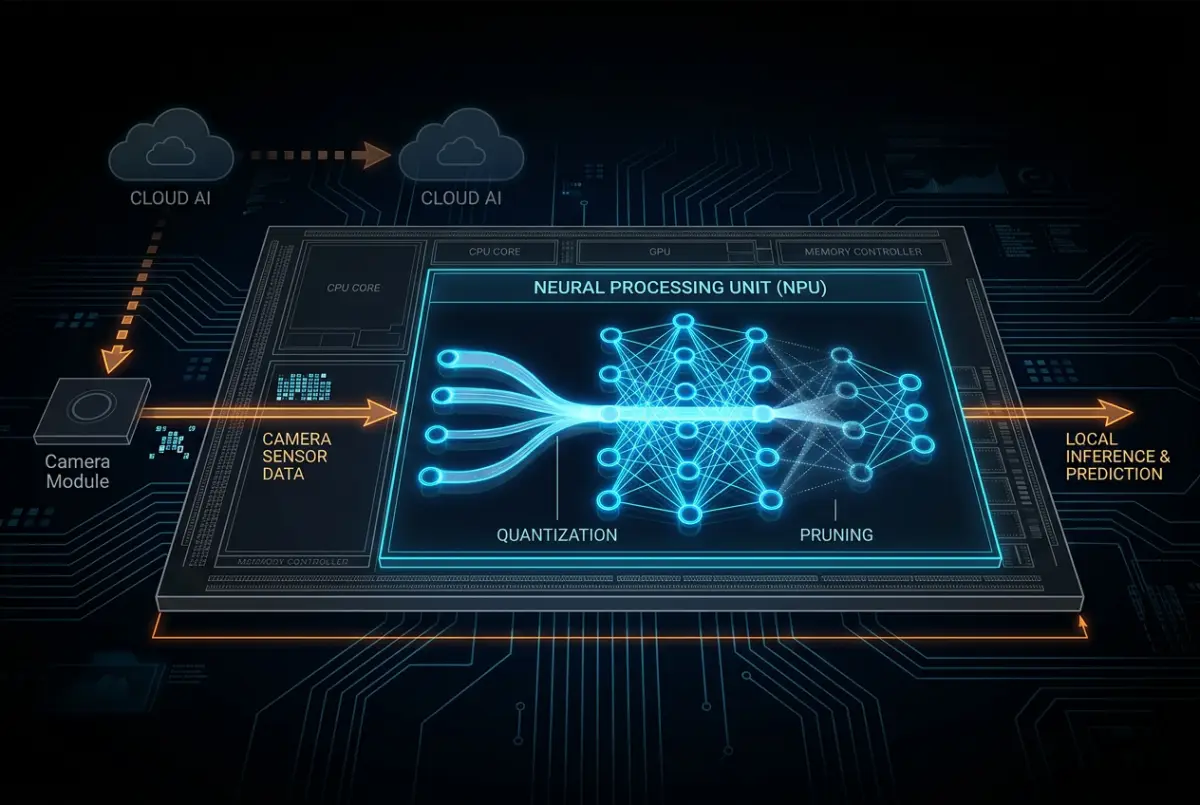
The rapid advancement of artificial intelligence has forced a fundamental rethinking of digital infrastructure. Modern language models and neural networks demand such vast computational resources and energy that traditional CPU and GPU architectures are increasingly reaching their efficiency limits. This constraint is particularly evident in real-time data processing scenarios, where both latency and energy consumption become critical bottlenecks.… Read Full Article
See More
How On-Device AI Works: When Algorithms Run Directly on Hardware

How On-Device AI Works: When Algorithms Run Directly on Hardware

For years, artificial intelligence relied on centralized cloud servers as its primary computing environment. However, the rapid expansion of global networks and the growing demand for real-time computation have exposed the physical limits of this model. When billions of devices and sensors continuously transmit data to remote data centers, internet infrastructure increasingly faces critical constraints such as latency, bandwidth saturation, and connection instability. In this context, every millisecond matters, and constant communication with distant servers becomes both inefficient and often unsustainable. In response to these fundamental limitations, the computing paradigm is undergoing a structural shift, moving processing capabilities closer to where data is generated.… Read Full Article
See More
Why Edge AI Is Faster Than Cloud AI: The Real Physics of Latency

Why Edge AI Is Faster Than Cloud AI: The Real Physics of Latency

In modern artificial intelligence systems, response time—known as latency—is not merely a technical metric but a factor of critical importance. When technologies such as autonomous vehicles, intelligent surveillance cameras, or real-time industrial robotics are involved, even a few lost milliseconds can have serious consequences.… Read Full Article
See More
Cloud–Edge Continuum: The Future of Distributed Internet Architecture

Cloud–Edge Continuum: The Future of Distributed Internet Architecture

The modern internet is undergoing a fundamental transformation. Traditional centralized cloud infrastructure can no longer meet the requirements of next-generation real-time systems. High latency and limited bandwidth for data transmission have become critical barriers. In response to these challenges, the technology landscape is moving toward a new architecture known as the cloud-edge continuum. This model creates a seamless, integrated network where computing resources are dynamically distributed across cloud data centers, edge infrastructure, and end-user devices. The cloud-edge continuum is not simply a combination of two technologies; it marks a new stage in the evolution of the internet that merges the scalability of cloud computing with the speed of edge processing. This architecture creates a unified ecosystem essential for the stable operation of AI inference, autonomous systems, and intelligent infrastructure.… Read Full Article
See More
Edge AI: Why Artificial Intelligence Is Moving from the Cloud to Devices

Edge AI: Why Artificial Intelligence Is Moving from the Cloud to Devices

In the modern digital era, where data generation is reaching unprecedented scale, traditional cloud computing faces serious challenges. The first wave of artificial intelligence was powered by centralized servers and massive computational resources. Today, however, when every millisecond is critical—whether steering autonomous vehicles or analyzing critical medical data—the old paradigm is shifting. This is where AI inference at the edge enters the picture—a technological approach ensuring that AI models run not in distant data centers but directly at the source of data generation (on smartphones, industrial IoT sensors, and robots).… Read Full Article
See More
Cloud Latency: Why Distance Still Limits Modern Internet Infrastructure

Cloud Latency: Why Distance Still Limits Modern Internet Infrastructure

Modern digital infrastructure largely relies on centralized data centers that provide enormous computing power and virtually unlimited storage capacity worldwide. This model has enabled the rapid expansion of cloud computing, allowing businesses, developers, and entire industries to access scalable computing resources without maintaining their own physical infrastructure. However, despite these advantages, the centralized cloud architecture has an inherent structural limitation that cannot be fully resolved through traditional engineering approaches. This limitation is network delay, commonly referred to as latency, which arises directly from the physical distance between end-user devices and remote servers.… Read Full Article
See More
What Is Edge Computing? — The Role of Peripheral Computing in the Modern Internet

What Is Edge Computing? — The Role of Peripheral Computing in the Modern Internet

The modern digital ecosystem is undergoing an unprecedented transformation in which the rate of data generation far exceeds the transmission capacity of traditional network architectures. Billions of connected sensors, advanced artificial intelligence applications, and real-time autonomous systems continuously generate enormous streams of information every second. Sending this constant flow of data to distant centralized cloud servers for processing is becoming increasingly inefficient and time-consuming. Against this backdrop, Edge Computing is emerging as a critical layer of modern digital infrastructure. Importantly, it does not replace traditional cloud technologies but rather complements and extends them. By relocating data processing closer to the source of generation — at the periphery of the network — this approach dramatically reduces latency and significantly relieves pressure on the core internet infrastructure. Such capabilities are essential for technologies that must… Read Full Article
See More