

How Large AI Models Fit into Small Devices
 Tornike Moss

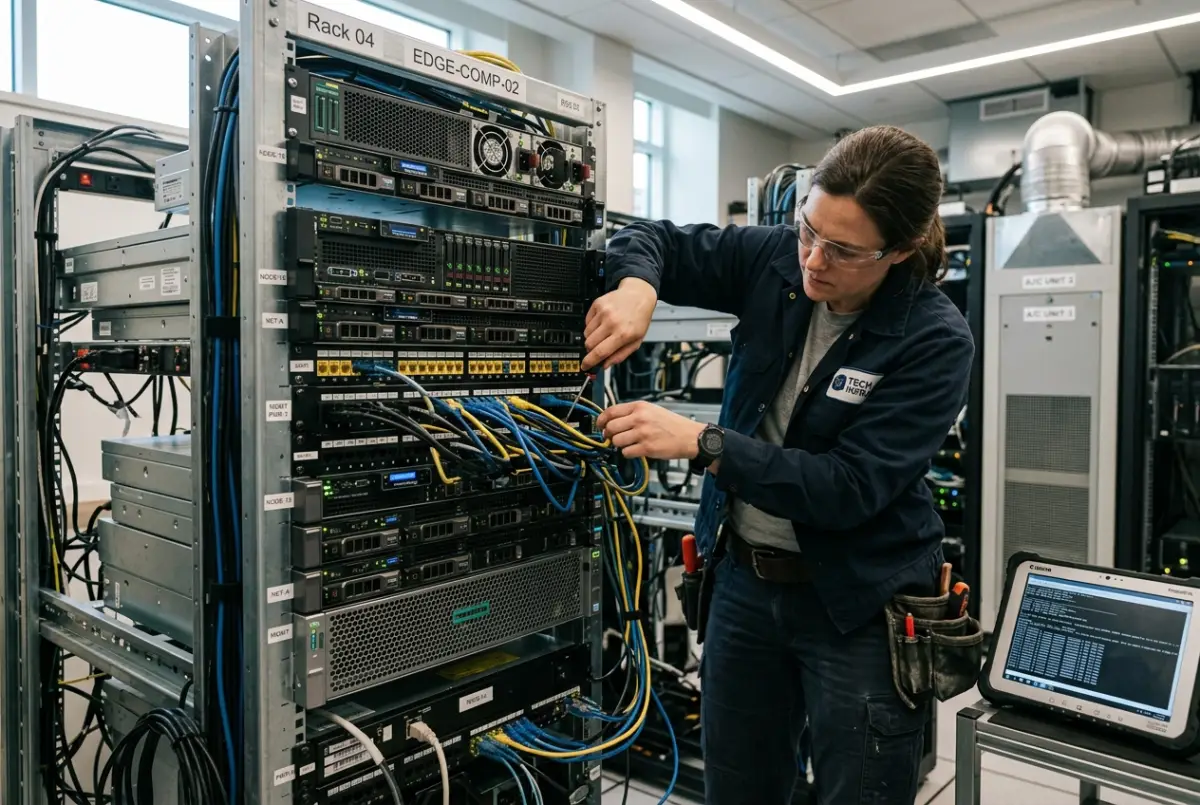
The scale of modern neural networks increasingly clashes with physical constraints. Architectures with billions of parameters demand immense computational power, memory bandwidth, and energy when deployed in data centers. However, when inference must run locally on edge devices, engineers face strict hardware constraints. Available memory is often limited to just a few gigabytes, while power budgets, battery capacity, silicon area, and thermal dissipation form a critical boundary where the demands of powerful algorithms collide with the limited resources of edge environments. At the same time, memory bandwidth itself becomes a bottleneck during inference, as generating each new token or prediction requires rapid access to large volumes of weights. This imbalance cannot be resolved by simplifying algorithms alone; it requires system-level optimization.
Under these conditions, model compression is no longer optional—it is an engineering requirement. Executing complex tensor operations on portable processors requires reducing weight precision through quantization and eliminating redundant neural connections through pruning, significantly reducing both parameter count and memory usage. In parallel, knowledge distillation transfers the behavior of large architectures into compact models while preserving critical quality. These methods are no longer incremental improvements; they are essential for enabling real-time inference on low-power, battery-operated, or resource-constrained devices. Together, they reshape network topology so that local inference becomes feasible even under severe memory and compute limitations, making system-level trade-offs explicit.
Quick Summary
Main ideas: The core arguments and conclusions of the article are outlined below.
- Large AI models do not naturally fit edge devices due to strict constraints in memory, bandwidth, and energy.
- The primary limitation is often memory bandwidth (the Von Neumann bottleneck, or Memory Wall), not raw computational power.
- Quantization reduces model size and response time by shifting to low-bit representations.
- Pruning removes redundant connections and reduces computational load at a structural level.
- Knowledge distillation transfers the behavior of large models into compact architectures.
- The most effective approach combines these methods and aligns them with hardware accelerators such as neural processors.
- Model optimization is now a systemic necessity rather than a performance enhancement technique.
Table of Contents
Why Large AI Models Do Not Naturally Fit Edge Devices
Modern large language models and complex neural architectures are built on a fundamentally different computational paradigm than the hardware ecosystem powering portable electronics. In data centers, where hundreds of GPUs operate in parallel, transistor budgets and power supply are effectively unconstrained. On edge devices, however, the technical landscape changes dramatically. When matrices with billions of parameters are deployed in edge infrastructure, systems immediately encounter physical constraints—limits in silicon area, memory capacity, restricted memory controller architectures, and critical thresholds defined by thermal design power (TDP). Due to this technological asymmetry, directly deploying standard models on mobile processors is not merely inefficient, but practically impossible without additional optimization. By 2025–2026, however, low-bit quantization (INT4/INT8) enables 7–9 billion parameter models to run within constrained memory budgets on flagship devices. For system architects, the primary challenge is not only computational complexity, but the continuous transfer of data from memory to compute cores, which introduces latency and can stall real-time inference. Without architectural coordination between hardware and software layers, large-scale tensor operations cannot be executed efficiently in local microchips.
In practice, even 7–13 billion parameter language models require tens of gigabytes of memory without quantization, while typical mobile devices provide only a few gigabytes of available resources, making local inference physically constrained.
In modern deployments, models with 7–9 billion parameters—such as Llama-3-class or smaller Qwen variants—are often compressed to 4-bit formats (e.g., grouped INT4 or AWQ), reducing their size to approximately 3.5–5.5 GB. Under these conditions, including KV cache, they can run on mobile chips at speeds of 15–40 tokens per second.
On flagship chipsets such as recent Snapdragon generations or Apple silicon, 7–8B models in 4-bit format often achieve approximately 30–45 tokens per second.
Examples include Qwen 2.5 and compact Llama 3 variants operating efficiently in 4-bit form on mobile hardware. Smaller architectures such as Phi and Gemma are also widely used, delivering even higher inference speeds under constrained resources.
Parameter Scale and Real Memory Limits
Each parameter in a standard neural network is typically represented in 32-bit floating-point (FP32) format, meaning a single weight requires 4 bytes. As a result, loading a 7-billion-parameter model alone requires approximately 28 GB of memory, excluding additional space for context windows and activations. In portable devices, total unified memory is significantly smaller and shared with the operating system and background processes. When on-device AI systems attempt to load matrices of this scale into memory, the system quickly encounters Out-Of-Memory (OOM) failures, as on-chip SRAM buffers and external DRAM modules cannot physically accommodate such tensor structures. This fundamental constraint forces engineers to apply aggressive compression techniques to fit models within existing hardware limits.
Memory Bandwidth as the Primary Constraint
More critical than memory capacity is memory bandwidth, which manifests as the classical Von Neumann bottleneck. During the decode phase of inference—where tokens are generated sequentially—the system must repeatedly reload model weights from main memory for each new token, resulting in frequent DRAM accesses. On edge devices, where memory bandwidth typically ranges between 50–100 GB/s, this process becomes the dominant limiting factor, directly constraining real-world inference performance. The data transfer channel (memory bus) between memory and compute cores is inherently narrow, causing arithmetic logic units (ALUs) to remain idle while waiting for data. This phenomenon is known as the Memory Wall, where system performance is determined not by computational throughput (TFLOPs), but by data transfer speed (GB/s). As a result, optimization strategies focus not only on reducing model size, but also on minimizing data movement between memory and processors to maximize utilization of compute cycles.
KV cache management becomes particularly important, as it grows rapidly with context length in autoregressive models. Modern systems frequently apply KV cache quantization (INT8 or INT4), significantly reducing memory load and DRAM accesses, partially mitigating the effects of the Memory Wall.
In practice, KV cache size often determines the maximum model size that can realistically run on a given device, directly influencing configuration choices discussed below.
In recent years, techniques such as speculative decoding and multi-token generation methods—such as Medusa or Lookahead—have also been adopted. These approaches reduce memory dependency per generated token and improve overall throughput under the same hardware constraints.
Energy Consumption and Thermal Constraints in Edge Environments
Memory-intensive operations are directly linked to exponential increases in energy consumption. Reading data from DRAM can consume orders of magnitude more energy than performing matrix multiplications on-chip. In mobile and edge devices, energy budgets are tightly constrained by battery capacity and, more importantly, thermal limits defined by TDP. As chips process large volumes of data, heat generation increases, and passive cooling systems—such as those in smartphones—cannot dissipate it effectively. Once critical temperature thresholds are reached, systems initiate thermal throttling, reducing processor frequency and dramatically slowing model execution. Any algorithm intended for local deployment must therefore operate within a narrow energy-efficiency envelope; otherwise, the hardware cannot sustain stable performance over time. In practice, modern flagship devices under sustained load often reach temperatures of 45–55°C, after which thermal throttling begins and performance drops by 30–50% within minutes.
How Quantization Reduces Model Size and Resource Requirements
Quantization is one of the most powerful mathematical tools for neural network compression, grounded in information theory and hardware-aware optimization. Technically, it involves mapping high-resolution continuous values (floating-point representations) of model weights and activations into a smaller set of discrete values. The foundation of quantization lies in the empirical observation that deep neural networks are highly tolerant to noise and do not require absolute numerical precision to recognize patterns effectively. This scaling of precision allows engineers to preserve informational entropy using significantly simpler data structures. The process involves complex calibration algorithms that determine tensor dynamic ranges and balance quantization error so that the final prediction accuracy is minimally affected while resource efficiency is maximized. As such, quantization is not merely a memory-saving technique—it is a fundamental adaptation of algorithmic semantics to hardware constraints, effectively translating transformer architectures into a form compatible with mobile chipsets.
This is particularly effective on modern hardware, where specialized accelerators are optimized for low-bit operations and can deliver significantly higher throughput within the same energy budget.
What Low-Bit Precision Means in Neural Networks
Low-bit precision refers to representing model parameters using fewer bits. Engineers move from traditional 32-bit (FP32) systems to 16-bit (FP16/BF16), 8-bit integers (INT8), or even extreme 4-bit quantization (INT4). In INT8 format, each parameter is limited to 256 possible values, compared to the vast range available in floating-point representations. This requires mapping original tensor values into a constrained range using scaling factors and zero-points. This transformation significantly reduces computational complexity, as integer arithmetic at the silicon level requires far simpler logic than floating-point operations.
How Quantization Reduces Memory Footprint and Latency
The primary outcome of quantization is a sharp reduction in memory footprint—transitioning from FP32 to INT8 reduces model size by a factor of four. This directly improves cache efficiency, as L1 and L2 buffers can store four times more parameters, reducing expensive DRAM accesses. As data transfer bottlenecks are alleviated, Edge AI latency and speed improve significantly, with vectorized operations executing almost instantaneously. In addition, integer arithmetic enables processors to perform more operations per clock cycle using SIMD instructions, reducing both data transfer time and compute cycles.
In real-world systems, this process is often implemented through formats such as Q4_K_M, AWQ, or GPTQ, each balancing accuracy and memory efficiency differently.
Modern systems frequently employ mixed precision, where weights are represented in INT4 or INT8 while activations remain in higher precision (FP16 or BF16). Group-wise or channel-wise quantization further reduces error propagation, enabling more aggressive compression with minimal loss in accuracy.
This effect is particularly evident in autoregressive models, where latency directly defines user experience.
When Quantization Trade-offs Become Critical
The key technical trade-off in quantization lies between efficiency and accuracy degradation. Compressing parameters introduces rounding errors, which can accumulate across layers. This becomes especially critical in large language models, where so-called activation outliers—extremely high values—can disrupt logical reasoning if improperly handled. At this point, engineers must choose between post-training quantization (PTQ) and the more resource-intensive quantization-aware training (QAT). If degradation exceeds acceptable thresholds, the local model begins to hallucinate or loses contextual coherence, indicating that the limits of compression have been reached.
Pruning and Knowledge Distillation: Structural Compression of Neural Networks
While quantization alters the numerical representation of data, pruning and knowledge distillation target the transformation of neural network topology and structural scale itself. Large architectures are characterized by significant overparameterization, meaning they contain far more parameters than are actually required to solve a given task. The majority of these parameters contribute minimally during inference, creating substantial optimization potential. In this context, structural modification techniques adapt algorithmic architectures to the constraints of resource-limited devices. Pruning algorithms physically remove redundant neural connections, while distillation constructs entirely new compact networks that replicate the behavior of larger models. These methods reflect computational analogs of neuroplasticity, preserving only the most critical and information-dense pathways. The result is an architecture that retains the functional behavior of the original model while being structurally and operationally optimized for the strict technical constraints of edge systems.
How Pruning Works and What Gets Removed
Pruning is based on a simple yet powerful principle: not all weights in a neural network are equally important. Algorithms analyze weight matrices to identify parameters that are either close to zero or contribute minimally to gradient flow within activation functions. In unstructured pruning, individual connections are removed, resulting in sparse matrices. However, because modern hardware struggles to efficiently process irregular sparsity patterns, engineers typically favor structured pruning. In this approach, entire neurons, channels, or tensor blocks are removed. This directly reduces matrix dimensions, translating into lower computational cost in terms of FLOPs and significantly improved system performance.
In practice, structured pruning is preferred in edge environments because it aligns more effectively with modern hardware accelerators and avoids the overhead associated with sparse matrix handling.
Knowledge Distillation as a Method for Training Compact Models
Knowledge distillation offers a fundamentally different approach. Instead of mechanically compressing an existing model, it trains a smaller “student” network to learn from a large “teacher” model. The core idea is that the student is trained not only on traditional hard labels, but also on soft targets generated by the teacher. These probabilistic outputs encode what is often referred to as “dark knowledge”—information about how the large model interprets similarities between classes. By internalizing this latent structure, the compact model can achieve levels of accuracy that would be unattainable through independent training under the same parameter constraints.
Modern approaches extend beyond classical teacher–student frameworks. Techniques such as self-distillation and progressive distillation enable models to iteratively compress themselves while preserving internal knowledge. Additionally, sequence-level distillation improves the transfer of structural and contextual patterns in generative models.
When Combined Optimization Becomes Most Effective
In real-world systems, maximum efficiency is rarely achieved through a single method. The highest performance typically results from a synergistic combination of quantization, pruning, and distillation. A large model is first distilled into a compact architecture, then structurally pruned to remove redundancy, and finally quantized into a low-bit representation. This hybrid pipeline becomes especially important when paired with specialized AI hardware acceleration (NPU chips), which are optimized for INT8 operations and structured tensor execution. The tight alignment between algorithmic optimization and system architecture ensures that large language and vision models can run reliably and with millisecond-level responsiveness on constrained edge devices.
Modern compact models such as Llama, Qwen, Gemma, and Phi variants are direct outcomes of this hybrid optimization paradigm, where architectural design is inherently aligned with constrained hardware environments.
By 2026, models deployed on edge devices are no longer arbitrary architectures—they are explicitly engineered for low-bit quantization, memory limitations, and decoding efficiency. The most widely used models include compact versions of Llama, Qwen, Gemma, and Phi, which demonstrate how theoretical optimization translates into real-world performance. The table below reflects these results across specific models and hardware environments.
Comparison Table: Top Models on Edge Devices in 2026
| Model | Parameters | Quantization | Size (RAM) | Android Flagships (tok/s) | Apple Devices (tok/s) | Context | Advantage | Accuracy Loss |
|---|---|---|---|---|---|---|---|---|
| Llama 3.2 / 3.1 | 3–8B | Q4 / AWQ | 2.0–4.7 GB | 35–48 | 40–50 | 4K–8K | Fast interaction | ~1–3% |
| Qwen 2.5 / 3 | 7–8B | Q4 / Q5 | 3.8–5.2 GB | 30–45 | 38–48 | 8K–32K | Multilingual | ~1–2.5% |
| Gemma 3 | 9–12B | Q4 | 5–6.5 GB | 25–40 | 35–45 | 8K | Efficiency-focused | ~2–4% |
| Phi-4 mini | 3.8–14B | INT4 | 2.2–7 GB | 40–55 / 20–35 | 45–60 | 4K–16K | Efficiency-driven | ~1–3% |
| Llama 3.1 8B | 8B | Q4 | 4.5–5 GB | 30–40 | 35–45 | 8K | Open source | ~2% |
| Qwen2.5-VL-7B | 7B | Q4 | 4–5 GB | 25–38 | 32–42 | Vision | Multimodal | ~2–4% |
Note: tok/s values depend on KV cache configuration, context length, and thermal throttling. Optimal range: 7–8B Q4/Q5 models.
What to Consider When Selecting a Model
- Memory (RAM): Model size and KV cache determine whether it can run on a given device.
- Latency: Real-time usability depends on token generation speed (tok/s), which is influenced by quantization and hardware acceleration.
- Use case: Smaller models are better suited for fast interaction, while larger models handle more complex reasoning and code generation.
As ZenoFusion analysis suggests, model optimization is no longer just a performance enhancement technique—it has become a foundational architectural layer that determines whether artificial intelligence can transition from centralized infrastructure to distributed, local systems.
In practice, effective on-device inference is no longer built on a single technique. Modern edge AI systems are defined not by individual techniques, but by their integration.
Go backComments (0)
From This Author
Select Crypto to Support the Author 💫
×TXintEE7aezp6QxNNtbghCXvmXJdgofEyr
0x9c6299454A6B617A0Db228024279F2a3EEf956dD
bc1qj7caz3xfh5qd4ud3v3nh7k4tfl5lg8jh9er73e
0x9c6299454A6B617A0Db228024279F2a3EEf956dD
3TndfWAhPytTaBZjC2GbNWqh9iWx171SYACjbG2j5vx8
DHsrtwiL56Xk1xAj3fe8pVcfLhE8xgt3EQ
0x9c6299454A6B617A0Db228024279F2a3EEf956dD
UQDFkubJxb8KmxFmy1arJxkewzmNEg6-G2pJFVzFihB65d7W
ltc1q3fentl6ur9cxm0vxyqkdmmzxkj92j00p9l8m7z
✍ Article Author
- Registration: 26 July 2025, 19:34
- Location: Georgia