


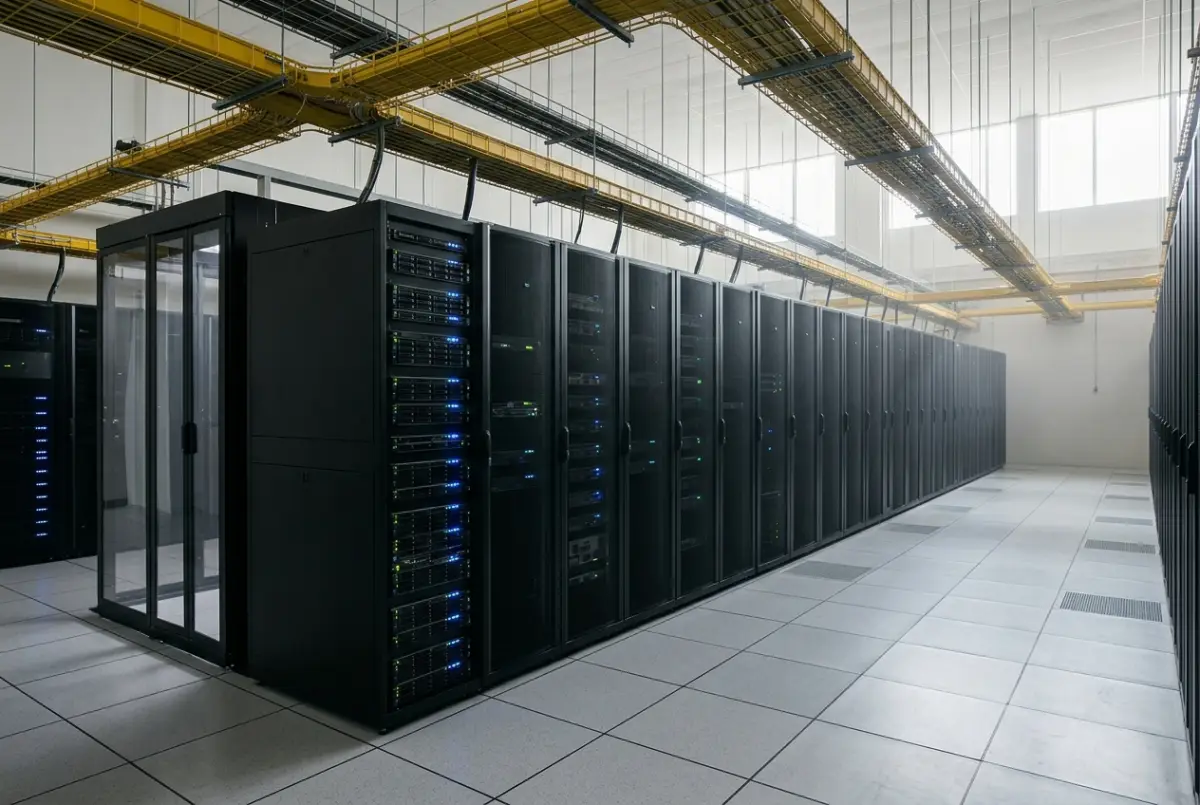
Edge AI and Data Security: Why Local Processing Is More Secure
 Tornike Moss
Updated • 20-03-2026, 00:12
The integration of artificial intelligence into modern digital infrastructure has created a structural paradox: the more technologically advanced a system becomes, the more complex—and often more fragile—its security architecture becomes. Traditional models, largely dependent on cloud computing, require the continuous circulation of sensitive information between devices and remote servers. This persistent cycle of data transmission expands the attack surface and introduces multilayered risks, including network interception, data leakage, third-party access, and the compromise of centralized storage systems. As information moves through layered infrastructure, each intermediary becomes a potential vulnerability, making privacy protection a technically complex challenge.
In response to this systemic weakness, Edge AI introduces a fundamentally different security model in which computational processes shift closer to the point of data generation. Running neural networks locally—whether on a smartphone, camera, or industrial sensor—significantly alters the security paradigm by reducing the need to transmit sensitive data across networks. When analytical operations are executed within a local, isolated environment, the effectiveness of MITM and other network-based attacks decreases significantly. As a result, critical information remains within the local device boundary, which not only reduces the risk of leakage but also establishes a more resilient and decentralized security architecture for modern AI systems.
Quick Summary
Key takeaways: The main ideas and conclusions of the article are summarized below.
- Data in transit is the most vulnerable phase of the data lifecycle, as each network node increases the attack surface.
- Edge AI reduces risk by keeping sensitive data on local devices instead of transmitting it across networks.
- Local processing significantly decreases exposure to MITM attacks, data leakage, and metadata-based analysis.
- Data minimization becomes practical, as systems transmit only processed outputs rather than raw data.
- Specialized hardware (NPUs, neural engines) and model compression enable efficient and secure on-device inference.
- Hybrid architectures (Edge + Cloud) balance privacy, scalability, and computational efficiency.
- Edge AI reduces not only data security risks but also infrastructure overload, bandwidth pressure, and latency.
- Local AI is emerging as a foundational standard for privacy, resilience, and secure system design.
Table of Contents
Data Movement Increases Risk, While Local Processing Reduces the Attack Surface
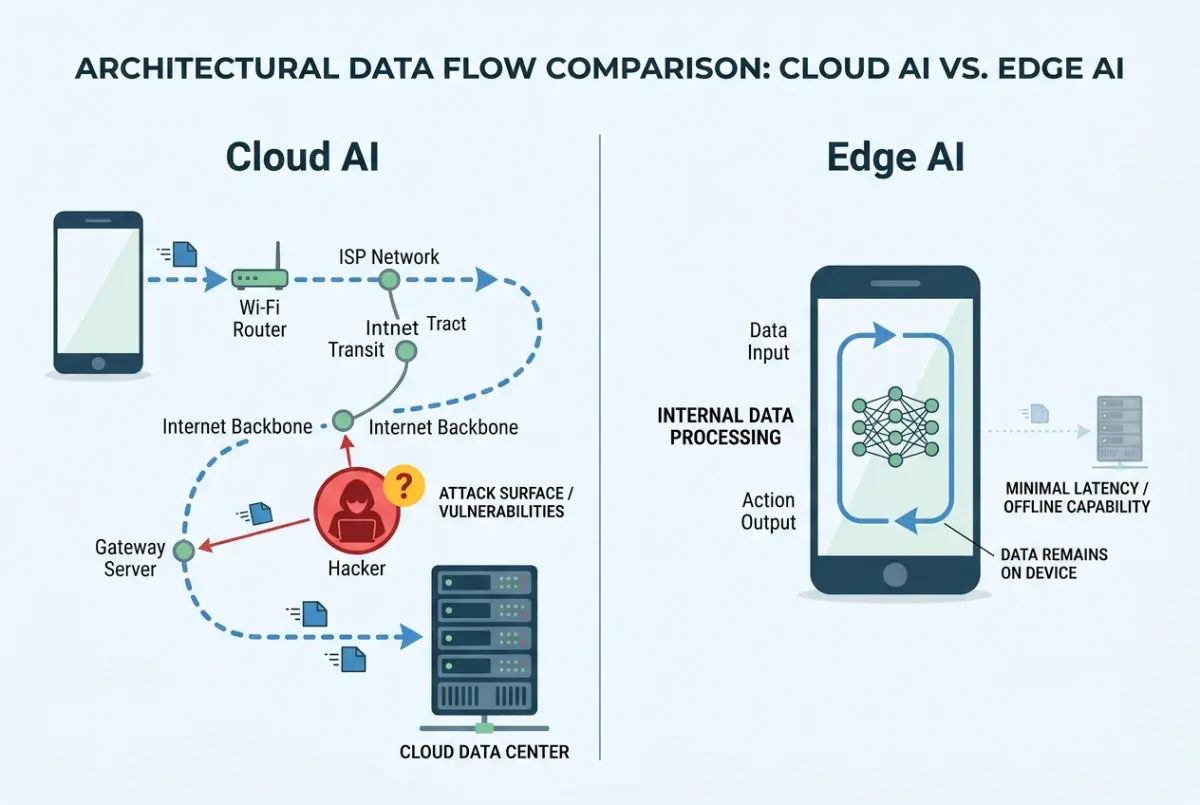
One of the core principles of modern cybersecurity is that data in transit represents the most vulnerable phase of the data lifecycle, as moving data is inherently more difficult to protect than static data stored in controlled environments. When a system relies entirely on classical cloud architecture, massive volumes of raw data collected from millions of sensors and user endpoints continuously pass through routers, telecom infrastructure, content delivery networks, and multiple data centers operated by cloud providers.
This constant movement increases the number of potential infiltration points, as each additional node in the network introduces a new layer of security risk. In contrast, the concept of Edge AI relocates intelligent computation directly to the point where data is generated, fundamentally changing the logic of security. In this model, minimizing the attack surface is achieved not by adding more cryptographic layers, but by reducing the root cause of exposure—data transit itself. As a result, local hardware environments become significantly more resistant to targeted external manipulation and large-scale data breaches.
Why Data Transit Is the Weakest Link in Security
Transmitting sensitive information across network infrastructure exposes systems to a wide range of both traditional and emerging cyber threats, as data packets must traverse multiple intermediate servers and routing layers before reaching their destination. During packet formation, routing, and transmission, systems face elevated risks of Man-in-the-Middle attacks, session hijacking, protocol-level manipulation, and traffic pattern–based side-channel analysis. Even when data is transmitted over encrypted channels, the management of TLS mechanisms, key generation, and certificate validation introduces significant operational and technical overhead. A compromised certificate chain, outdated protocol, or endpoint-level zero-day vulnerability can still trigger critical security incidents. In addition, dependence on remote servers inevitably introduces latency constraints, further illustrating why Edge AI is faster and how optimized local computation becomes a decisive factor in real-time systems where even milliseconds represent a critical security parameter.
At the same time, the presence of standard cryptographic algorithms often creates an illusion of security in data transit. In practice, modern cyberattacks increasingly focus on deep analysis of metadata. By examining traffic volume, packet sizes, timestamps, IP addresses, and transmission frequency, sophisticated attackers can infer critical insights about user behavior, device type, or industrial processes, even when the payload itself is securely encrypted. Moreover, in large-scale Internet of Things ecosystems, each connected device that maintains continuous communication with the cloud can effectively act as a potential backdoor into a broader corporate network. The proliferation of such transit channels significantly complicates centralized traffic monitoring and timely anomaly detection, leaving infrastructure exposed to automated botnet attacks and exploitation of zero-day vulnerabilities. In cloud-based models, this becomes particularly dangerous because centralized logging and aggregated signals from multiple sources enable attackers to reconstruct a much broader behavioral profile.
Local Processing as a Practical Model for Data Minimization
Modern legal and ethical frameworks for privacy, such as the EU’s GDPR and California’s CCPA, are built around strict data minimization principles. Edge AI implements this principle with unprecedented technological efficiency. In local processing architectures, endpoint devices continuously collect large volumes of raw sensor, audio, or visual data, but embedded neural networks analyze this information directly on the local processor. As a result, the system transmits not the original data files, but only final outputs—such as anonymized textual results or specific metadata—to external infrastructure. For example, a smart security camera powered by advanced Edge AI does not upload high-resolution video streams containing identifiable individuals to a cloud server; instead, it transmits only a coded event identifier or an anonymized result to a central system. This approach fundamentally reshapes data ownership and control, as the most sensitive information is protected from transit risks and, in practice, never leaves the physical endpoint.
From a technical perspective, this level of data isolation is enabled by hardware-enforced security mechanisms integrated into modern microprocessors. Devices increasingly rely on Hardware Security Modules, Trusted Execution Environments such as ARM TrustZone, and optimized runtimes like TensorFlow Lite, Core ML, or ONNX Runtime, which provide the necessary foundation for secure and controlled local data processing. Running AI inference models within such strictly controlled environments ensures that even if the primary operating system is compromised, malicious code or attackers cannot gain direct access to raw personal data or cryptographic keys. In this context, data minimization ceases to be merely an abstract legal requirement and becomes a rigorously defined, hardware-enforced protocol that embeds security directly into the silicon layer of the system. This architectural approach has enabled the large-scale deployment of local capabilities such as on-device audio and text processing in smartphones, local image analysis in portable medical devices, and real-time defect detection in industrial IoT infrastructures.
Why Reducing Cloud Dependence Does Not Mean Losing Functionality
For a long time, the technology industry operated under the assumption that high-performance and accurate artificial intelligence required massive cloud clusters and virtually unlimited computational resources. However, recent advances in machine learning optimization have significantly weakened this assumption. Through innovations such as model quantization, neural network pruning, and knowledge distillation, engineers can substantially compress large models and adapt them for devices with limited resources. These techniques preserve model accuracy while dramatically reducing both its physical size and computational requirements. As a result, even resource-constrained microcontrollers operating within TinyML environments can perform complex analytical tasks, including real-time object recognition and natural language processing, effectively transforming local devices into fully autonomous intelligent systems.
Importantly, reducing the dominance of cloud infrastructure in favor of edge architectures does not imply abandoning centralized systems altogether. Instead, it reflects a more rational and security-aware distribution of functions. In modern hybrid systems, cloud platforms retain their role in global orchestration and computationally intensive model training, while real-time, latency-sensitive decision-making occurs primarily at the edge. A clear example of this approach is federated learning, where edge devices improve models locally using their own data and transmit only updated parameters—often protected by mechanisms such as differential privacy and secure aggregation—back to the cloud. This balanced synergy ensures that global AI systems continue to evolve based on decentralized experience across thousands of devices, while simultaneously maintaining strong data privacy guarantees, offline autonomy, and the level of operational flexibility that fully centralized models often struggle to provide.
Privacy by Design Becomes Real When Data Stays on the Device
The concept of Privacy by Design is often treated in the technology industry as a compliance tool or a marketing label, yet its true technical implementation requires privacy to be embedded directly into system architecture rather than added as an afterthought. Edge AI represents one of the clearest realizations of this principle, as it prevents raw sensitive data from leaving the device at the hardware level from the outset. When complex computational algorithms are integrated directly into the physical environment where data is generated, data protection no longer depends solely on network encryption, TLS or VPN channels, endpoint-level security, or the integrity of remote server administrators. Instead, user privacy becomes a mathematically and hardware-enforced property of the system. Potential attack vectors associated with data transit and centralized storage are neutralized at the physical level through local isolation protocols, while the centralized data aggregation model—historically a primary target for large-scale attacks—fails to emerge in the first place.
On-device Architecture and Practical Privacy Advantages
In earlier stages of intelligent system development, it was widely assumed that multi-layer neural networks could operate effectively only within powerful cloud-based clusters. Advances in microprocessor design and model compression have fundamentally changed this paradigm. Today, On-device AI systems can perform complex analytical operations, real-time object recognition, and natural language processing locally with high accuracy, without requiring continuous connectivity to global networks. Because inference is executed directly on the same chip or local accelerator where data is generated, personal conversations, private text messages, and visual content never physically leave the smartphone, personal computer, or industrial sensor.
This decentralized architecture redefines traditional trust models. Instead of organizations merely claiming that they do not access user data, systems are engineered so that such access is technically impossible. The primary drivers of this transformation are the widespread integration of specialized neural processing units, tensor cores, and platforms such as Apple Neural Engine and Google Tensor, which optimize resource utilization. These purpose-built chips, combined with models optimized through quantization, pruning, and knowledge distillation, are designed for efficient matrix operations and significantly reduce energy consumption. This makes local inference not only more secure but also highly efficient. From both practical and business perspectives, this is particularly critical in sectors such as healthcare and finance, where even a single data leak can result in severe regulatory penalties and reputational damage. For example, portable medical monitoring devices or smartphone-based text and image analysis systems process data locally and transmit only results, anonymized metadata, or critical anomaly signals to central systems, ensuring strict control over both server load and data privacy.
Biometric Data Is Most Secure When Processed Locally
Unlike traditional passwords and cryptographic keys, biometric identifiers—such as fingerprint patterns, three-dimensional facial geometry, or unique voice characteristics—are inherently immutable. If compromised at scale, users cannot simply reset or replace their biometric identity, which makes centralized storage of such data in third-party cloud systems a high-risk practice. The widespread adoption of Edge AI technologies directly addresses this critical challenge by confining the entire multi-stage authentication process within the device’s isolated hardware environment, such as Secure Enclave, Titan M, or TrustZone-type secure elements. When a user unlocks a modern smartphone using facial recognition or an iris scanner, the high-resolution image captured by the optical sensor is not transmitted to the cloud for comparison; instead, a local AI algorithm performs the verification instantly against a securely stored reference pattern.
In practice, this means that the original biometric image, geometric map, or audio sample is never persistently stored in system memory. Instead, during initial enrollment, the system generates a specific cryptographic hash or mathematical vector representation that does not contain raw data and cannot be reverse-engineered with current computational capabilities. This security paradigm relies on isolated enclaves that physically separate biometric processing from the main processor and operating system. Local biometric processing eliminates the need for large centralized databases, which have historically been primary targets for hacker groups and state actors, thereby significantly reducing the risk of mass surveillance. At the same time, exposure is minimized not only to external attackers but also to internal personnel and third-party contractors, which is particularly important in financial and medical authentication scenarios.
When Local AI Becomes an Architectural Advantage for Privacy
The architectural advantages of local artificial intelligence become most evident when systems operate on highly sensitive data, function within regulated environments, or scale rapidly as the number of connected devices increases. In modern smart city infrastructures, personal assistants, medical systems, autonomous transportation, and industrial automation, centralized cloud models are no longer capable of guaranteeing complete isolation and confidentiality of continuous sensitive data streams generated by thousands of nodes. In such highly connected and mission-critical environments, Edge AI strengthens system resilience and cyber robustness by turning each device into an active guardian of its own data rather than a passive transmitter.
Instead of relying on multilayered yet often vulnerable centralized firewalls, security responsibility is distributed across the network. This ensures continuity of local operations even in the event of critical infrastructure failures. A key technological extension of this model is the adoption of federated learning, which fundamentally redefines the traditional centralized paradigm of machine learning. Rather than aggregating massive amounts of user data on central servers, a base model is distributed to local devices, where it is trained within each device’s closed ecosystem using local data. Smartphones and specialized sensors improve the model independently and return only updated weights, gradients, or parameter deltas to the cloud. This advanced synergy, often combined with differential privacy and secure aggregation, enables continuous system improvement without extracting raw data at scale. For this reason, in high-risk domains, local processing is increasingly regarded as a foundational architectural principle for compliance, resilience, and long-term trustworthiness. As noted in multiple technology analyses, including ZenoFusion assessments, local AI inference is steadily emerging as the basis for a new standard in privacy.
Secure Edge AI Is Built on Specialized Hardware and Model Optimization
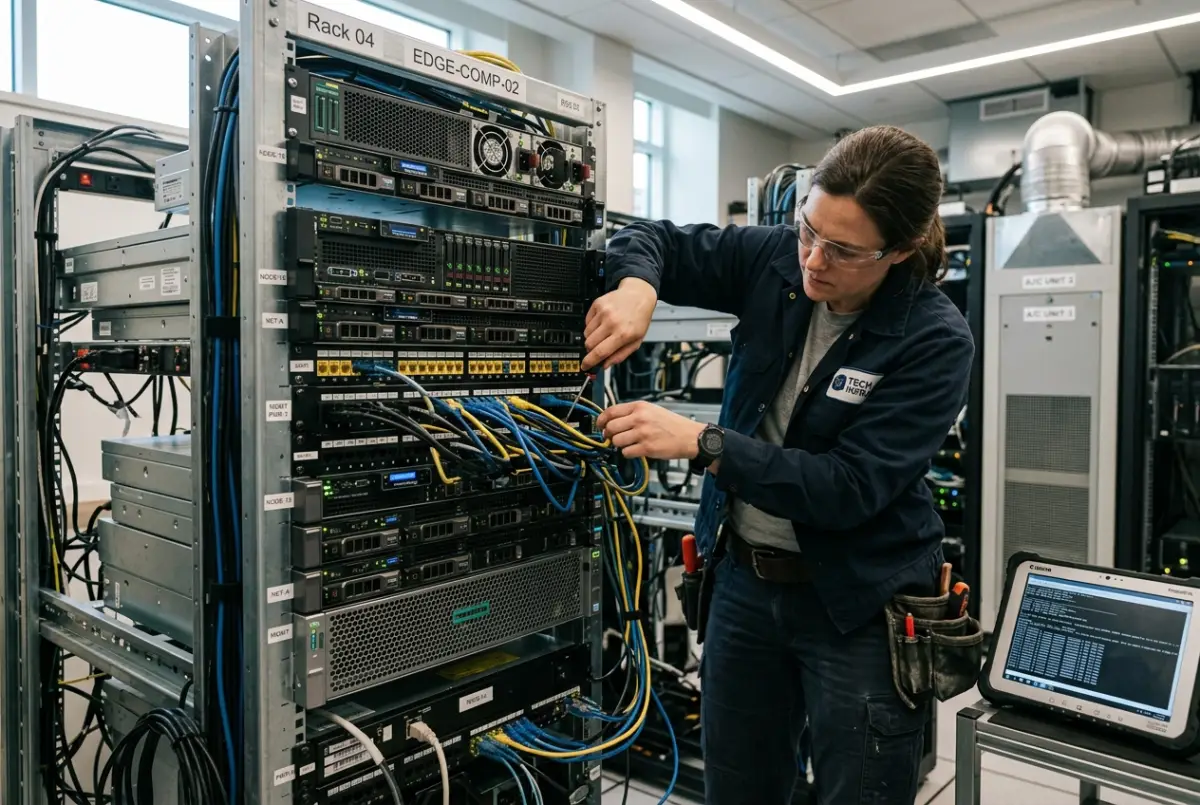
Local security is not merely an abstract theoretical advantage—its practical realization depends directly on how efficiently an endpoint device can execute artificial intelligence models. Deploying Edge AI infrastructure is fundamentally impossible without specialized silicon chips, software-optimized neural models, and precise management of computational resources. Keeping sensitive information on the device requires that the terminal itself be capable of performing complex analytical operations independently. This shifts the traditional security paradigm, which relied on remote servers and network firewalls, toward enforcement at the hardware level. The synergy between purpose-built microarchitectures and compressed algorithms ensures that local data processing does not result in energy inefficiency or performance degradation; otherwise, the system would revert to cloud dependency, reintroducing the very attack surface Edge AI is designed to reduce.
Why Edge AI Requires Specialized Chips
Traditional central processing units and graphics processors, despite their versatility, are often inefficient for the specific demands of local artificial intelligence. Neural networks fundamentally rely on parallel computation and optimized matrix operations, particularly large volumes of multiply-accumulate cycles, which standard architectures handle with relatively high energy consumption. This has led to the emergence of specialized units such as neural processing units, tensor processors, dedicated neural engines, and other local AI accelerators, including solutions like Qualcomm’s Hexagon architecture. In practice, specialized AI chips enable complex mathematical algorithms to run with exceptional speed and minimal power consumption, which is critical for battery-powered sensors and portable devices.

The integration of such specialized hardware directly correlates with improved data security and reduced latency. When dedicated AI accelerators handle analytical workloads, on-device inference becomes not only feasible but highly performant. Audio, video, and biometric signal processing can take place entirely within an isolated microchip, eliminating the need to transmit sensitive data across networks for external processing. In this context, silicon-level efficiency and computational capacity become a physical guarantee of privacy, significantly reducing the risk of network interception and data exposure.
Model Compression as a Core Element of Security Architecture
Even with advanced microprocessors, deploying large-scale AI models directly on local devices remains constrained by strict hardware limitations, particularly memory capacity. Typical edge devices offer between 4 and 16 GB of available memory, while server-grade models often require tens of gigabytes. This makes algorithmic compression an essential component of edge architecture. Techniques such as quantization—reducing parameter precision from 32-bit to 8-bit or even 4-bit—and neural network pruning significantly decrease model size, in some cases achieving compression ratios of 10x to 50x. Knowledge distillation further enhances efficiency by allowing a compact student model to replicate the behavior of a large teacher model, preserving accuracy within constrained environments and improving inference efficiency.
This sophisticated engineering effort serves not only performance optimization but also data security and minimization. When an optimized model operates entirely within a local environment, the device no longer needs to continuously transmit raw data to remote servers, directly reducing exposure to external processing risks. A critical secondary effect is bandwidth reduction, as the system transmits only final analytical results rather than high-volume sensor data streams. As a result, model compression evolves from a technical necessity into a powerful security mechanism that limits the circulation of sensitive information across open networks.
When Hybrid Models Outperform Fully Local or Fully Cloud Approaches
Despite the clear advantages of local computation from a security perspective, complete decentralization is not always the optimal engineering solution. Modern technological ecosystems derive significant benefits from integrated architectures that combine edge processing with cloud orchestration. In this synergistic model, responsibilities are clearly partitioned: real-time decisions and highly sensitive data processing occur locally to preserve privacy, while centralized cloud infrastructure handles computationally intensive tasks such as large-scale model training, fine-tuning, aggregation, historical data analysis, and continuous system updates.
Federated learning acts as a critical bridge between these two paradigms. This approach allows endpoint devices to actively contribute to improving global models without sharing raw data. Instead, only locally computed parameter updates, gradients, or deltas are transmitted to central systems. Such a hybrid model establishes a balance in which scalability does not compromise strict security protocols. Updates moving through centralized layers remain anonymized or aggregated, while operational flexibility allows the system to adapt dynamically to changing network conditions. The result is a resilient and pragmatic architecture that protects sensitive data while preserving the capacity for collective intelligence, continuous improvement, and adaptive performance.
Edge AI Reduces Not Only Data Leakage Risk but Also Infrastructure Overload
Discussions around artificial intelligence security traditionally focus on data privacy, yet the architectural value of Edge AI extends well beyond that dimension. Delegating computational workloads to endpoint devices reduces not only the likelihood of sensitive data leakage but also the risks associated with infrastructure overload, network bandwidth saturation, and rising energy consumption in data centers—challenges that are increasingly critical at a global scale. As the number of connected devices grows rapidly, traditional centralized models struggle to handle the resulting traffic intensity. The more analytical and inference operations are executed locally, the more sharply the volume of traffic directed toward central servers decreases. This optimization of network resources is directly tied to system scalability and overall resilience. By deploying local neural models, organizations free up critical bandwidth, reduce pressure on cloud clusters, and distribute resources more efficiently across the infrastructure, ultimately creating a more secure, autonomous, and fault-tolerant technological ecosystem where security and performance evolve together.
Scaling Centralized AI Infrastructure Introduces New Risks
The rapid integration of millions of IoT sensors and smart devices into global networks has revealed that models relying solely on cloud infrastructure are approaching physical limits. Scaling centralized AI requires continuous synchronization of massive volumes of raw video, audio, and sensor data between endpoints and remote data centers, inevitably leading to network congestion. As infrastructure struggles to handle this volume, systemic delays emerge, latency increases significantly, and central GPU clusters become bottlenecks when demand exceeds parallel processing capacity. For real-time applications such as autonomous navigation or industrial automation, this degradation is unacceptable.
Experts increasingly examine why the internet struggles with AI workloads and how persistent dependence on cloud infrastructure becomes a primary source of operational vulnerability. If connectivity is disrupted, regional servers are overloaded, or access to cloud platforms is temporarily unavailable, centralized systems rapidly lose functionality because their operational logic depends on continuous external synchronization. In such scenarios, large-scale data movement across networks not only increases cost and slows response times but also creates a single point of failure. The risk of infrastructure collapse becomes directly proportional to the number of active devices within the ecosystem.
Why MITM and Interception Risks Decrease in Edge Architectures
Data transmission across global networks inherently involves multiple intermediate nodes, where each router, telecom exchange, CDN, or regional server represents a potential interception point. In such architectures, the likelihood of Man-in-the-Middle attacks and intermediate data capture increases significantly. Although TLS protocols encrypt traffic and protect it from direct inspection, they have inherent technical limitations. Modern cyberattacks increasingly target metadata—timestamps, packet sizes, IP addresses, and traffic patterns—through which system vulnerabilities can still be inferred even when payload data remains encrypted.
Edge architectures fundamentally alter this dynamic. When AI inference is executed locally on isolated hardware, raw sensitive data never enters the network. This significantly reduces the attack surface by eliminating the transit phase where interception, modification, or manipulation would otherwise be possible. Security is further strengthened at the hardware level, particularly when devices rely on isolation mechanisms such as Secure Enclave or TPM.
Why Edge AI Is Emerging as a Security Standard
Technological trends clearly indicate that the evolution of artificial intelligence is moving from continuous centralization toward distributed architectures. In the next phase, system design will prioritize reduced data movement and significantly greater computational capacity at endpoint devices. This paradigm consolidates three critical dimensions—data security, low latency, and scalability—into a unified ecosystem that is less dependent on the performance limits of centralized nodes. This shift does not imply the disappearance of large data centers; rather, it establishes a refined hybrid model in which training, updates, and aggregated analytics remain in the cloud, while real-time inference and sensitive processing are distributed across edge devices.
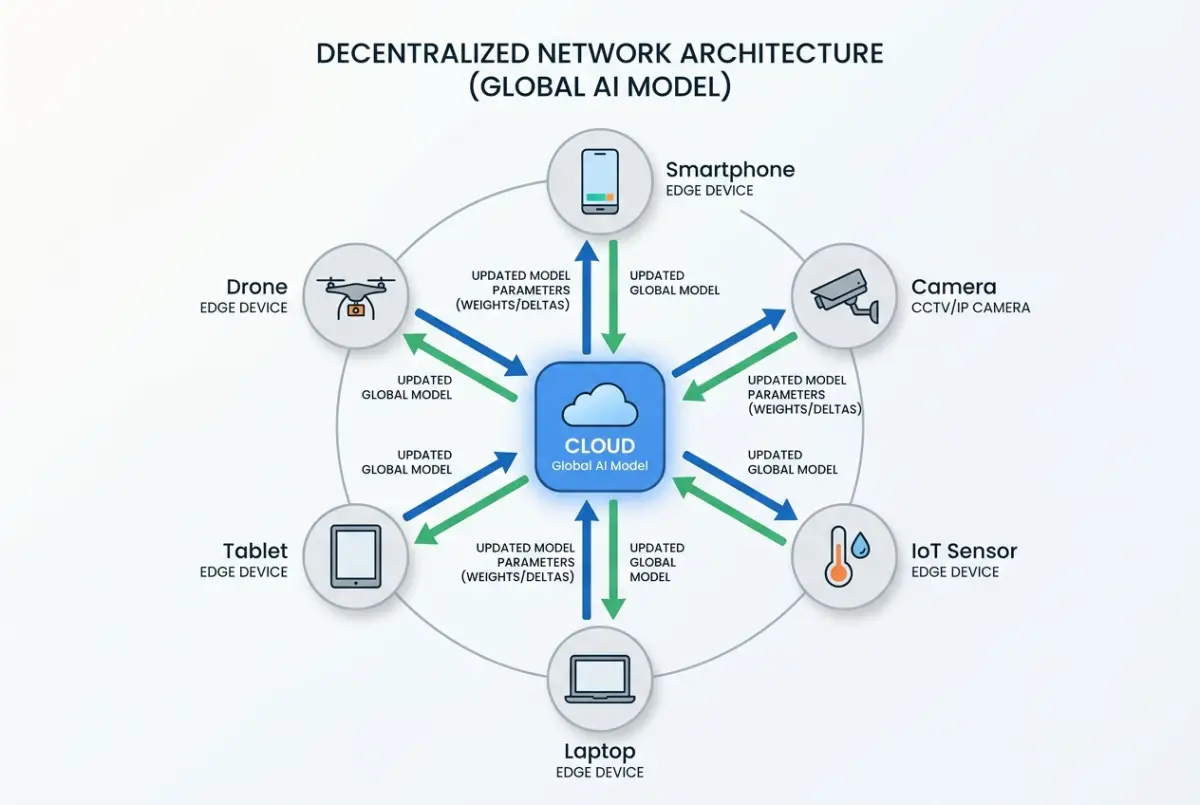
This intelligent synergy creates an ecosystem that is not only more resilient to cyber threats but also more efficient in utilizing physical resources, achieving a more balanced integration of security, speed, and functionality.
Ultimately, the transition to Edge AI represents more than a technical optimization or an isolated improvement in local security. It defines a new paradigm of resilience and protection within modern digital infrastructure. By localizing data processing and distributing intelligence across endpoint devices, systems simultaneously reduce attack surfaces and infrastructure strain. Security, low latency, and scalability converge within a single architectural framework. When critical systems are freed from the burden of constant cloud synchronization, they naturally achieve higher resilience against both infrastructure disruptions and targeted external manipulation. This integrated approach establishes a new engineering paradigm in which strict security, operational autonomy, and execution speed are not competing priorities but complementary characteristics. In the era of hybrid orchestration, this convergence positions local processing as the foundational layer for building more secure, efficient, and trustworthy distributed intelligence systems.
Go backComments (0)
From This Author
Select Crypto to Support the Author 💫
×TXintEE7aezp6QxNNtbghCXvmXJdgofEyr
0x9c6299454A6B617A0Db228024279F2a3EEf956dD
bc1qj7caz3xfh5qd4ud3v3nh7k4tfl5lg8jh9er73e
0x9c6299454A6B617A0Db228024279F2a3EEf956dD
3TndfWAhPytTaBZjC2GbNWqh9iWx171SYACjbG2j5vx8
DHsrtwiL56Xk1xAj3fe8pVcfLhE8xgt3EQ
0x9c6299454A6B617A0Db228024279F2a3EEf956dD
UQDFkubJxb8KmxFmy1arJxkewzmNEg6-G2pJFVzFihB65d7W
ltc1q3fentl6ur9cxm0vxyqkdmmzxkj92j00p9l8m7z
✍ Article Author
- Registration: 26 July 2025, 19:34
- Location: Georgia