


Edge Computing in Smart Cities: How Local Intelligence Is Transforming Urban Infrastructure
 Tornike Moss
Imagine the city as a fully-fledged, living organism. For decades, urban infrastructure was strictly passive — a lifeless labyrinth built of concrete, steel, and asphalt. The first wave of Smart Cities partially changed this paradigm, equipping cities with digital perception through sensor networks. However, the architecture of this model relied on sending massive volumes of data to distant, centralized cloud servers, where it was processed and then returned to the city's infrastructure. Today, at a new stage of technological maturity, it is becoming clear: true urban evolution requires not only the perception of the environment but also instant, flawless reflexes. This is exactly where the paradigm shift from the cloud to the "edge" begins.
Edge Computing endows urban infrastructure with decentralized, local intelligence. It forms the city's digital nervous system, where critical decisions are made exactly where the data is generated — at intersections, power grids, or public spaces. When it comes to coordinating autonomous mobility or managing peak energy consumption, milliseconds decide everything. Network latency is no longer just a technical inconvenience; it is a primary barrier to urban safety and functional efficiency.
This article examines how Edge Computing is transforming urban environments into flexible, self-regulating ecosystems. We stand on the threshold of a fundamental transformation: leaving behind the "passive city" and building an "active, intelligent organism," where traffic optimization, energy efficiency, and citizen safety are managed in real time, without reliance on centralized servers.
Quick Summary
Key takeaways: The main ideas and conclusions of the article are summarized below.
- Edge Computing moves data processing closer to where information is generated, allowing smart city infrastructure to analyze data locally instead of relying entirely on distant cloud servers.
- Traditional cloud-centric smart city systems suffer from network latency because data must travel long distances before decisions can be made.
- Edge infrastructure distributes computing power across intersections, communication towers, sensors, and urban devices, enabling real-time decision making directly within the city environment.
- This local intelligence powers next-generation mobility systems such as V2X communication, predictive traffic management, and autonomous transportation networks.
- In energy infrastructure, Edge Computing supports smart grids and microgrids by analyzing demand in real time and dynamically balancing electricity distribution across the city.
- By processing sensitive data locally, Edge systems also strengthen public safety while improving data privacy through decentralized, privacy-by-design architectures.
Table of Contents
The Anatomy of the Urban Nervous System: From Cloud to Edge
The modern city is transforming from a passive infrastructure model into an active, powerful computational ecosystem with its own digital nervous system. If traditional cloud technologies created the first, foundational layer of urban intelligence, Edge Computing introduces decentralized, local reflexes into this ecosystem. This is not merely a superficial technological upgrade; it is a fundamental architectural shift that dictates how the city perceives, processes, and reacts to ongoing events in real time. When infrastructure decisions require immediate response, the operational sensitivity of the urban space becomes critical, surpassing the capabilities of traditional centralized models.
The Limits of Centralized Computing and the Latency Problem
For years, the concept of smart cities relied primarily on a centralized cloud architecture, where information collected from sensors deployed across the city was sent to unified, remote servers for processing. However, the exponential growth of urban data has clearly exposed the physical and technological limits of this approach. When dealing with millions of connected devices, transferring continuous data streams over long distances creates network congestion and requires massive bandwidth. Furthermore, transmitting the signal, routing it, and returning a response from the server takes time, which gives rise to the problem of latency. From a technical standpoint, this delay may only be measured in milliseconds, but in critical situations, this precise amount of time determines the efficiency and reliability of the system.
If you want to explore in greater depth why network latency remains one of the fundamental limitations of modern internet architecture and how physical distance still constrains centralized cloud infrastructure, read our detailed analysis — Cloud Latency: Why Distance Still Limits Modern Internet Infrastructure.
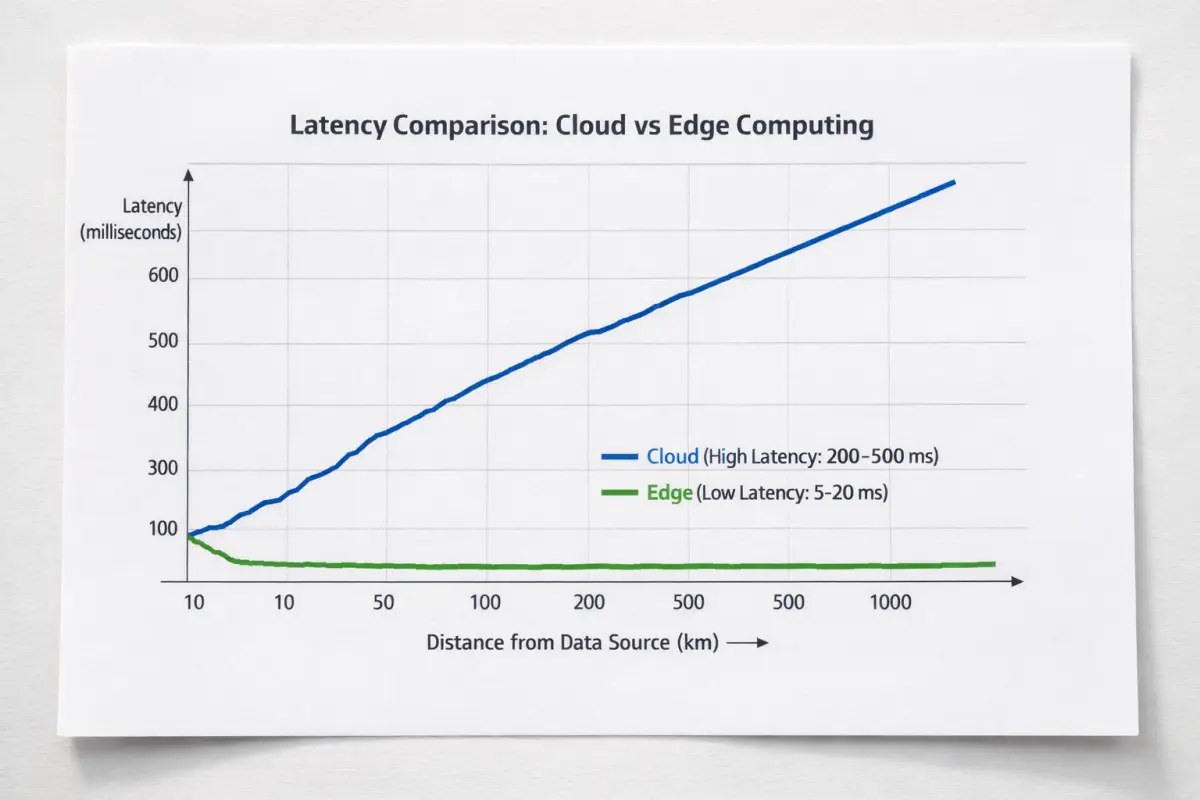
The impact of latency becomes most apparent when analyzing real-time urban services. Imagine a smart transportation system or a surveillance camera that has detected a traffic incident. If this device must send data to a cloud server located hundreds of kilometers away, wait for the algorithm to identify the threat, and only then receive the command to activate an emergency response signal, the lost time could prove fatal. Environmental sensors and emergency response systems that require immediate action face similar challenges. The centralized cloud is simply too distant to keep up with real-time urban dynamics. This architectural limitation has accelerated the adoption of decentralized edge infrastructures, especially when compared with traditional cloud-centric models, as discussed in Edge Computing vs Cloud: Why Cloud Alone Is No Longer Enough.
Decentralized Architecture: Micro Data Centers and Local Sensor Networks
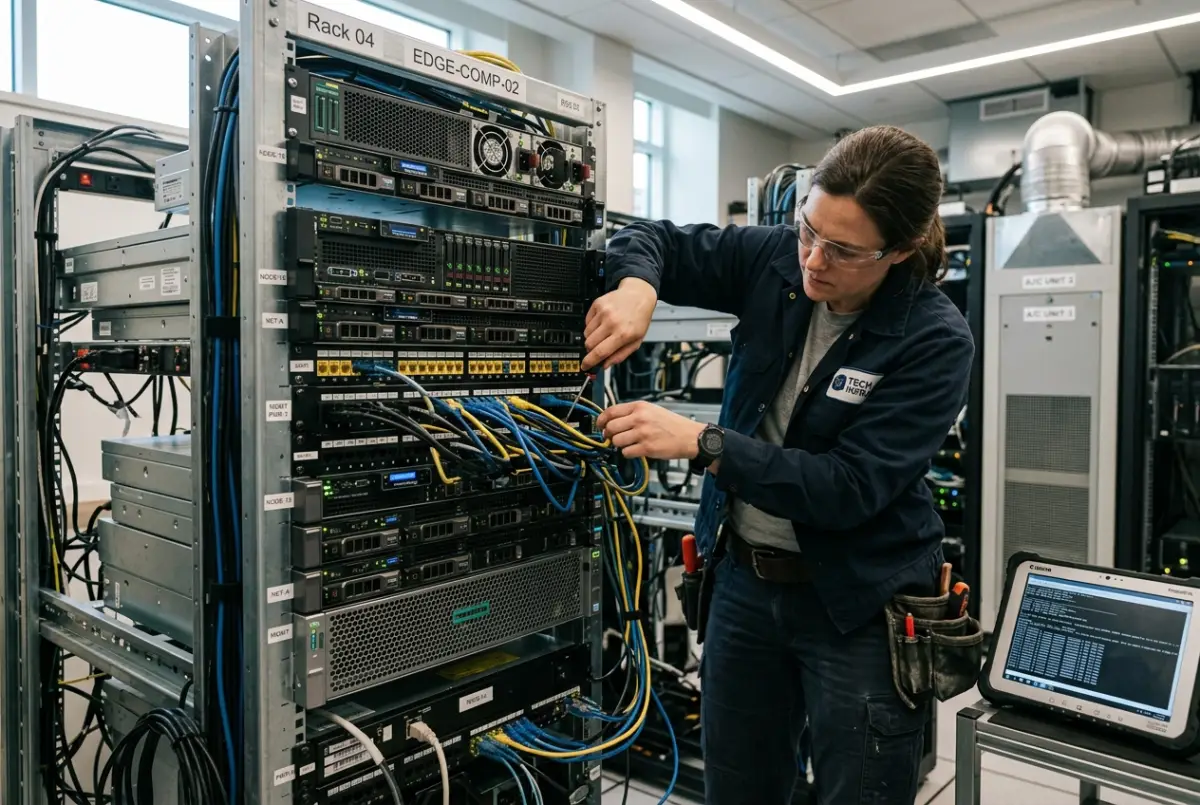
In response to this critical challenge, Edge Computing completely changes the logic of data processing by distributing computational power directly along the city's infrastructure, at physical locations. Instead of information traveling to distant servers, the decentralized architecture creates so-called Edge Nodes and micro data centers exactly where the data is generated.
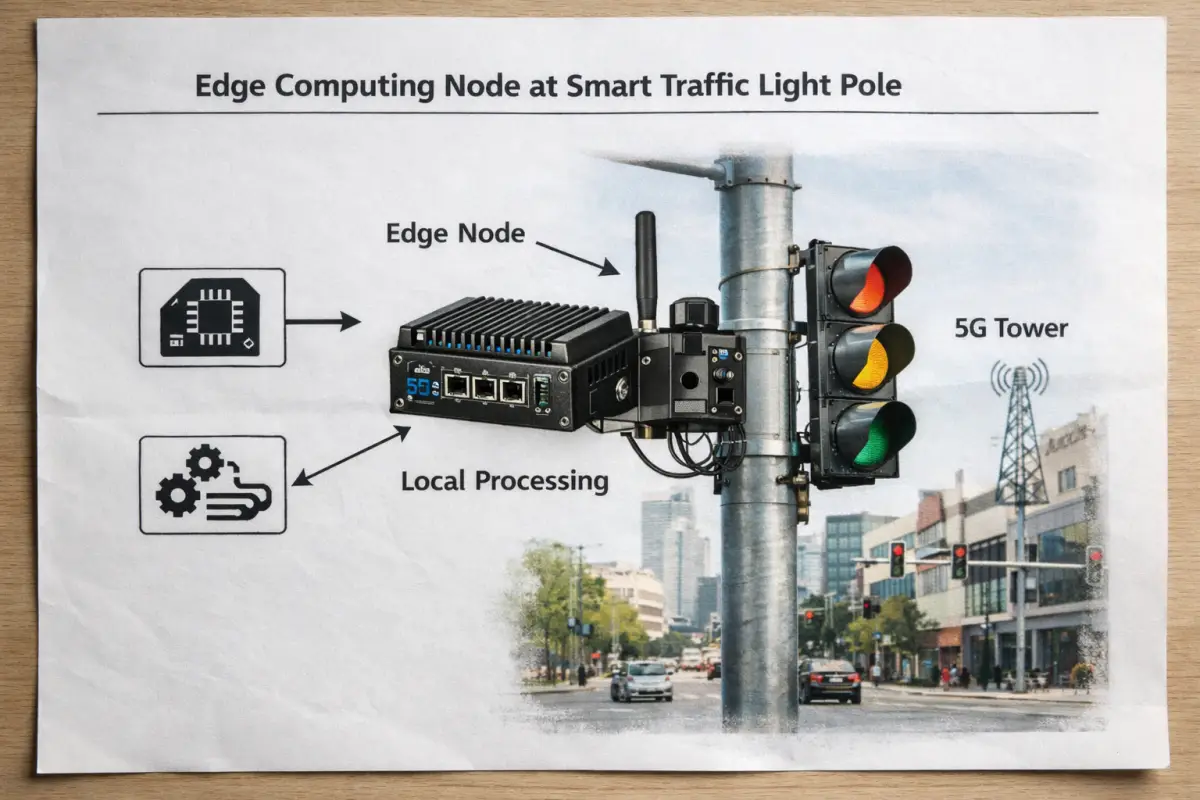
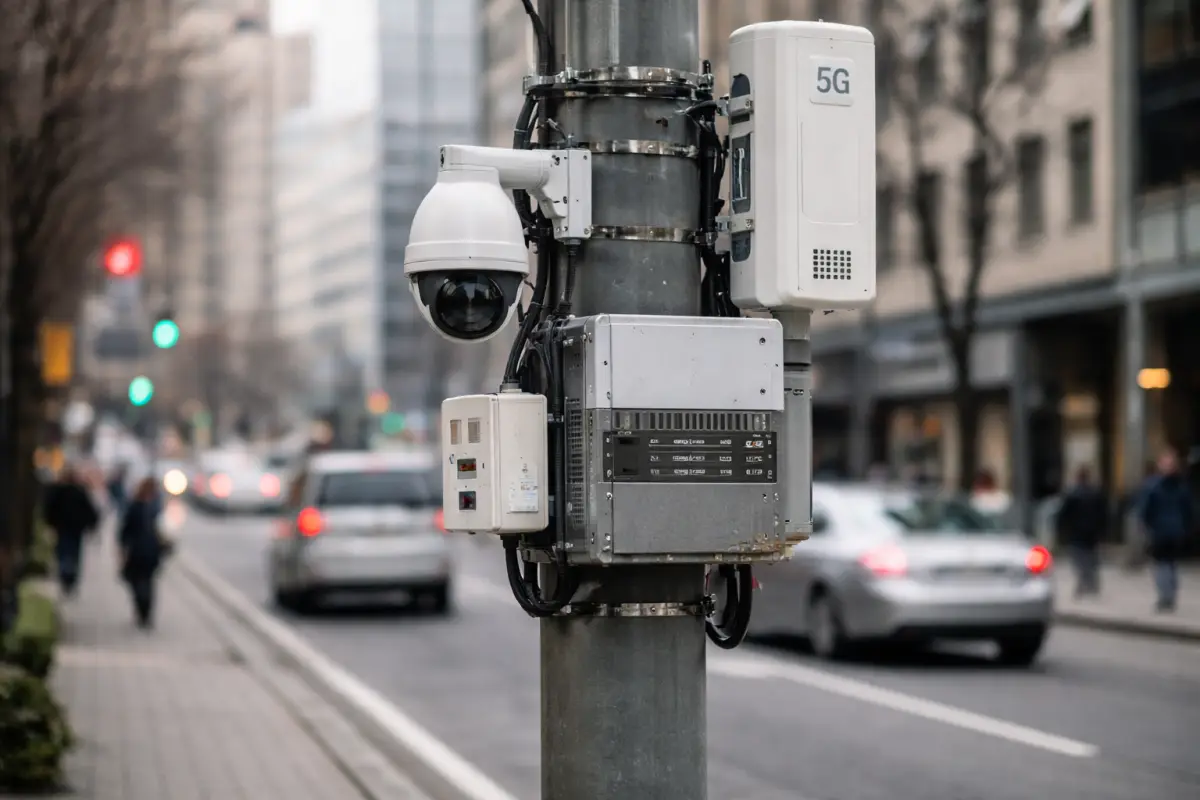
This means that 5G towers, smart intersections, street lighting poles, and building management modules — equipped with edge computing nodes — effectively function as distributed micro-computing units that process data directly at the source. These systems run dedicated processors and analytical software, allowing them to make intelligent decisions locally without relying on a centralized cloud infrastructure.
The primary advantage of local computing is not just the minimization of latency; this approach also radically reduces the overall load on the network. Edge infrastructure filters raw data on-site, analyzes it, and sends only the necessary, pre-processed, and summarized information to the cloud server for long-term archiving. As a result, the city gains the ability to react to local events instantly and autonomously. For example, a smart traffic light can alter the duration of a green light in fractions of a second during a sudden shift in traffic, without waiting for confirmation from a central server. It is this local autonomy that turns the city's infrastructure into a flexible and responsive mechanism.
These instant reflexes of local data processing manifest most clearly in the most dynamic segment of urban life—the realm of transport and mobility. When city infrastructure begins to think in milliseconds, entirely new horizons open up for the implementation of intelligent mobility and autonomous transportation systems, where every vehicle and intersection becomes a participant in a unified, invisible dialogue.
The New Paradigm of Mobility: Intelligent Traffic and Autonomous Transport
Urban transportation systems are transforming from traditional, static management models into entirely new, data-driven, and adaptive mobility ecosystems. The era when traffic was regulated by pre-scheduled, rigid timetables and isolated traffic lights is fading into the past. Today, modern intelligent mobility requires physical infrastructure and vehicles to operate in perfect synchronization. It is Edge Computing that makes it possible for real-time computations at the edge of the network to ensure the instant coordination of cars and streets. This new paradigm transforms the city's transport network into an adaptive, intelligent system that constantly learns and adapts to ongoing events without any disruption.
V2X (Vehicle-to-Everything) Communication and Instant Synchronization
The fully-fledged operation of autonomous and connected transport is impossible without V2X (Vehicle-to-Everything) technology, which allows vehicles to continuously communicate with everything around them. Within this invisible digital dialogue, cars exchange information not only with each other (V2V) but also with road infrastructure (V2I), traffic lights, and even pedestrians' smartphones (V2P). When thousands of objects moving on the street simultaneously generate terabytes of data regarding their speed, exact location, trajectory, and environmental conditions, transmitting and processing this information via traditional cloud servers becomes physically impossible and dangerous. This is exactly where Edge Computing architecture steps in, providing V2X networks with vital speed and unprecedented reliability.

Edge Computing ensures millisecond-level synchronization without relying on distant servers, which is directly linked to road safety and human lives. For example, when approaching a smart intersection, the local sensors of the vehicle and the infrastructure analyze potential hazards in fractions of a second. If the system detects that another car is about to run a red light, or a pedestrian suddenly steps out of a blind spot, the collision prevention algorithm instantly issues a braking command on the spot. Such cooperative traffic flow management and accident prevention are only possible when the artificial intelligence is physically located right there, in the intersection's control node.
Predictive Congestion Management and Dynamic Traffic Signal Algorithms
Beyond instant safety, local computing fundamentally changes the city's traffic throughput and the traditional philosophy of congestion management. Massive volumes of data from street cameras, radar sensors, and connected vehicles are processed in real time directly at edge nodes. Powerful analytical algorithms do not merely register already-formed traffic jams; they perform predictive modeling. Local micro-centers analyze the density of vehicle flows, average speeds, and directions to accurately forecast congestion hotspots before they can actually paralyze a specific area of the city.
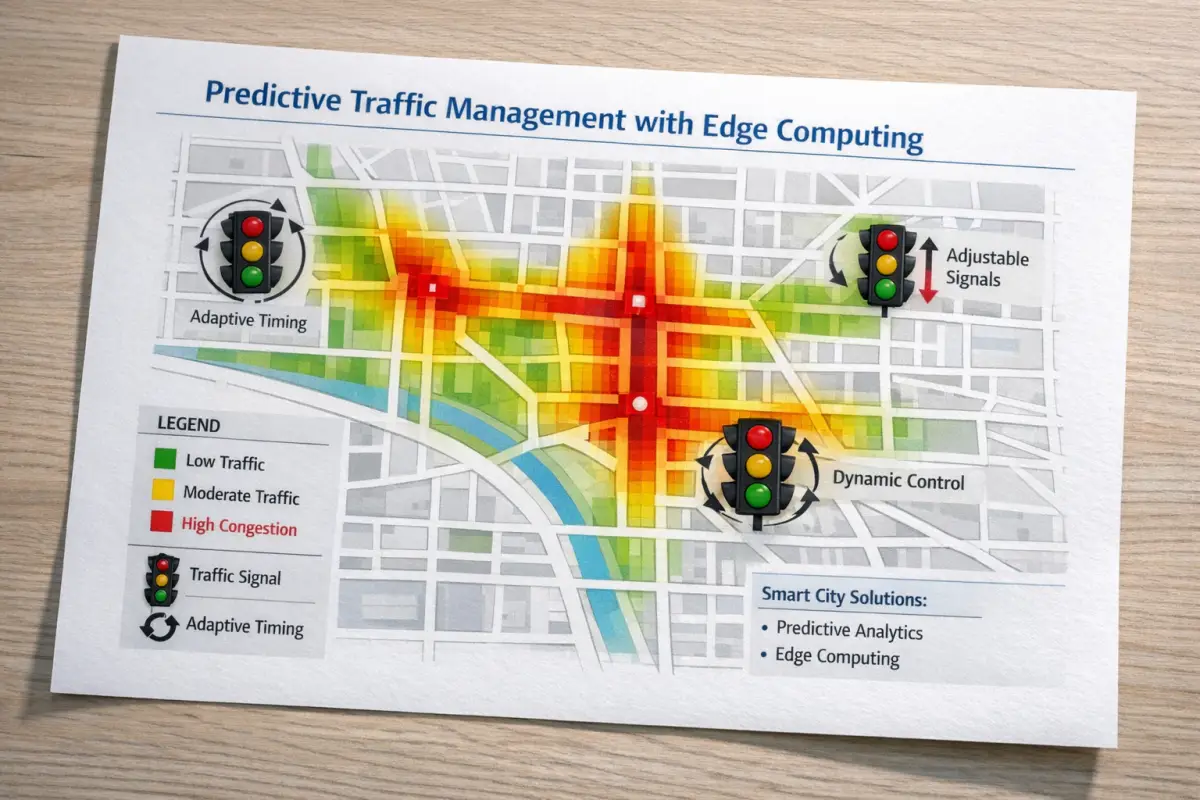
Based on this predictive analysis, the system employs dynamic traffic signal management algorithms, completely replacing outdated practices. Instead of pre-programmed timers, each intersection independently makes decisions regarding the duration of the green light to maximize traffic flow and maintain continuity. If the volume of vehicles increases on a particular arterial road, the local Edge system immediately extends their green phase, while adjusting the cycle accordingly on parallel, less congested streets. This coordinated operation of dynamic signals drastically reduces idle time spent in traffic jams, improves the overall commuting experience, and significantly cuts vehicle emissions, thereby protecting urban ecology.
However, this ultra-modern ecosystem of intelligent mobility, with its thousands of sensors and constantly thinking road infrastructure, requires immense and continuous energy resources. For the city's transport nervous system to function smoothly, the existence of an equally smart, stable, and adaptive urban energy infrastructure is essential. This is where the crucial role of decentralized energy systems and Smart Grids becomes apparent, representing the next, equally important stage of urban evolution.
Energy Independence and Smart Grids
The seamless operation of intelligent transportation systems, millions of sensors, and urban computing infrastructure is unimaginable without a stable and adaptive energy foundation. Traditional, strictly centralized electricity grids simply can no longer cope with the dynamic, rapidly changing demands of real-time digital cities. When energy consumption fluctuates from minute to minute, the old model—which involved supplying energy in only one direction, from the generator to the consumer—becomes inefficient and vulnerable. In response to this challenge, Smart Grids come to the forefront, representing a data-driven, decentralized energy ecosystem. Supported by Edge Computing, these grids grant the city energy independence and unprecedented flexibility.
Decentralized Energy Distribution and Load Balancing
The primary factor determining the efficiency of smart grids is the localized, neighborhood-level analysis of electricity consumption patterns. Unlike traditional systems, where consumption data is collected at the end of the month or, at best, the end of the day, Edge-based infrastructure monitors processes in real time. Smart meters installed in buildings and sensors placed on transformers instantaneously record the rise or fall in energy demand. These local computing nodes independently process the information and precisely determine which part of the city requires additional resources at any given moment.
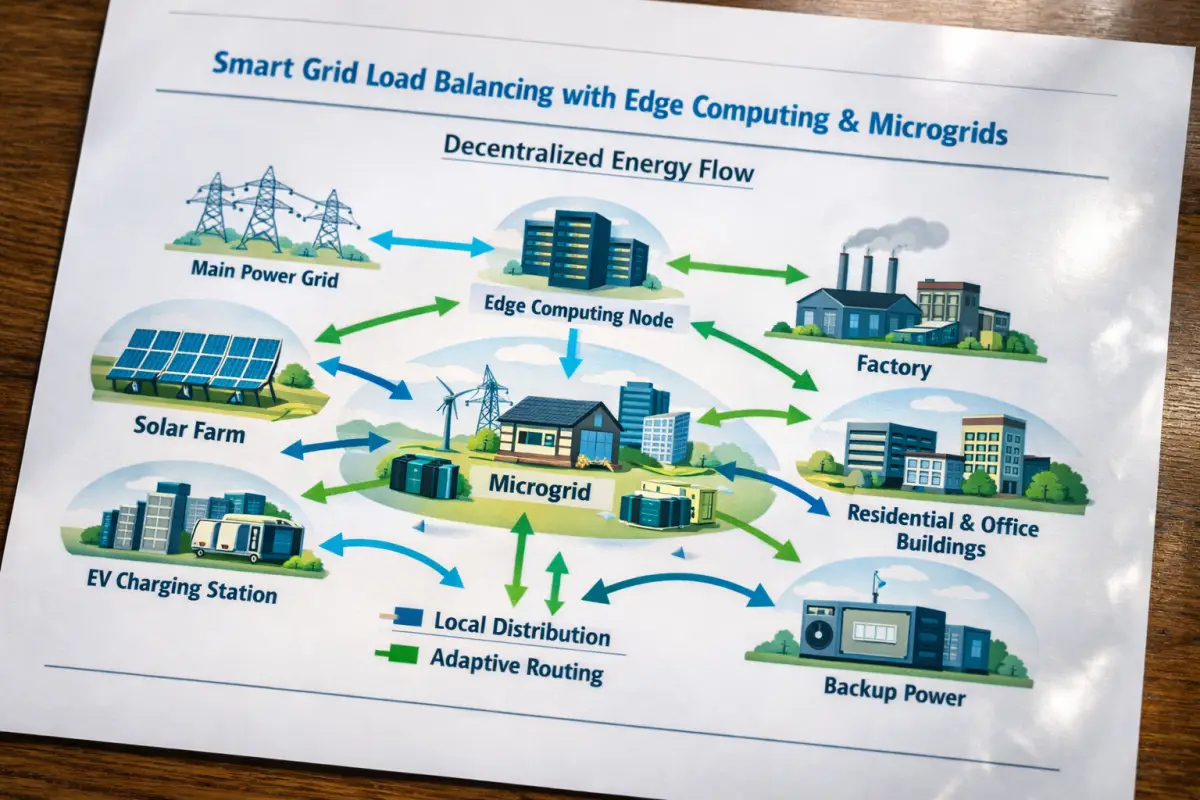
Such continuous monitoring enables dynamic Load Balancing, which is the guarantee of the urban energy system's stability. When energy consumption peaks in a specific neighborhood—for example, due to the mass charging of electric vehicles during evening hours—local algorithms automatically, without human intervention, redirect power flows (Adaptive Power Routing). The system draws surplus energy from areas where demand is low—such as commercial zones during non-working hours—and routes it toward overloaded locations. This instant redistribution effectively prevents grid overload and eliminates the risk of large-scale disruptions or blackouts.
Microgrids and the Real-Time Integration of Renewable Energy
An even higher level of decentralization is represented by the integration of Microgrids into the urban space. Microgrids are localized, independent energy systems capable of operating either in sync with the central grid or in a completely autonomous mode. They allow specific city districts, hospitals, or university campuses to generate and store their own energy. However, when it comes to renewable energy sources, such as solar panels and wind turbines, their unstable, fluctuating nature remains a major challenge. The intensity of solar radiation or wind speed can change radically within minutes, creating a serious imbalance for the traditional grid.
To regulate this very volatility, Edge Computing algorithms are critically important. Edge computations analyze local weather forecasts, current generation metrics, and the charge levels of energy storage systems (batteries) in real time. If the energy generated by solar panels drops sharply due to cloud cover, the local system makes a decision in milliseconds and compensates for the deficit from energy storage, or instantly connects to the central grid. In this way, the management of renewable energy sources becomes not a chaotic, but a strictly calculated and stable process, where the balance of supply, storage, and distribution is flawlessly maintained.
However, the more connected, autonomous, and "smart" the city becomes with its transport or energy infrastructure, the more acute the issue of security becomes. With the expansion of the digital ecosystem, ensuring the physical safety of citizens and the inviolability of their personal data becomes vital, pointing to the necessity of the next stage in urban planning—public safety and Privacy-by-Design architecture.
Public Safety and Privacy-by-Design in the Urban Space
As the modern city becomes more autonomous and interconnected with its countless sensors, cameras, and computing systems, ensuring public safety and data protection becomes increasingly critical. The continuous digital monitoring of urban spaces, on the one hand, increases response efficiency, but on the other hand, raises legitimate questions about the privacy of citizens. Traditional approaches, which involved storing massive amounts of personal information in centralized databases, now pose serious cyber risks. That is why Privacy-by-Design—the concept of embedding privacy from the design stage—is becoming a foundational principle for next-generation smart cities. This concept, in synergy with the capabilities of Edge Computing, establishes an entirely new, decentralized standard of security, where technology protects us from threats without invading our personal space.
Video Analytics at the Edge: Threat Identification Without Delay
In the process of managing public safety, the speed of response is often of vital importance. Video analytics systems integrated with Artificial Intelligence (AI) at the Edge level radically change the methodology for handling crisis situations. Instead of street cameras sending large video streams to cloud servers and waiting for analysis there, computational processes take place directly within the camera module or an associated local micro-center. This means the system can identify critical events—such as a traffic accident, a sudden fire, infrastructure damage, or a violent incident in crowded areas—in real time, without any network latency.
This real-time responsiveness is fundamentally constrained by network latency and explains why edge-based AI systems outperform cloud-dependent architectures in time-critical scenarios. For a deeper explanation, see — why Edge AI outperforms cloud systems in latency-critical tasks.
Such instant identification translates directly into saved lives and minimized damage. For example, if a smart surveillance system detects a severe accident at an intersection, the local algorithm assesses the severity of the situation in fractions of a second and sends an automated alarm signal to the nearest emergency medical services and police patrol units. Simultaneously, the system can independently alter the mode of nearby traffic lights to create a green corridor for responders on the move. Bypassing cloud analysis and shifting to local processing ensures that the emergency response chain is not broken due to temporary internet connection disruptions or central server overload.
The Advantage of Local Processing: Protecting Data Privacy
Although the abundance of cameras and sensors is considered a guarantee of security, it naturally gives rise to fears of global surveillance and the misuse of personal data. Edge Computing resolves this complex dilemma elegantly and technologically, as its architecture inherently improves the level of privacy.

When video footage and sensor data are processed locally, personal information—whether it be people's faces, their movement trajectories, or behavioral patterns—never leaves the physical boundaries of the device. The algorithm analyzes the frame on the spot, extracts only the necessary metadata from it (for example, "fire detected" or "50 people moving on the street"), and then either deletes the video file itself or renders it completely anonymized (e.g., by blurring faces) before sending it to the central database.
This approach dramatically reduces the risks of cyberattacks and mass data leaks. It becomes practically impossible for a potential hacker to gain access to citizens' sensitive information because the centralized database simply no longer stores raw, personal footage. Thanks to local processing, the city's multimedia infrastructure acts as an event detector rather than an individual controller of citizens. Ultimately, this high standard of privacy protection strengthens public trust in urban digital technologies, which is a necessary prerequisite for the successful development of any smart city.
When real-time infrastructural intelligence, adaptive mobility, energy autonomy, and secure data architecture converge, we see how the city begins to function as a fully integrated, self-regulating digital ecosystem. It is no longer just a territory saturated with technology; it is an entirely new paradigm where passive infrastructure finally gives way, and an active, thinking urban organism takes the stage.
Transformation: From Passive Infrastructure to an Active Urban Organism
When mobility systems, energy networks, security infrastructure, and local data processing capacities are linked into a single, continuous chain, the city ceases to be a static, lifeless environment. The passive infrastructure of concrete and asphalt transforms into an adaptive digital ecosystem capable of reacting instantly to ongoing events. As a result of this massive technological synergy, a fully-fledged digital urban organism is born before our eyes. It is no longer merely a physical space for human habitation; it becomes an independent, living mechanism that constantly learns, evolves, and regulates itself.
The Synergy of Infrastructure and User Experience (UX)
In this new urban paradigm, the interaction between infrastructure and the citizen shifts to a completely invisible, intuitive level, fundamentally changing the User Experience (UX) of public spaces. Technology no longer requires direct, mechanical intervention from humans—pressing a button, opening an app, or issuing a command. Instead, the city itself "senses" the movement and behavioral activity of citizens through thousands of sensors and data streams. Transport, street lighting, temperature control in public buildings, and other municipal services automatically adapt to human behavior and movement patterns in the background.
For instance, when a pedestrian walks down an empty street at night, the smart lighting system, aided by local sensors, turns on the streetlamps ahead of them in sync with their footsteps, and then dims them again after they pass to save energy. Similarly, public transport routes and schedules change dynamically depending on where more passengers are gathering at any given moment. This is a city that anticipates the needs of its residents and creates the most comfortable, safe, and personalized environment for them in a way that remains technologically imperceptible.
Edge Computing as the Foundation of Self-Regulating Ecosystems
From all the above, it clearly emerges that the functioning of this complex, multi-layered urban architecture would be impossible without Edge Computing. It is the local intelligence located at the edge of the network that makes it possible to minimize latency, which is so critical for autonomous transport and public safety. At the same time, decentralized computing ensures system resilience—even if the connection to the central server is lost, individual nodes of the city continue to operate independently. Furthermore, local data processing is the practical embodiment of the Privacy-by-Design principle, reliably protecting citizens' privacy.
Therefore, Edge Computing should not be viewed merely as another technological upgrade or an improvement of IT infrastructure. It is the fundamental bedrock upon which the smart cities of the future are built. Traditional, cloud-dependent models can no longer meet the speed and complexity that modern urbanization demands. Without local computational power, the city will simply remain a chaotic network of sensors lacking the ability to act in real time. Edge Computing gives it a "brain" exactly where its "sensory organs" are located.
Ultimately, we are witnessing the birth of the intelligent city—a fully-fledged, living system. Thanks to distributed intelligence, this urban organism continuously senses its environment, processes highly complex data in fractions of a second, and responds to any change with precise, instant reflexes. This is the city of the future, where technology and physical space merge in perfect harmony to serve humanity and create a safer, more efficient, and sustainable living environment.
Go backComments (0)
From This Author
Select Crypto to Support the Author 💫
×TXintEE7aezp6QxNNtbghCXvmXJdgofEyr
0x9c6299454A6B617A0Db228024279F2a3EEf956dD
bc1qj7caz3xfh5qd4ud3v3nh7k4tfl5lg8jh9er73e
0x9c6299454A6B617A0Db228024279F2a3EEf956dD
3TndfWAhPytTaBZjC2GbNWqh9iWx171SYACjbG2j5vx8
DHsrtwiL56Xk1xAj3fe8pVcfLhE8xgt3EQ
0x9c6299454A6B617A0Db228024279F2a3EEf956dD
UQDFkubJxb8KmxFmy1arJxkewzmNEg6-G2pJFVzFihB65d7W
ltc1q3fentl6ur9cxm0vxyqkdmmzxkj92j00p9l8m7z
✍ Article Author
- Registration: 26 July 2025, 19:34
- Location: Georgia