



The Sun Covered in Spots: A Peak in Solar Activity and Its Visible Signs
 Tornike Moss
Each morning, as the horizon brightens and the darkness of night slowly retreats, our gaze instinctively turns skyward. In human memory, the Sun has always been associated with constancy, stability, and perfection. It is the golden disk that has shone for billions of years, warming Earth and sustaining life. It feels so familiar, so permanent, that we rarely pause to question its true nature. Our eyes grow accustomed to its brilliance and stop searching for detail. We know it will rise, trace its path across the sky, and set—only to return again the next day. This steady rhythm creates a sense of security, as if the Sun were a frozen image: eternal, untouchable, immune to time and change.
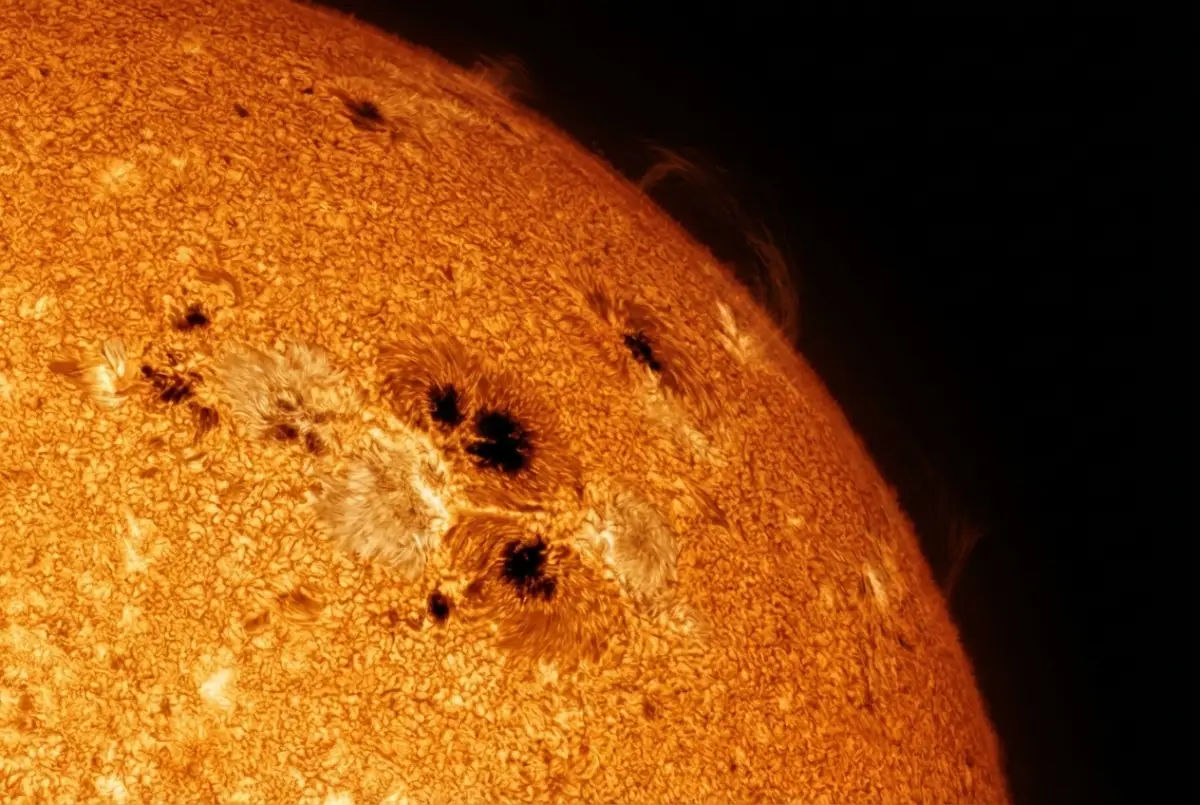
Yet when we observe this luminous body with proper tools and patience, a different reality emerges. Perfection, it turns out, is an illusion created by distance. In recent times, unusual markings have appeared on the Sun’s once-uniform yellow surface. They did not arrive suddenly. At first, it was as though a single drop of ink had fallen onto a glowing canvas. Then more appeared, growing larger, gathering into clusters. Like a calm ocean that hides turbulence beneath its surface, the Sun began to reveal its hidden character. These dark spots, which appear as tiny specks from Earth, actually cover regions as large as entire planets. They disrupt the visual harmony of the solar disk and remind us that the star warming our planet is not a static monument—it is a living, dynamic, and ever-changing entity.
To understand what we are seeing, we need to look beyond appearances and listen to nature’s language rather than equations. Sunspots are not solid objects, nor are they blemishes on the Sun’s surface. They emit light too—just less intensely than the surrounding regions. The Sun is woven from complex magnetic fields. At times, these invisible magnetic threads become tangled and rise to the surface, blocking the upward flow of heat from the Sun’s interior. As a result, these areas cool slightly. “Cool,” in this context, is relative—the temperature there still reaches thousands of degrees. But because the surrounding surface is even hotter, the contrast makes these regions appear dark, almost black, to our eyes and instruments. It is a play of shadows within an ocean of light.
Sunspots do not appear randomly, nor do they vanish without order. The Sun has a rhythm—its own kind of breathing—not measured in seconds or minutes, but in years. Scientists call this the solar activity cycle, which lasts about eleven years on average. During solar minimum, the Sun appears calm: its surface relatively clear, its magnetic fields more orderly. Then, gradually, the star awakens. Magnetic disturbances increase, spots emerge near the equator and the poles, and the Sun enters its active phase. What we are witnessing now—a disk scattered with dark regions—is a sign of the cycle’s peak, known as solar maximum. It is a natural, essential rhythm, as fundamental to the Sun as a heartbeat is to a living organism.
From Earth, this process takes on a distinctly visual character. To the naked eye—especially without proper protection, which is dangerous and strongly discouraged—the Sun still looks blindingly bright. But at sunrise or sunset, when Earth’s atmosphere acts as a natural filter, an attentive observer may notice subtle changes in color along the horizon. Photographers and astronomy enthusiasts using telescopes see far more: complex structures where dark cores are surrounded by lighter regions called penumbrae. The scene is never static. Spots drift across the Sun’s surface as it rotates, changing shape, splitting apart, or merging together. It resembles the movement of clouds—only on a fiery surface of plasma.
Sunspots are not merely a visual curiosity; they are linked to far-reaching phenomena that extend all the way to Earth. Active regions on the Sun often release streams of energy and charged particles known as the solar wind. When this invisible flow interacts with Earth’s magnetic field, the sky comes alive. The aurora—those shimmering curtains of green, purple, and red light near the poles—is a direct response to the Sun’s restlessness. The more sunspots there are, the more active the Sun becomes, and the more frequently and vividly the northern and southern skies glow. It is a silent dialogue between Sun and Earth, where violent processes inside a star are transformed into calm, luminous displays in our atmosphere.
For humans, this all unfolds at a distance, from the position of observers. Around the world, astronomers carefully record the number and movement of sunspots each day. This record stretches back centuries. Since the time of Galileo Galilei, people have sketched the solar disk by hand, marking the spots they observed. Even today, despite advanced satellites, many amateur astronomers still track sunspot groups with backyard telescopes. There is something meditative about it—watching a process you cannot control, slow down, or accelerate. It serves as a reminder that we live beside immense cosmic forces that follow their own rules.
It is important to remember that this phase is temporary. The peak of solar activity is not a permanent state. Over time, magnetic fields will settle, sunspots will fade, and the Sun will return to a quieter phase. The spots that now dominate its surface will become part of history. The Sun will reclaim its familiar visual perfection—at least until the next cycle begins. This pattern of renewal and rest has continued for billions of years and will persist long into the future.
In the end, when we look up at the sky, sunspots invite us to reflect on the dual nature of the universe: it is both constant and changing. The Sun remains the Sun, yet it is never exactly the same as it was yesterday. These dark markings are its chronicle, written across a fiery surface, telling the story of a star’s inner rhythm. And we, as humans, are small but attentive witnesses to this grand spectacle, trying to read and understand one of the oldest languages of the cosmos.
Go backComments (0)
From This Author
Select Crypto to Support the Author 💫
×TXintEE7aezp6QxNNtbghCXvmXJdgofEyr
0x9c6299454A6B617A0Db228024279F2a3EEf956dD
bc1qj7caz3xfh5qd4ud3v3nh7k4tfl5lg8jh9er73e
0x9c6299454A6B617A0Db228024279F2a3EEf956dD
3TndfWAhPytTaBZjC2GbNWqh9iWx171SYACjbG2j5vx8
DHsrtwiL56Xk1xAj3fe8pVcfLhE8xgt3EQ
0x9c6299454A6B617A0Db228024279F2a3EEf956dD
UQDFkubJxb8KmxFmy1arJxkewzmNEg6-G2pJFVzFihB65d7W
ltc1q3fentl6ur9cxm0vxyqkdmmzxkj92j00p9l8m7z
✍ Article Author
- Registration: 26 July 2025, 19:34
- Location: Georgia