




The Sea That Glowed at Night: When Bioluminescence Reached the Shore
 Tornike Moss
When the sun sinks beyond the horizon and the last pale streaks of daylight fade away, the sea takes on its familiar nighttime form. In the darkness, water and sky merge, and the horizon line becomes almost impossible to distinguish. For anyone standing on the shore, the sea at night is defined first and foremost by sound — the steady, rhythmic roll of waves breaking against the coast, accompanied by the soft rasp of sand or stone. Space seems to contract; visibility extends only a few metres, limited to the reach of moonlight or the dim glow of coastal lamps. The air is heavy with the damp scent of salt and seaweed. Black and deep grey dominate the palette, creating a world associated with depth, concealment, and the unknown. The night sea is usually a symbol of calm paired with constant motion — visually subdued, as if resting from colour altogether.
But from time to time, nature disrupts this monotone darkness — and does so without warning.
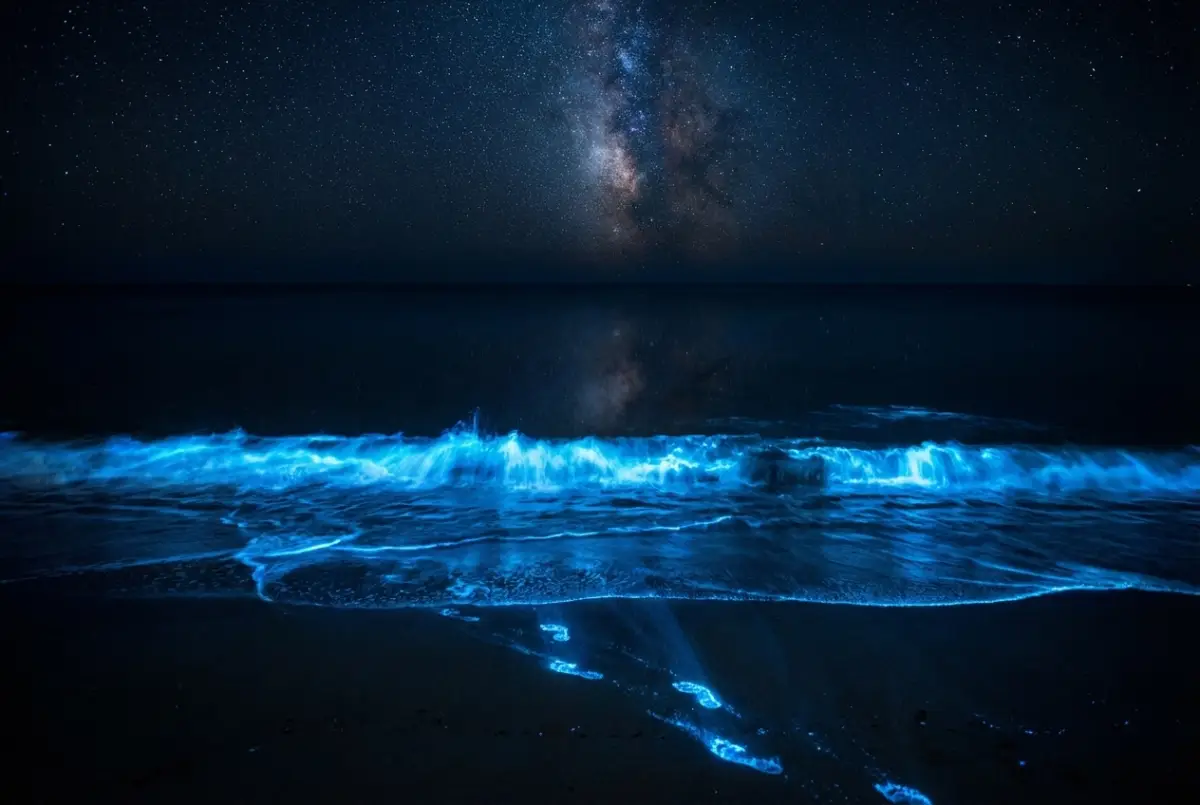
The change does not arrive with noise or sudden brightness. It begins quietly, almost imperceptibly. A person walking along the shore may notice that a footprint pressed into wet sand briefly leaves behind a faint bluish glow. At first, it seems like an illusion, perhaps a trick of moonlight reflecting off the surface. Then a wave crashes onto the beach, and instead of white foam, it ignites in a cold, electric blue. The light is not constant. It appears only when the water moves — when a wave breaks, when a stone is thrown, when something disturbs the surface. Points of light flicker and vanish across the dark water, as if the sea were mirroring the stars — except these stars rise from the depths below.
This spectacle, often described as magical or otherworldly, has a very real biological explanation. The phenomenon is known as bioluminescence — the ability of living organisms to produce light. In the ocean, this effect is most commonly caused by microscopic organisms, particularly certain types of plankton. These invisible creatures drift in the upper layers of the water and usually go unnoticed by the human eye. Inside their cells, however, a complex chemical reaction takes place, converting chemical energy into light. This is not heat-producing light like fire, but a cold glow. Plankton use this ability mainly for defence or communication. When the water is disturbed — by waves, a boat cutting through the surface, or even a human hand — they respond instantly by lighting up. When millions of these microscopic “lights” react at once, the result is the glowing sea.
At the height of bioluminescence, the shoreline is transformed. Every wave rolling toward the beach glows neon blue. The crest of a wave traces a luminous line along the horizon before shattering into thousands of sparkling fragments. Water that was once black and opaque becomes radiant and translucent — but only where it moves. If you dip your hand into the sea and stir it, a halo of light forms around your fingers. When you lift your hand out, droplets shimmer like tiny diamonds before falling back into the dark. Even footprints left in wet sand retain a faint glow for a few seconds. The water seems to turn into living, liquid light, responding to every movement and reshaping itself with each touch.
What makes the experience even more striking is the silence that accompanies the light. The human mind often associates brightness with sound — crackling flames, thunder, the hum of city lights. Here, the glow is completely silent. The only sound is the familiar, ancient rhythm of the waves, while the eyes witness something entirely new. This contrast — a known sound paired with an unfamiliar visual — creates a hypnotic effect. The sea murmurs and roars just as it did the night before, but its visual language has changed entirely. In the darkness, blue lines shimmer and dance without music, giving the scene a mystical yet deeply peaceful atmosphere.
People who encounter this phenomenon almost always slow down. Walkers stop and stare at the glowing waves. Many kneel by the shoreline, running their hands through the wet sand to reassure themselves that what they are seeing is real. Fishermen, for whom the sea is a workplace rather than a wonder, watch their oars carve glowing spirals into the water. Swimmers brave enough to enter the night sea discover their bodies wrapped in light; every movement sets the water aglow, making swimming feel like drifting through a field of stars. Loud exclamations are rare. The reaction is usually a quiet smile, prolonged observation, and the realisation that something rare is unfolding.
It is important to remember that this is not a local miracle. Similar displays have been recorded around the world — in the Maldives, along the coast of California, in Australia, and even at certain times along the Black Sea. Bioluminescence, however, is always temporary. It depends on water temperature, currents, wind, and the concentration of plankton. Sometimes the glow lasts only a few hours; sometimes it returns for several nights in a row. Nature offers no guarantee of repetition. This unpredictability is precisely what makes the experience so valuable. You know that what you are witnessing now may not exist tomorrow.
Just as it appears, the light slowly fades. Plankton concentrations drop or are carried away by currents. Waves lose their neon intensity, and the glow grows weaker with each passing moment. The sparks disappear. Eventually, the sea returns to its original state — dark, mysterious, monochrome once again. Only the sound of waves and the salty air remain. The shoreline blends back into the night, and memory becomes the sole keeper of the blue light that briefly reshaped perception itself.
In the end, as we stand in silence and look out at the darkened sea once more, a thought lingers about nature’s hidden potential. Bioluminescence reminds us that our planet is filled with beauty that does not always sit on the surface. It does not announce itself, demand attention, or require an audience. These processes unfold independently of us, following nature’s own internal rhythm. And when we are fortunate enough to witness them, it feels like a gift — a quiet reminder that even in darkness, light can exist, if only we take the time to look closely.
Go backComments (0)
From This Author
Select Crypto to Support the Author 💫
×TXintEE7aezp6QxNNtbghCXvmXJdgofEyr
0x9c6299454A6B617A0Db228024279F2a3EEf956dD
bc1qj7caz3xfh5qd4ud3v3nh7k4tfl5lg8jh9er73e
0x9c6299454A6B617A0Db228024279F2a3EEf956dD
3TndfWAhPytTaBZjC2GbNWqh9iWx171SYACjbG2j5vx8
DHsrtwiL56Xk1xAj3fe8pVcfLhE8xgt3EQ
0x9c6299454A6B617A0Db228024279F2a3EEf956dD
UQDFkubJxb8KmxFmy1arJxkewzmNEg6-G2pJFVzFihB65d7W
ltc1q3fentl6ur9cxm0vxyqkdmmzxkj92j00p9l8m7z
✍ Article Author
- Registration: 26 July 2025, 19:34
- Location: Georgia