




When Flowers Bloomed in the Desert: A Chronicle of a Rare Super Bloom
 Tornike Moss
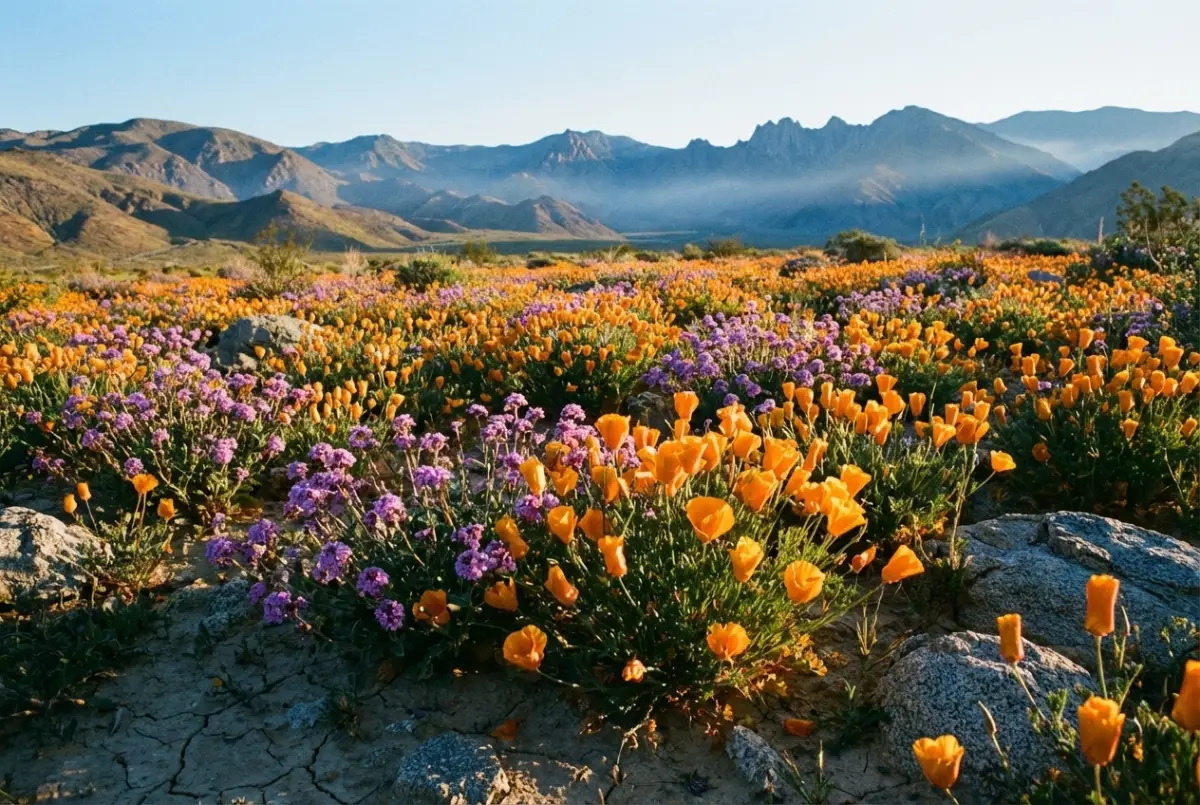
Here, where the horizon seems to dissolve into infinity, time moves differently. The desert’s familiar face is harsh and uncompromising. This is a landscape dominated by stone, cracked clay, and tones of sand and faded gold. During the day, the sun scorches the barren surface without mercy; in the evening, when the heat finally recedes, silence becomes almost tangible — as solid as the ground itself. For years, this scenery appears unchanged. Sparse shrubs dot the terrain, grey and dust-covered, as if life abandoned them long ago. Wind sweeps freely across open spaces, shaking dry branches and pushing grains of sand from one place to another. To the visitor, the desert represents emptiness, stillness, and eternal stasis — a place where nothing happens, and nothing is expected to.
Yet change always begins quietly.
Last winter, when the sky grew heavier than usual and grey clouds rolled over distant mountain ridges, the desert received rain. It was not a flood or a violent storm, but steady, prolonged rainfall that soaked deep into the parched soil. At first, the visual effect was subtle. The ground darkened slightly, growing heavier and denser. For weeks, nothing on the surface hinted at the processes unfolding below. Cold nights alternated with damp days, and the desert remained silent. Still, the air carried an unfamiliar scent — wet earth mixed with vegetation — a smell entirely foreign to such an arid climate.
What scientists and nature observers call a super bloom is, in reality, the result of a rare and delicate alignment. It is not an ordinary spring flowering. Desert soil holds millions of seeds lying dormant for years, sometimes even decades. These seeds possess a remarkable ability to wait for the precise moment when survival becomes possible. For a super bloom to occur, a perfect chain of conditions must align: sufficient rainfall in autumn and winter to reach the seeds; moderate soil temperatures that are neither too cold nor too hot; and, crucially, the absence of destructive winds that could damage fragile new shoots. It is a complex equation of nature, where the absence of even one element can halt the entire process. This year, every condition fell into place.
As spring warmth arrived, the desert slopes began to transform. The change did not happen overnight. At first, a thin green veil spread across the surface, barely tinting the brown landscape from a distance. Then, as if guided by an unseen hand, the colours intensified. Yellow, violet, orange, and white patches expanded, slowly merging into one another. Wild verbena, desert sunflowers, and poppies emerged from the sand, unfolding a vivid carpet where only dust and stone had existed before. Light altered the scene throughout the day: at dawn, flowers reflected cool, bluish tones; by midday, under the harsh sun, entire fields glowed in gold and purple.
With the plants came other forms of life that had remained hidden or migrated elsewhere. The bloom drew insects first. Butterflies moved in clusters, their wings whispering softly through the air as they drifted from flower to flower. The desert filled with the hum of bees and other pollinators, an unusual soundtrack for such a place. Birds followed, feeding on insects and adding motion and sound to what had once been a static landscape. Beneath shrubs and in patches of fresh grass, small mammals became more active. Rabbits and ground squirrels ventured out more boldly, supported by abundant food and sheltered by taller vegetation that offered protection from predators. The chain of life, beginning with plants, reassembled itself naturally and in balance.
For people, the phenomenon became an event of quiet observation. Visitors travelled into the desert to witness the rare transformation with their own eyes. They moved carefully, keeping to marked paths to avoid trampling the fragile flowers. Photographers waited for hours, watching the light shift, capturing shadows on petals and the contrast between blossoms and distant mountains. There was no noise, no rush. Conversations were hushed, as if loud voices might disturb the delicate beauty unfolding before them. It felt like a shared act of respect for a force of nature capable of turning lifeless ground into something almost paradisiacal.
Like all natural phenomena, the super bloom is temporary. Its lifespan is measured in weeks. As sunlight intensifies and soil moisture decreases, the bloom reaches its peak and then slowly fades. This is not a tragic decline, but a necessary phase. Flowers must wither so seeds can mature. Colours that burned brightly in early March soften by late April. Purples turn grey; yellows fade into straw. Insects gradually disappear, and the desert prepares once more for the long, hot days of summer.
Little by little, the landscape returns to its familiar state. Green cover dries and breaks apart. The wind resumes its work, scattering mature seeds into cracks in the soil, beneath stones, and under layers of sand. There, the seeds wait again — for one year, five years, or much longer — until nature decides the moment is right. The desert reclaims its austere, monochrome appearance. Silence settles back over the plains, and only stone and sand remain as witnesses to the brief celebration of life.
In the end, observing this cycle leaves a deep impression of nature’s patience. The desert does not need an audience to bloom, nor sorrow to fall back into sleep. It follows its own rhythm, independent of human presence. The super bloom reminds us that beauty is often hidden — and that even in the harshest conditions, in the most unexpected places, it can suddenly unfold. When it does, it demands nothing. It simply exists — calm, powerful, and fleeting — until time carries it back beneath the surface once more.
Go backComments (0)
From This Author
Select Crypto to Support the Author 💫
×TXintEE7aezp6QxNNtbghCXvmXJdgofEyr
0x9c6299454A6B617A0Db228024279F2a3EEf956dD
bc1qj7caz3xfh5qd4ud3v3nh7k4tfl5lg8jh9er73e
0x9c6299454A6B617A0Db228024279F2a3EEf956dD
3TndfWAhPytTaBZjC2GbNWqh9iWx171SYACjbG2j5vx8
DHsrtwiL56Xk1xAj3fe8pVcfLhE8xgt3EQ
0x9c6299454A6B617A0Db228024279F2a3EEf956dD
UQDFkubJxb8KmxFmy1arJxkewzmNEg6-G2pJFVzFihB65d7W
ltc1q3fentl6ur9cxm0vxyqkdmmzxkj92j00p9l8m7z
✍ Article Author
- Registration: 26 July 2025, 19:34
- Location: Georgia