

The Night the Sky Turned Purple: Aurora in Places Where It’s Rare
 Tornike Moss
Friday evening, May 10, 2024, felt like a perfectly ordinary end to the week. Across Europe and North America’s temperate regions, cities and small towns were settling into their familiar rhythm. Spring warmth encouraged people outdoors, but no one anticipated what would unfold after the Sun slipped below the horizon. It was the night when nature briefly erased the invisible borders between the polar circle and the rest of the world.
As twilight deepened, the sky didn’t darken the way it normally does. In southern England, central Europe, and even parts of the Caucasus, an unusual glow appeared along the northern horizon. At first, many assumed it was distant city lights or artificial illumination reflecting off clouds. But this light was not static. It shifted, expanded, and slowly claimed parts of the sky usually reserved for stars alone.
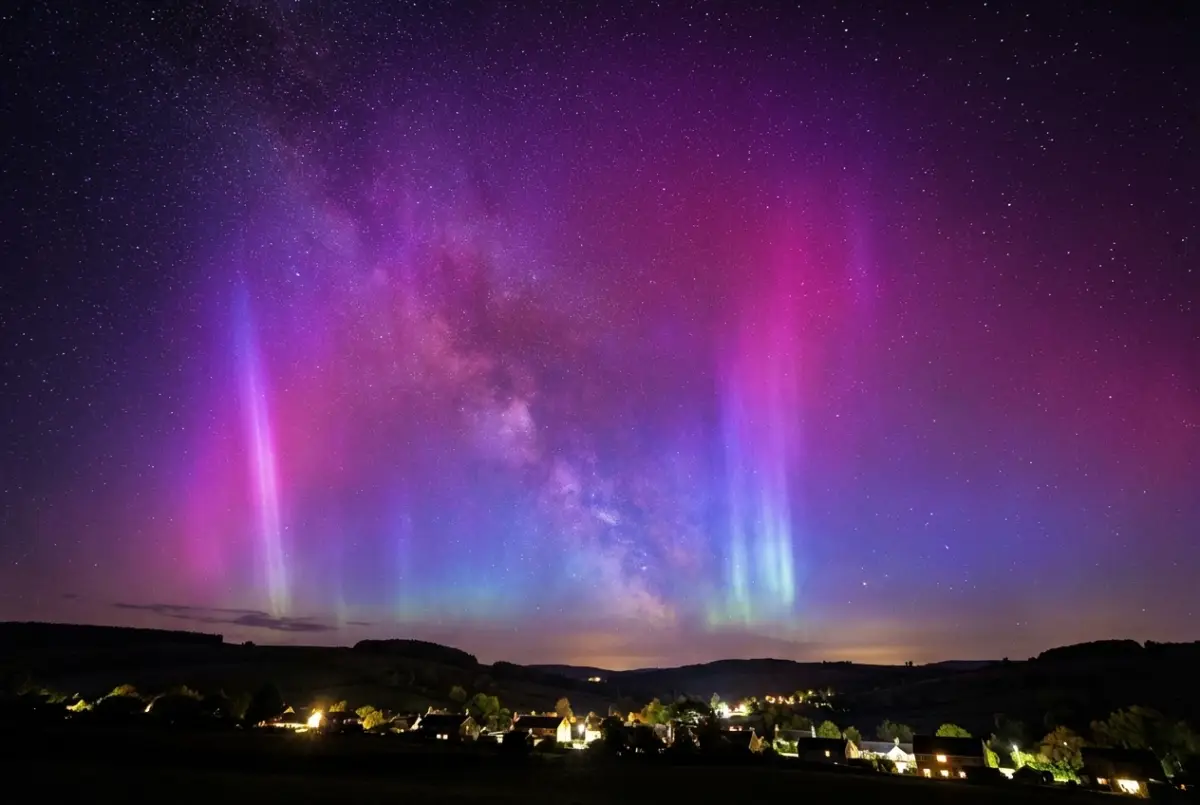
By around 11 p.m., it became clear that something rare was happening in Earth’s atmosphere. The aurora—normally confined to the Arctic, where it dances in green curtains above ice and snow—had traveled thousands of kilometers south. Here, however, it looked different. Instead of its familiar green tones, the aurora at lower and mid-latitudes revealed deep purples, pinks, and shades of violet.
This striking difference has a physical explanation. When an especially powerful stream of charged particles from the Sun collides with Earth’s magnetic field, those particles can penetrate deeper into the atmosphere or interact with oxygen and nitrogen at very high altitudes. At those heights, nitrogen and oxygen emit red and purple light—the same hues that lit up the sky that night. It was as if a colossal neon lamp had been switched on above the planet.
Around midnight, the display reached its peak. The sky seemed to open. Vertical columns of violet light rose toward the zenith, merging into a luminous crown overhead. Colors flowed continuously: soft pinks deepened into rich purples, occasionally sliced by pale, shimmering streaks of white. This was not chaos, but a slow, majestic rhythm—like breathing. Waves of light traveled from the horizon toward the center of the sky, as though an invisible artist were calmly painting on a black canvas.
People’s reactions were remarkably similar, no matter where they stood. In cities where light pollution usually hides the stars, the aurora was powerful enough to overpower artificial lighting. Cars slowed and stopped. Drivers pulled over, stepped out, and simply looked up. People gathered in yards, on balconies, and on rooftops. Voices dropped to whispers. The scale of the moment seemed to silence everyone at once.
What made the experience even more surreal was the silence. We associate powerful natural events—thunderstorms, hurricanes, fireworks—with sound. This time, the entire sky was alive and moving, yet everything unfolded in complete quiet. The contrast intensified the sense of unreality. Colored waves collided without a sound; towering pillars of light rose and faded in absolute stillness.
For photographers and casual observers alike, the night became a kind of test. Cameras and modern sensors captured a broader color range than the human eye, making the sky appear even more dramatic—almost fiery red—in photographs. Yet even without a lens, the view was unforgettable. White and purple bands were so distinct that their reflections could be seen on water surfaces and in building windows.
Equally remarkable was how this event connected distant places. In the Alps, along the Florida coastline, in the mountains of Georgia, and across the plains of Germany, people were looking at the same sky. Normally, these regions exist in very different astronomical realities. That night, a geomagnetic storm placed them all beneath a single, shared spectacle.
By around 3 a.m., the intensity began to fade, though the sky retained its unusual glow. The auroral columns grew more diffuse, and the colors softened. What had once been sharp lines transformed into gentle, luminous clouds that slowly dissolved into the blue of the night. People who had stood outside for hours, despite the cold, were reluctant to go indoors. There was a lingering sense that looking away meant missing something important.
This surge in solar activity is part of a natural cycle that repeats over time, though events of this scale and geographic reach are rare. That night, Earth’s atmosphere became a screen, transforming solar energy into visible light. It was a reminder that our planet drifts through a cosmic ocean, constantly connected to its star.
As the eastern sky brightened and the first rays of morning appeared, the purple glow finally disappeared. Dawn reclaimed its familiar blues and golds. Cities woke up, traffic resumed, and daily routines returned. Yet in memory—and in countless digital archives—the night remained: a moment when the laws of physics and space weather briefly turned an ordinary landscape into something magical.
By morning, the world looked the same. But anyone who had looked up that night knew the space above Earth is far more alive, colorful, and dynamic than it seems at first glance. Nature quietly added another vivid page to its long story—then calmly returned to its usual rhythm.
Go backComments (0)
From This Author
Select Crypto to Support the Author 💫
×TXintEE7aezp6QxNNtbghCXvmXJdgofEyr
0x9c6299454A6B617A0Db228024279F2a3EEf956dD
bc1qj7caz3xfh5qd4ud3v3nh7k4tfl5lg8jh9er73e
0x9c6299454A6B617A0Db228024279F2a3EEf956dD
3TndfWAhPytTaBZjC2GbNWqh9iWx171SYACjbG2j5vx8
DHsrtwiL56Xk1xAj3fe8pVcfLhE8xgt3EQ
0x9c6299454A6B617A0Db228024279F2a3EEf956dD
UQDFkubJxb8KmxFmy1arJxkewzmNEg6-G2pJFVzFihB65d7W
ltc1q3fentl6ur9cxm0vxyqkdmmzxkj92j00p9l8m7z
✍ Article Author
- Registration: 26 July 2025, 19:34
- Location: Georgia