




Clouds That Never Move: The Phenomenon of Lenticular Clouds
 Tornike Moss
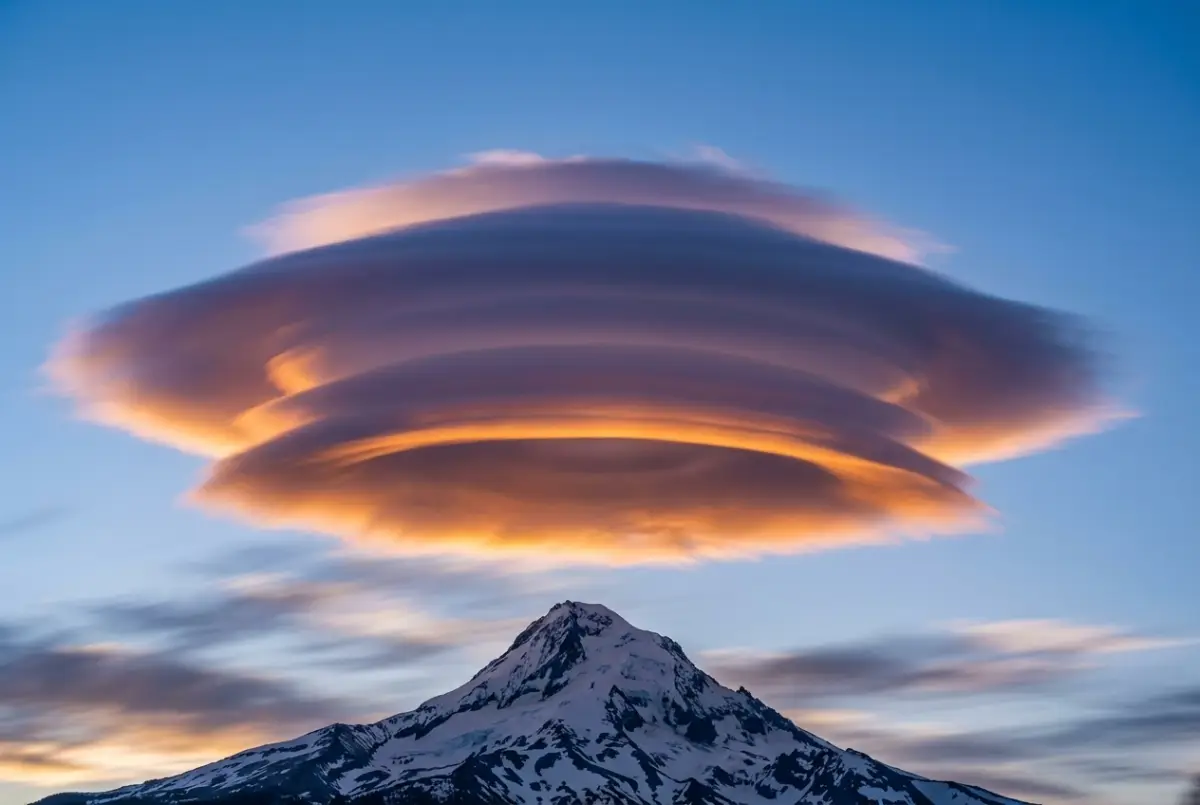
High in the mountains, when strong winds race through valleys and bend treetops toward the ground, the sky often presents a strange spectacle. Below, everything is in motion — grass ripples, dust swirls, and ordinary clouds slide quickly across the sky, as if fleeing from something unseen. Yet, if you lift your gaze a little higher, toward the peaks, you may notice something that defies this chaos. There, suspended above the mountain ridge, hangs a white shape that appears perfectly still. It resembles a giant plate, a stack of smooth lenses, or even a spacecraft from an unknown civilization that has decided to park in midair.
This is a lenticular cloud — one of nature’s most refined and, at the same time, most paradoxical creations. Encountering it for the first time is often disorienting. We are accustomed to thinking of clouds as shapeless, fluffy, and constantly moving. This one is different. It has sharp, smooth edges, as if meticulously sculpted from ice or marble. It does not drift with the wind or change its form, even though we know that winds at that altitude are far stronger than those at ground level. It stands like a silent sentinel, seemingly indifferent to the atmospheric turmoil unfolding around it.
The reason this cloud appears so stubbornly stationary lies not in its weight, but in the peculiar behavior of the air itself. A lenticular cloud is visible proof of an invisible process happening right before our eyes. Imagine a fast-flowing river with a large rock embedded in its bed. Water rushes toward the rock, flows over it, and forms a standing wave just downstream. The water itself never stops moving, but the wave remains fixed in the same position — anchored by the rock.
A similar process takes place in the atmosphere. When strong, moisture-rich winds collide with a mountain range, the air is forced upward. After crossing the ridge, the airflow begins to oscillate in waves. As air rises to the crest of one of these waves, its temperature drops, moisture condenses, and a cloud forms. As the air sinks into the trough of the wave, it warms, and the cloud dissipates. What we perceive as a stationary object is, in reality, a continuous cycle of formation and disappearance. Wind races through the cloud at great speed — entering at the front and exiting at the back — while the cloud itself remains fixed at the peak of the atmospheric wave, much like the standing wave behind the rock in the river.
This mechanism creates the striking visual effect that can hold our attention for hours. Lenticular clouds often appear layered, stacked like a pile of plates. Their surfaces are so smooth that sunlight reflects off them in remarkable ways. During the day, they glow white against the blue sky. At sunset, they transform into a spectacle of color. As the sun sinks toward the horizon, these “plates” shift from gold to deep orange and finally to rich shades of purple. Because they form at high altitudes, they catch the sunlight long after lower clouds have fallen into shadow, glowing like luminous sculptures against the darkening sky.
It is no surprise that throughout history — and even today — lenticular clouds have been the source of myths and misunderstandings. Their symmetrical, almost engineered appearance makes them ideal candidates for UFO sightings. Many photographs of so-called unidentified flying objects circulating online are, in fact, lenticular clouds. It can be hard to believe that wind and water vapor alone can produce shapes so precise that they resemble something designed by human hands. Yet nature, governed by the laws of physics, often proves to be a far more accomplished architect than we imagine.
Despite their calm and poetic appearance, these clouds are viewed very differently by those who work in the sky. For pilots, a lenticular cloud is not a symbol of beauty but a warning sign. It indicates strong atmospheric turbulence — powerful vertical air movements that can shake an aircraft violently beyond the cloud’s serene exterior. For this reason, aviation treats them with caution and respect. Experienced mountaineers tell a similar story. The appearance of a “cap” cloud over a peak often signals worsening weather, strengthening winds, or an approaching storm. What looks like a peaceful sculpture from the valley can be a sign of nature’s unrest for those closer to the summit.
For those of us standing safely on the ground, however, lenticular clouds often symbolize calm. There is something hypnotic about the way they maintain their form for hours, sometimes even days. They do not disperse or dissolve, only subtly changing size or color as the light shifts. It feels as though time itself has paused at a single point in the sky. Often, the same mountain ridge produces lenticular clouds again and again, as if the mountain has been assigned its own personal cloud — a loyal companion hovering above it.
In the end, lenticular clouds remind us that the world is not always what it seems at first glance. Stillness can be the result of immense speed, and silence can be the balance of invisible motion. The next time you find yourself in the mountains and spot a perfectly shaped white “plate” hanging motionless in the sky, don’t think of alien worlds. This is our own planet at work — painting with wind, mountains, and light. And the image it creates reveals just how much harmony can emerge from apparent chaos. All we need to do is pause, look up, and observe.
Go backComments (0)
From This Author
Select Crypto to Support the Author 💫
×TXintEE7aezp6QxNNtbghCXvmXJdgofEyr
0x9c6299454A6B617A0Db228024279F2a3EEf956dD
bc1qj7caz3xfh5qd4ud3v3nh7k4tfl5lg8jh9er73e
0x9c6299454A6B617A0Db228024279F2a3EEf956dD
3TndfWAhPytTaBZjC2GbNWqh9iWx171SYACjbG2j5vx8
DHsrtwiL56Xk1xAj3fe8pVcfLhE8xgt3EQ
0x9c6299454A6B617A0Db228024279F2a3EEf956dD
UQDFkubJxb8KmxFmy1arJxkewzmNEg6-G2pJFVzFihB65d7W
ltc1q3fentl6ur9cxm0vxyqkdmmzxkj92j00p9l8m7z
✍ Article Author
- Registration: 26 July 2025, 19:34
- Location: Georgia