



A Night When Meteors Fell Like Rain: A Celestial Performance in Silence
 Tornike Moss
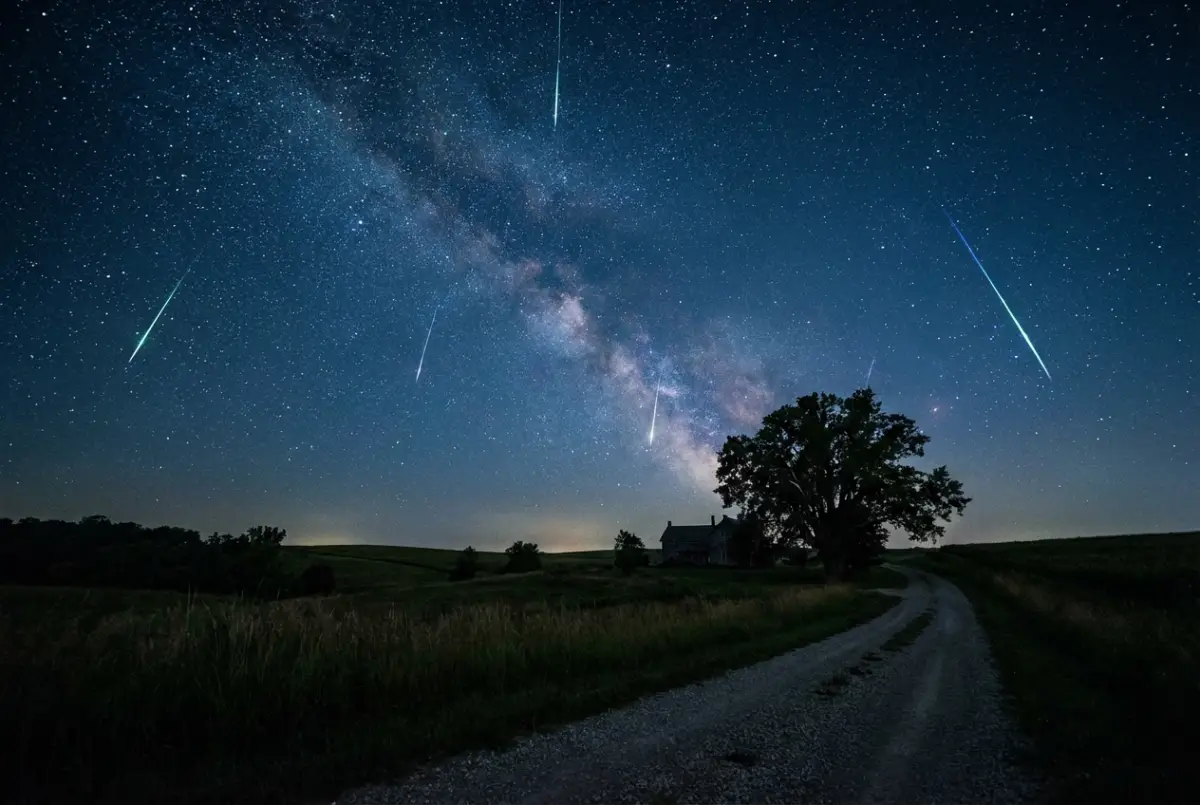
Far from city lights, where asphalt ends and a gravel road dissolves into tall grass, night becomes something else entirely. It is not merely the absence of light. It feels physical—dense, almost tangible—pressing gently on your shoulders and urging you to lower your voice. The car engine has long been turned off, its metallic ticking faded away, leaving only space behind. At first, your eyes resist the darkness. It feels thick enough to touch. But slowly, minute by minute, the sky begins to open.
This is not the sky we know from beneath streetlamps. This is depth without limits, where stars do not simply shine but appear suspended against black velvet. The Milky Way stretches faintly from horizon to horizon, a pale, milky band, as if someone dragged a careless brush across the dome of the universe. The silence is so profound that even your own breathing feels intrusive. You stand there, head tilted back, waiting. The air carries a strange tension, as though nature itself is holding its breath in anticipation of something important. A cold breeze moves past you, but you hardly notice. Your attention is fixed upward, where nothing seems to happen—yet—beyond the calm flicker of distant stars.
Then it happens.
A faint flash catches the corner of your eye—so fast you question whether it was real. You turn your gaze, but the sky is already empty again. Minutes pass. Silence returns. And suddenly, a sharp white line slices through the darkness, as if an invisible blade has cut across the sky. It leaves a fleeting trace that vanishes almost instantly.
“One,” you count silently.
Your body tenses. Your vision widens, trying to take in the entire sky at once.
Gradually, the rhythm changes. What first felt like coincidence begins to reveal a pattern. Another streak appears—longer, brighter. Then another. And another. The sky seems to awaken. This is no longer a static image; it is motion. Meteors appear more frequently now, some alone, some in pairs, some in clusters, as if racing each other across the darkness. What we poetically call a “meteor shower” begins—though on this night, even that phrase feels inadequate. It looks less like falling stars and more like rain—rain made of light, silently pouring toward Earth but never reaching the ground. From every direction, luminous arrows fly inward, creating the illusion that we are standing at the center, while the universe hurls sparks toward us.
But what is this “rain,” really?
As you watch, immersed in its beauty, it is hard to believe that this spectacle has nothing mystical about it. In reality, this is cosmic archaeology. Imagine an ancient traveler—a comet—wandering through the solar system. Made of ice and rock, it begins to melt as it approaches the Sun, shedding debris along its path: dust, grains of sand, tiny stones. These remnants remain suspended in space like footprints in fresh snow. And Earth, in its annual journey around the Sun, crosses these trails once—or sometimes several times—a year.
Our planet, like a massive spacecraft, plows into these clouds of debris at extraordinary speed. What we see in the sky is the moment of encounter. These particles—most no larger than grains of sand—slam into Earth’s atmosphere at tens of kilometers per second. The atmosphere, our invisible shield, resists them. The friction is so intense that the air in front of the particles ignites, and the grains are instantly incinerated. What we witness is not the rock itself, but a glowing channel of superheated air—their final struggle, their swan song rendered in light. They do not fall. They dissolve, so that we may see.
The act of watching becomes all-consuming. Time loses meaning. You cannot tell whether an hour has passed or three. Conversations fade away. Politics, work, everyday worries—everything recedes into irrelevance. Only brief exclamations break the silence: “Did you see that one?” “That was huge!” All eyes remain fixed on the same point in the sky, where the stream seems to originate. Occasionally, a so-called bolide appears—a particularly large meteor, blazing as brightly as Venus. It leaves behind a smoky trail that lingers for seconds, sometimes tinted with color: green, yellow, or blue, depending on the chemical elements it carries. Magnesium burns green. Sodium adds yellow hues. It is a chemistry lesson written not on a chalkboard, but across the night sky.
There is something deeply paradoxical about this experience. Cinema and science fiction have trained us to associate meteors with catastrophe—fiery objects obliterating cities, triggering tsunamis, ending civilizations. But here, in the real night, the truth is the opposite. This is not apocalypse. It is ballet. There is no noise, no thunderous explosions—except in extremely rare cases. Only a silent choreography of light. Fear feels out of place. It is replaced by awe and calm. You realize that Earth absorbs tons of this material from space every single day, gently, harmlessly. The atmosphere transforms potential danger into visual art. It is a reminder that natural processes—even those involving combustion and destruction on a microscopic scale—are part of a larger harmony.
As the night deepens, your sensations shift. Your neck aches from looking up. The cold seeps through your clothes. Yet you cannot look away. You are afraid that if you blink, you will miss the best moment. Slowly, though, the intensity fades. The meteors that once fell like rain become sporadic. The sky calms again, as if exhaling. Stars return to their familiar stillness. But something remains with you—the sense that you have been allowed to witness a secret. This specific stream, these specific particles, formed billions of years ago at the dawn of the solar system, have ended their journey here, before your eyes. This exact image will never happen again. Next year, Earth will pass through the same region of space, but it will be different dust, a different rain, a different performance.
When the eastern sky begins to lighten and the stars slowly fade, what remains is gratitude. Nothing dramatic occurred. No heroes emerged, no tragedies unfolded. Yet something far more meaningful took place—a brief alignment with the cosmic rhythm. A meteor shower reminds us that we do not live sealed inside a glass dome. We inhabit a planet in constant motion, crossing paths, brushing against the remnants of other worlds, endlessly interacting with the surrounding universe.
This rain of light teaches us that it is always worth looking up, even at the cost of a stiff neck. It reminds us that darkness always holds light, waiting for the moment it meets our atmosphere and ignites. And when you finally get back into the car and turn toward the city, you carry no photographs—phones are nearly useless here—but something far more lasting: calm, and the quiet certainty that for one night, the universe danced just for you. The sky, once a mere backdrop, has become the main character—a living, breathing presence that briefly revealed its secret.
Go backComments (0)
From This Author
Select Crypto to Support the Author 💫
×TXintEE7aezp6QxNNtbghCXvmXJdgofEyr
0x9c6299454A6B617A0Db228024279F2a3EEf956dD
bc1qj7caz3xfh5qd4ud3v3nh7k4tfl5lg8jh9er73e
0x9c6299454A6B617A0Db228024279F2a3EEf956dD
3TndfWAhPytTaBZjC2GbNWqh9iWx171SYACjbG2j5vx8
DHsrtwiL56Xk1xAj3fe8pVcfLhE8xgt3EQ
0x9c6299454A6B617A0Db228024279F2a3EEf956dD
UQDFkubJxb8KmxFmy1arJxkewzmNEg6-G2pJFVzFihB65d7W
ltc1q3fentl6ur9cxm0vxyqkdmmzxkj92j00p9l8m7z
✍ Article Author
- Registration: 26 July 2025, 19:34
- Location: Georgia