




The Lake That Changes Color: Seasonal Transformations Beneath the Surface
 Tornike Moss
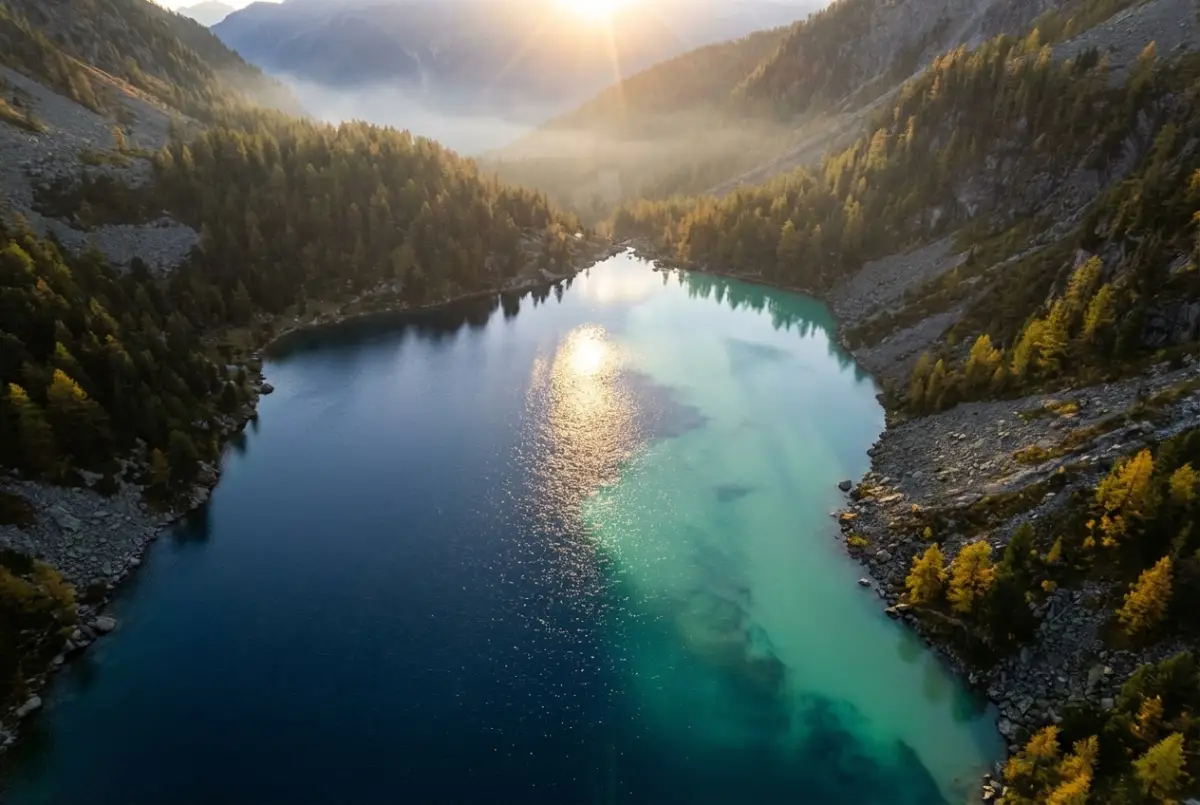
From a balcony or the shoreline, the view often feels unchanged: morning mist rising like a milky veil, followed by the first sunlight turning the water into a mirror. A lake seems like the most stable element of any landscape—the most immobile. Trees grow and shed their leaves, mountains disappear into clouds, but the lake appears constant: blue, calm, unyielding. We grow accustomed to thinking of water as colorless, or at best, a reflection of the sky. We stand at the edge, listening to the gentle rhythm of small waves, convinced this scene is timeless—that water has no color of its own beyond what the world lends it.
And then time passes—weeks, perhaps entire seasons—and you return to the same place. At first, your eyes resist what they see. The deep blue or steel-gray you remember is gone. The water no longer behaves like a mirror; it now seems to glow from within. This is not the sky reflected back at you. It is a dense turquoise, or a rich emerald green, as if the color rises from the depths themselves. You watch sunlight slide across this transformed surface and begin to doubt your perception. Is the light different? Are the clouds creating an illusion? But the sky is clear, the sun unchanged. The transformation lies in the water—its structure, its inner “breath.” The lake that was blue yesterday is green today, and tomorrow it may turn milky white.
So what is really happening beneath this calm surface?
Nature is painting here, using light as its brush and microscopic life and minerals as its pigments. When we see a lake’s color, we are witnessing an intricate dance of chemistry and physics—so seamless it feels like magic. No complex equations are required to understand the essential truth: water responds to its environment like a living organism.
Often, these sudden shifts toward green or turquoise are caused by invisible inhabitants—phytoplankton and algae. As sunlight strengthens and water temperatures rise, these microscopic organisms multiply. They contain chlorophyll, just like land plants, and convert sunlight into energy. Imagine billions of tiny particles suspended in the upper layers of water, forming a living veil that gives the lake its emerald hue. In other cases, the color change is driven by minerals. Meltwater flowing down from mountains often carries fine rock particles known as “glacial flour.” These grains are so light that they remain suspended rather than sinking. When sunlight strikes this milky water, a remarkable effect occurs: most of the light spectrum is absorbed, while blue and turquoise wavelengths are reflected back. The result is an almost unreal brightness, as if the lake were digitally enhanced.
But color does not exist only in particles—it lives in depth as well. Light travels through water, and the deeper a lake is, the more filters sunlight must pass through. Water absorbs reds and yellows first, leaving blue behind. The effect resembles a giant prism. Near the shore, water may appear clear or sandy-toned, but as the bottom drops away and depth increases, the color deepens and intensifies. These are the lake’s dark blue or near-black zones, where light can no longer reach the bottom to reflect back. What remains is the endless blue of water itself—dense, weighty, and mysterious.
The most striking changes, however, are seasonal. A lake is never the same throughout the year.
In spring, as ice melts and fresh streams rush down from the mountains, the lake awakens. The water is often cloudy, milky-turquoise, rich with minerals and new life. It is the color of renewal—vivid and energetic—standing in contrast to still-gray shores.
Summer tells a different story. The sun stands high, light penetrates to its maximum depth, and life reaches its peak. If algae bloom, the lake may resemble a green meadow reflecting drifting clouds. If the water remains clear, it takes on a deep, saturated sapphire tone. A summer lake is confident and full, embodying abundance.
Autumn brings calm. As temperatures drop and microorganisms die off or sink, the water often becomes crystal clear. The lake turns into a flawless mirror, reflecting forests ablaze in yellow and red. Water and foliage merge into a palette of gold and copper. This is a season of quiet and reflection, when the lake feels lighter, more transparent.
Winter, if the lake does not freeze, strips color down to steel gray and dark slate. The sky hangs low, light is weak, and the water seems withdrawn—severe and distant. If ice forms, an entirely new spectrum appears: whites and blues, cracks in the ice, snow layered on top.
Those who witness these transformations rarely hide their amazement. People standing on the shore try to capture the color with cameras, but technology often fails. “Is this real?” they ask. There is something hypnotic in the way nature changes its scenery. At times, this inspires myths—stories of creatures or spirits beneath the surface, painting the water at will. Yet reality is no less enchanting. This is not magic; it is motion. Scientific explanation does not diminish the romance of the phenomenon—it enhances it, revealing how deeply interconnected everything is: the angle of the sun, a grain of stone, a single cell, and the human eye.
Perhaps the most important lesson these shifting colors teach is impermanence. You can never step into the same-colored lake twice. Today’s turquoise may vanish tomorrow, carried away by wind, cloud cover, or the turning of the season. This beauty matters precisely because it is fleeting. It is not a frozen painting on a museum wall, but a performance unfolding only here, only now.
As you leave the lake behind, you carry the realization that nature is not a static backdrop to human life. It breathes, adapts, responds. The changing color is not an anomaly—it is the lake’s language, speaking of seasons, weather, and hidden depths. It reminds us that stability is an illusion, and change is life’s only constant. And when you return again, you must be ready for a new encounter—because the lake you left behind will greet you in different colors, ready once more to surprise you with its transformation.
Go backComments (0)
From This Author
Select Crypto to Support the Author 💫
×TXintEE7aezp6QxNNtbghCXvmXJdgofEyr
0x9c6299454A6B617A0Db228024279F2a3EEf956dD
bc1qj7caz3xfh5qd4ud3v3nh7k4tfl5lg8jh9er73e
0x9c6299454A6B617A0Db228024279F2a3EEf956dD
3TndfWAhPytTaBZjC2GbNWqh9iWx171SYACjbG2j5vx8
DHsrtwiL56Xk1xAj3fe8pVcfLhE8xgt3EQ
0x9c6299454A6B617A0Db228024279F2a3EEf956dD
UQDFkubJxb8KmxFmy1arJxkewzmNEg6-G2pJFVzFihB65d7W
ltc1q3fentl6ur9cxm0vxyqkdmmzxkj92j00p9l8m7z
✍ Article Author
- Registration: 26 July 2025, 19:34
- Location: Georgia