




The Wind That Makes Music: Natural Sounds Among Rock and Sand
 Tornike Moss
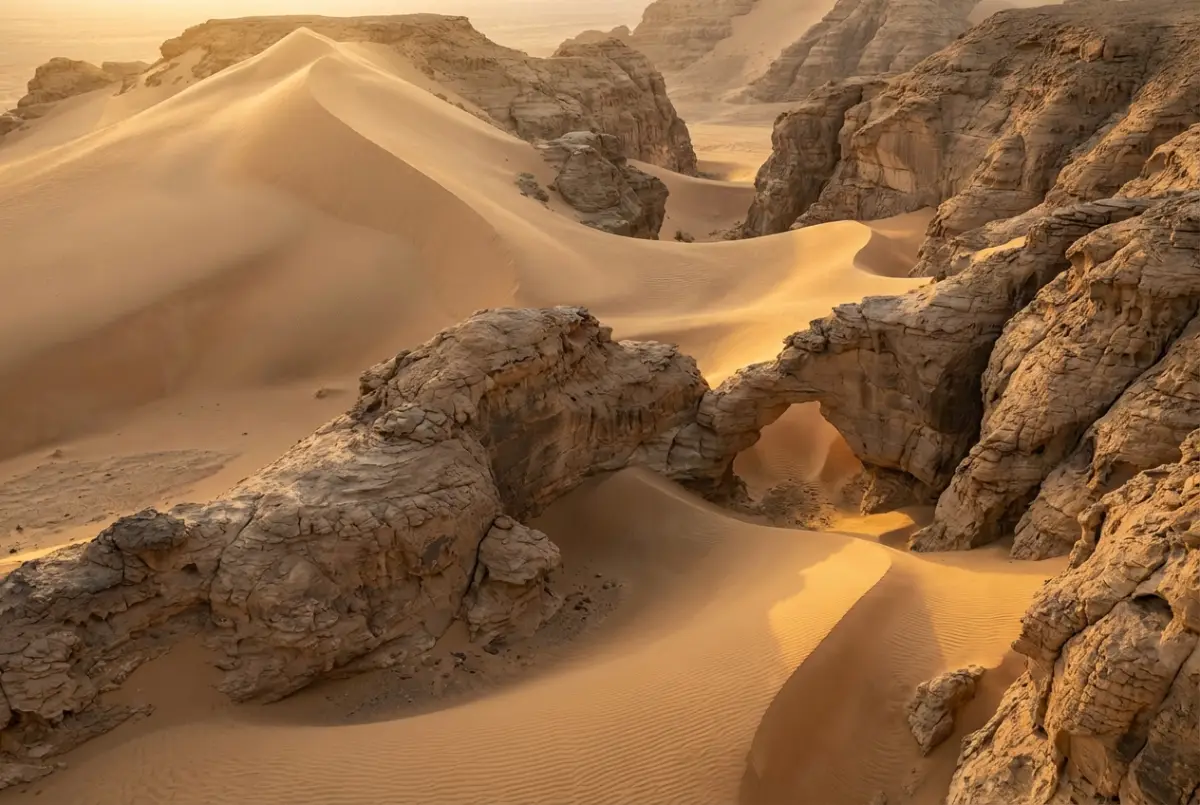
Here, where the noise of civilization faded long ago and the horizon belongs only to sand dunes and weathered rock, silence at first feels absolute. It is the kind of silence that presses against your ears, as if the world’s volume switch has been turned off. You stand at the base of a massive dune or at the mouth of a narrow rocky canyon and sense only heat and wind. At this stage, the wind is still just a physical phenomenon—moving air that brushes your face, tangles your hair, and scatters grains of sand around your feet. It has no voice yet, apart from the faint rustle of fabric. Invisible, bodiless, seemingly mute. But this is only an introduction, a pause before a concert that can begin at any moment.
Then, without warning, something changes.
It is not a sharp sound, not an explosion or a cry. It is a low vibration, barely audible, felt more in the body than in the ears. You stop and look around. The first instinct is rational: perhaps a distant aircraft? Maybe underground movement? But the sky is empty, and the ground beneath your feet is still. The sound grows stronger—a deep, monotonous hum suspended in the air. It resembles nothing familiar: not an animal, not running water. This is nature’s bass note, coming from nowhere and everywhere at once. You search for its source, turning slowly, but the sound is not localized. It belongs to the landscape itself.
As the wind gains speed or shifts its angle, the terrain gradually transforms into a true orchestra. If you listen closely, you realize the wind is no longer just passing through—it is performing. Like a skilled musician, it touches its instruments with precision. Desert dunes begin to emit a strange, droning chant, while narrow rock fissures release thin, piercing whistles. This is no longer random noise. There is tone, pitch, and intensity. The wind, once felt only on the skin, has become sound because it has encountered resistance—rock, stone, grains of sand—and forced them to “sing.”
What is actually happening during this seemingly magical symphony?
If we set aside mysticism and look to physics, we find that nature follows the same principles humans use when building musical instruments. Aeolian sounds—the scientific term for wind-generated tones—emerge when moving air collides with an obstacle. Think of a flute: a musician blows air through a narrow opening, the air vibrates, and sound is born. A rocky canyon, in essence, is a colossal natural flute. When wind strikes a crack, opening, or cave at just the right angle, the column of air begins to resonate. The rock is not merely stone; it is a resonator—a body that amplifies and shapes sound. What we hear is not the wind itself, but the rock’s response to it.
Among the most striking phenomena is that of the so-called “singing sands.” This is not metaphor but a real acoustic event, documented in only a few dozen locations worldwide. When wind blows across a sandy slope—or even when a person walks across it—billions of grains move simultaneously. The secret lies in their shape and size. The grains must be perfectly rounded and polished so that, when rubbing against one another, they produce not a rustle but a low-frequency vibration. The sound resembles the deepest note of a cello or the hum of an old aircraft engine. It rises from the ground and travels through the entire body. The dune feels like a living organism, sighing, telling its story in a baritone voice.
In rocky landscapes and canyons, the music is different—more varied and unpredictable. Here, sound depends on geometry. Narrow, sharp rock formations create high, cutting whistles that sometimes resemble human cries or birdsong. Wide, deep caves generate echoes that multiply, twist, and reshape sound. You may hear a kind of natural polyphony: a low drone from the canyon floor paired with a high soprano drifting from cliff edges. The acoustics are so refined that even the finest concert halls might envy them. Sound travels, bends around corners, and creates auditory illusions, as if the music itself is moving around you.
A person encountering this phenomenon for the first time often experiences a strange mix of emotions. Initially, there may be fear—a subconscious alarm, because our brains expect sound to come from living beings or machines. When you realize the sound originates from lifeless matter, fear gives way to a sense of reverence. Soon after comes calm and wonder. You stand still, close your eyes, and simply listen. You try to catch the rhythm, the melodic line. At times, it feels like genuine music, a composition with a beginning and an end—though in reality, it is a play of chaos and physics. This is the moment when a human feels not like a ruler of nature, but a member of its audience.
It is no surprise that for centuries people attributed these sounds to supernatural forces. Desert travelers heard the voices of spirits or the bells of buried cities in singing dunes. In rocky valleys, wind-whistles were believed to be conversations of gods or chants of the dead. Ancient Greeks imagined the wind god Aeolus playing his harp. Today, we understand the science—turbulence, frequency, friction—but this knowledge does not diminish the magic. On the contrary, realizing that simple sand and stone can produce sound makes the world even more extraordinary. It reminds us that matter is not silent; it has a voice, if touched in the right way.
Yet the most important aspect of this experience is its impermanence. This music is never recorded and never repeated. A slight shift in wind direction or a drop in speed is enough for the orchestra to fall silent. The dune stops humming. The rock stops whistling. The sound disappears as suddenly as it appeared, leaving behind a silence that now feels deeper, heavier. This transition—from sound back into silence—is often what lingers most vividly in memory. You stand there, waiting for the performance to resume, but nature takes no requests. It plays only when conditions are perfect.
When you finally leave, you carry a new understanding with you. You realize that our planet is not a quiet backdrop to human life. It has its own acoustics, its own language, its own songs—requiring no electricity or speakers. The wind, this invisible conductor and performer, uses the landscape as a vast instrument. Cliffs, canyons, and dunes become nature’s flutes, drums, and violins. And we, as humans, are merely passing listeners—sometimes lucky enough to witness this grand, invisible concert beneath the open sky.
Go backComments (0)
From This Author
Select Crypto to Support the Author 💫
×TXintEE7aezp6QxNNtbghCXvmXJdgofEyr
0x9c6299454A6B617A0Db228024279F2a3EEf956dD
bc1qj7caz3xfh5qd4ud3v3nh7k4tfl5lg8jh9er73e
0x9c6299454A6B617A0Db228024279F2a3EEf956dD
3TndfWAhPytTaBZjC2GbNWqh9iWx171SYACjbG2j5vx8
DHsrtwiL56Xk1xAj3fe8pVcfLhE8xgt3EQ
0x9c6299454A6B617A0Db228024279F2a3EEf956dD
UQDFkubJxb8KmxFmy1arJxkewzmNEg6-G2pJFVzFihB65d7W
ltc1q3fentl6ur9cxm0vxyqkdmmzxkj92j00p9l8m7z
✍ Article Author
- Registration: 26 July 2025, 19:34
- Location: Georgia