

The Architecture of Anticipation: Why We Can’t Look Away as the Blue Bar Fills
 Tornike Moss
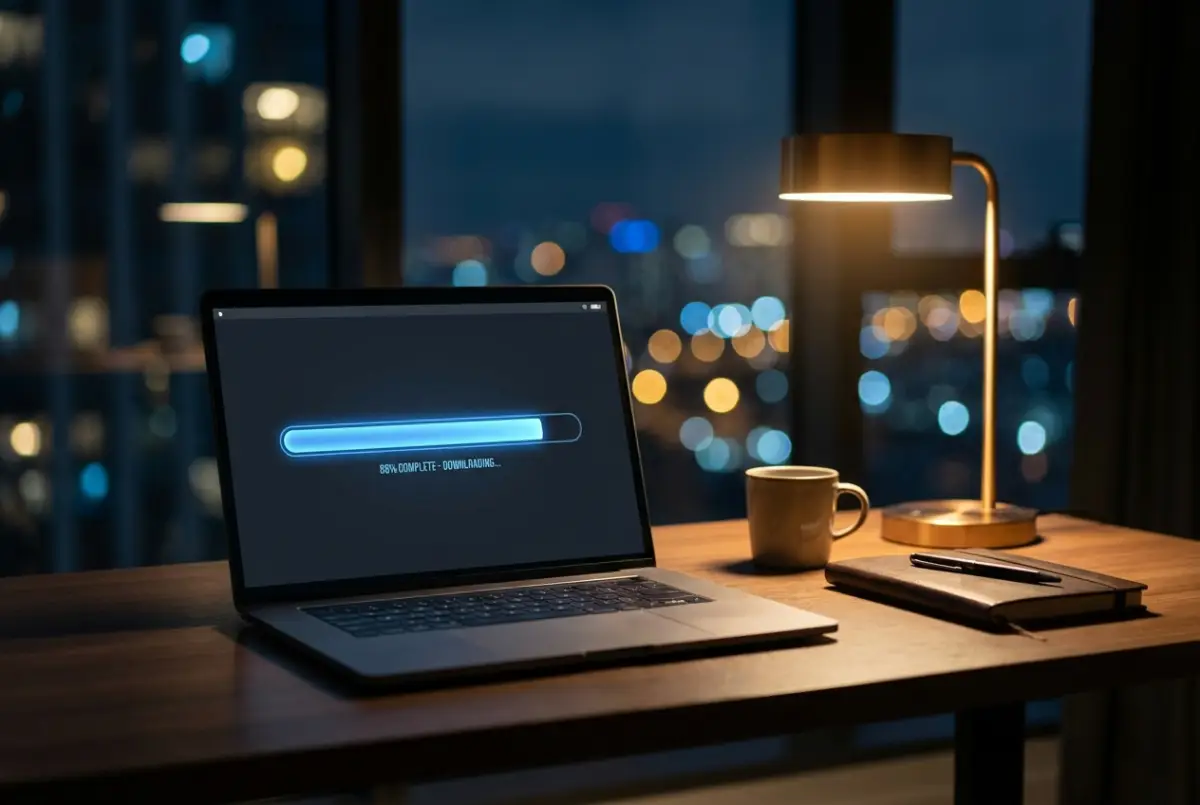
Think back to the last time you downloaded a large file or installed a system update. The screen dimmed slightly, the world seemed to pause, and then it appeared—a thin, rectangular shape slowly filling with color. You know perfectly well that staring at it won’t make the process faster. You know you could stand up, make coffee, or look away entirely. And yet you stay, watching, as if your gaze itself were the fuel pushing this digital train toward the finish line.
This strange fixation isn’t just boredom. It’s a deep psychological response to uncertainty—a kind of lifeline thrown into the ocean of the unknown. That lifeline has a name: the progress bar.
In an era where everything is expected to happen instantly—and “right now” already feels late—waiting has become our greatest enemy. Paradoxically, however, that slowly filling bar gives us a sense of calm we rarely experience in real life. Picture a traffic jam in the city: you don’t know when you’ll move, how far you’ve come, or how much is left. That uncertainty breeds anxiety. The digital world, by contrast, offers something philosophers have dreamed of for centuries—time made visible, and the illusion of control.
When we see an update reach 34%, the brain releases a small dose of dopamine. It recognizes progress. Movement. Evolutionarily, that signals safety: something is happening, the process is alive—even if, in reality, the computer might simply be “thinking” or quietly stuck in the background. The bar reassures us that chaos is being transformed into order.
Here lies one of UX psychology’s cleverest tricks. We hate uncertainty, but we’re willing to forgive a little deception if it’s elegantly presented. Notice how progress bars often move quickly at first, slow down in the middle, and then stretch endlessly at 99%. This isn’t a technical flaw—it’s a design language. Humans don’t believe in linear progress; we believe in narrative. A strong beginning, a difficult middle, and a long-awaited finale. The bar tells a story. It promises that disorder will soon resolve itself, and, most importantly, it feeds our obsession with completion.
The human brain dislikes unfinished business. Psychologists call this the Zeigarnik effect—the reason incomplete tasks linger in our minds. In an age of infinite scrolling, where social feeds never end and emails never truly disappear, the progress bar stands out as one of the few digital experiences with a real, tangible ending. A file download will eventually reach 100%. And when it does—when that small green “Completed” appears—we feel a fleeting sense of victory. Something, at least, is finished. Something today has reached a conclusion.
Ultimately, our affection for this simple graphic reveals how desperately we crave structure in an overstimulated world. The progress bar is a form of digital meditation—a temporary truce between human and machine, where both sides agree that patience is required for a result. It shows us that time isn’t just an abstract concept, but a space that can be filled with color, pixels, and hope.
So the next time you find yourself unable to look away from that slowly moving blue bar, don’t assume you’re wasting time. Pause for a moment and ask yourself: what are you really waiting for—the file to open, or that rare and satisfying instant when everything finally falls into place?
Go backComments (0)
From This Author
Select Crypto to Support the Author 💫
×TXintEE7aezp6QxNNtbghCXvmXJdgofEyr
0x9c6299454A6B617A0Db228024279F2a3EEf956dD
bc1qj7caz3xfh5qd4ud3v3nh7k4tfl5lg8jh9er73e
0x9c6299454A6B617A0Db228024279F2a3EEf956dD
3TndfWAhPytTaBZjC2GbNWqh9iWx171SYACjbG2j5vx8
DHsrtwiL56Xk1xAj3fe8pVcfLhE8xgt3EQ
0x9c6299454A6B617A0Db228024279F2a3EEf956dD
UQDFkubJxb8KmxFmy1arJxkewzmNEg6-G2pJFVzFihB65d7W
ltc1q3fentl6ur9cxm0vxyqkdmmzxkj92j00p9l8m7z
✍ Article Author
- Registration: 26 July 2025, 19:34
- Location: Georgia