




The Rocks That Turn Golden at Dawn: The Secret of the Sun’s Angle
 Tornike Moss
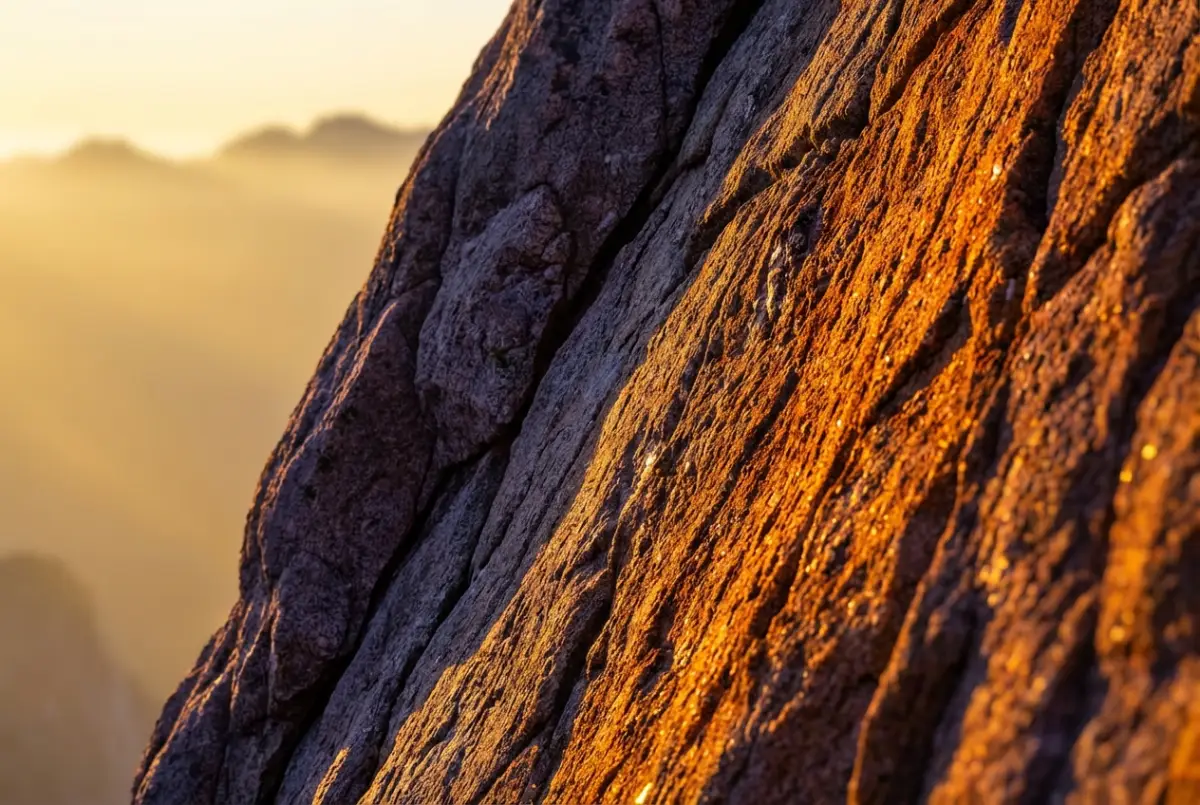
Mountains do not sleep at night—they simply lose their color. By four or five in the morning, when the air is still saturated with nocturnal cold and the silence is so deep you can hear your own breathing, a rocky landscape resembles a heap of gray monoliths. The world feels almost two-dimensional: shadows are vague, contours blurred, and stone—shaped over millions of years—seems reduced to lifeless scenery. Yet this static scene is only a prelude to the dramatic transformation brought by the Sun’s first rays. The moment light appears on the horizon, physics and geology conspire to produce a spectacle: cold, gray rock changes character in seconds and begins to glow, as if fire has ignited within it. This is the moment when cliffs turn gold.
Many of us have seen this sight in photographs or films, but few pause to consider that what we call a “beautiful view” is, in fact, the result of complex optical and atmospheric processes. The mountain does not change color; the stone remains the same. What changes is the long, intricate journey light takes through the layers of the atmosphere.
The key to the phenomenon lies in the Sun’s angle. At midday, when the Sun stands high, its rays pass through the atmosphere along the shortest path. Light meets little resistance, and we perceive a bright, neutral illumination that renders all colors evenly. At dawn—and again at sunset—the situation changes radically. The Sun sits low on the horizon, forcing light to travel a much longer distance through the atmosphere. That atmosphere acts as a giant filter. In physical terms, this is Rayleigh scattering: short wavelengths—blue and violet—collide with air molecules and scatter away before reaching us. Longer wavelengths—red, orange, and yellow—are more resilient. They survive the journey through the thick atmospheric layer and strike the rock surface. What we see, then, is not stone in its natural hue, but stone illuminated almost exclusively by warm light.
That is why the gray peaks of the Dolomites, the cold massifs of granite, or desert sandstone that may look dull at noon take on deep amber, crimson, or pure golden tones at sunrise. This is light that has endured a kind of atmospheric trial, with only its warmest components reaching the destination.
Color, however, is only half the story. The magic of morning light lies just as much in its texture. Unlike the “flat” illumination of midday, which falls from above and minimizes shadows, dawn light arrives at an extremely low angle. It seems to brush the Earth’s surface. This angle creates long, dramatic shadows even in the smallest cracks of the rock. Every fissure, every protrusion, every irregularity casts its own shadow. The contrast between illuminated golden surfaces and shaded areas—often deep and violet-toned—is striking. The cliff gains visual volume. It is no longer a flat backdrop but a three-dimensional sculpture whose relief feels almost tangible. We begin to see the rock’s character, its “wrinkles,” etched by millions of years of history.
Mineral composition also plays a role in this collaboration with light. Granite, rich in quartz and feldspar crystals, begins to sparkle at dawn. The minerals reflect the rays, making the mountain appear to glow from within. Sandstone, by contrast, with its porous, matte structure, does not reflect light so much as absorb it—then slowly release it back. That is why the canyons of Arizona or the cliffs of Jordan can look, in the early morning, as if they were forged from molten metal.
Another invisible participant in this process is the air itself. Morning air often differs markedly from evening air. Overnight cooling can cause dust and particles to settle—or moisture to condense. When fine mist or dust lingers in the atmosphere, it acts as an additional diffuser. Light scatters through these particles, creating the soft, luminous glow that photographers and painters have pursued for centuries. This effect smooths the transition between light and shadow, turning the mountain landscape into something painterly, where the boundary between reality and dream nearly dissolves.
For humans, this spectacle has always meant more than simple beauty. There is something deeply archetypal in waiting for the first touch of sunlight on a mountain peak. Climbers call it alpenglow—though technically, alpenglow occurs just before sunrise or after sunset, when the Sun is below the horizon and light is reflected within the atmosphere. The feeling, however, is the same: it is the moment the world awakens. In ancient cultures, from Egypt to the Incas, the first ray of sunlight striking rock was seen as a divine sign—a confirmation that darkness had been defeated and life would continue.
The emotional response we feel—calm, reverence, awe—is closely tied to the warmth of these colors. Psychologically, gold and orange tones are associated with safety, warmth, and energy. After the cold blue of night, seeing a mountain suddenly ignite in warm hues is perceived by the brain as reassurance, a friendly signal from the world.
Yet this beauty is brutally ephemeral. The magic lasts only minutes—sometimes seconds. As the Sun rises higher, the light’s path through the atmosphere shortens. Blue wavelengths return, rejoining the spectrum, and illumination turns white. Shadows shrink, contrast fades. The rock sheds its golden mantle and returns to its ordinary, prosaic gray. The sculpture flattens again; the secret disappears.
It is precisely this brevity that makes golden morning cliffs so precious. We know we cannot hold the moment. We cannot pocket the light. The only way to be part of the miracle is to be there—on time, in the cold, with patience. Nature reminds us that beauty is not a permanent property of an object; it is a relationship between the object, the light, and the observer. And the next time you look toward the mountains at dawn and watch dead stone turn into bars of gold, remember this: you are witnessing not just a sunrise, but a physical triumph of light over the atmosphere—one that grants us, for a few fleeting minutes, a world more beautiful than usual.
Go backComments (0)
From This Author
Select Crypto to Support the Author 💫
×TXintEE7aezp6QxNNtbghCXvmXJdgofEyr
0x9c6299454A6B617A0Db228024279F2a3EEf956dD
bc1qj7caz3xfh5qd4ud3v3nh7k4tfl5lg8jh9er73e
0x9c6299454A6B617A0Db228024279F2a3EEf956dD
3TndfWAhPytTaBZjC2GbNWqh9iWx171SYACjbG2j5vx8
DHsrtwiL56Xk1xAj3fe8pVcfLhE8xgt3EQ
0x9c6299454A6B617A0Db228024279F2a3EEf956dD
UQDFkubJxb8KmxFmy1arJxkewzmNEg6-G2pJFVzFihB65d7W
ltc1q3fentl6ur9cxm0vxyqkdmmzxkj92j00p9l8m7z
✍ Article Author
- Registration: 26 July 2025, 19:34
- Location: Georgia