



When the River Stops Being a Mirror: The Night That Took Color from the Water
 Tornike Moss
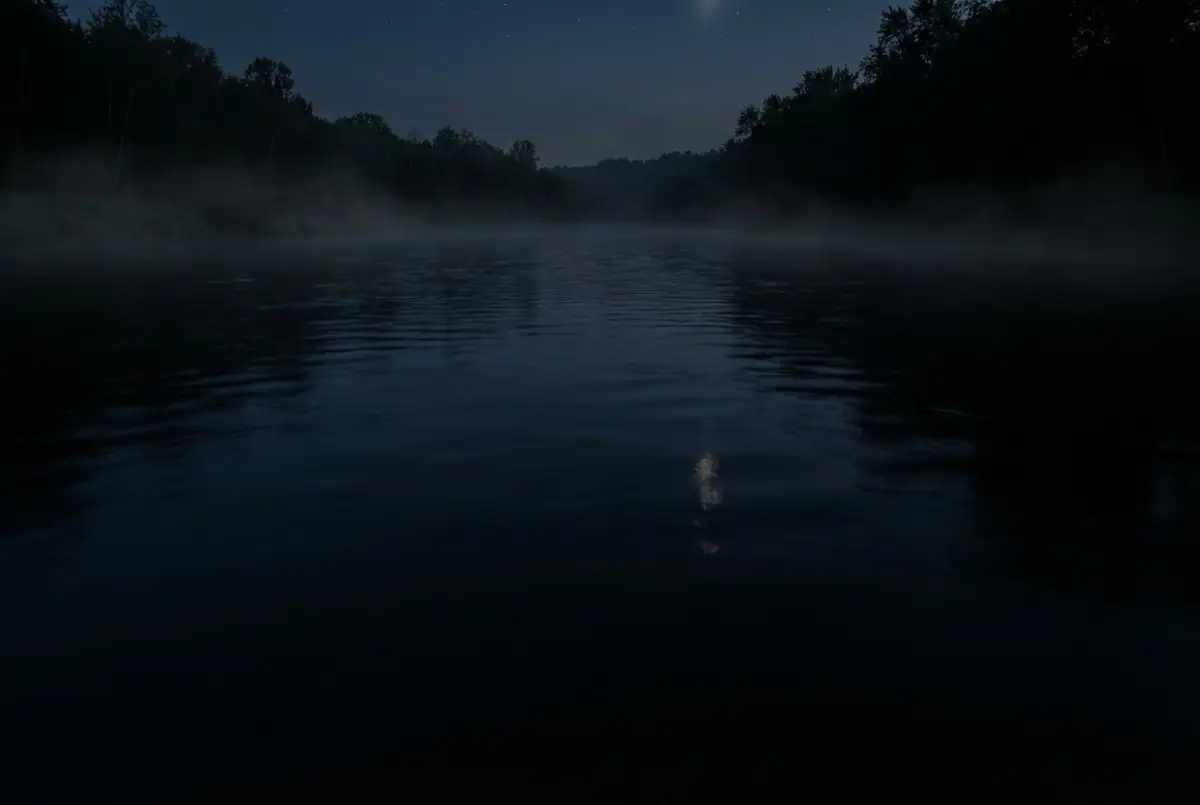
There is a brief, almost imperceptible moment at the boundary between day and night when a river ceases to function as a mirror. All day long, it has been a faithful archivist of the sky, the clouds, and the trees along its banks—reflecting light, doubling the world, offering the comforting illusion that a parallel reality exists on the water’s surface. But as the Sun’s final ray slips beneath the horizon and dusk thickens, something happens that a watchful eye never misses. The water loses its color, loses its transparency, and turns into a dense, absolute black. This is not merely the absence of light; it is a visual transformation of matter itself. A river that appeared blue or green by day seems to thicken at night, becoming liquid obsidian.
This is where the strange interaction between light and water truly ends—or rather, where its rules reverse. By day, the river’s surface obeys a simple law of physics: it reflects the light falling onto it. What we see is not so much the water as the sky mirrored upon it. At night, when the light source disappears, the water is stripped bare. It reflects almost nothing—perhaps a rare star, or a faint trail of moonlight. Everything else is absorbed. If by day the river gives images back to us, at night it takes them in. This visual absorption creates the illusion of infinite depth, far greater than the river actually possesses. The surface, once a clear boundary between air and water, becomes nearly invisible. What remains is only the sensation of proximity to something wet, moving, and profoundly dark.
At this point, human spatial perception begins to shift. Standing on the riverbank in darkness, the landscape loses its three-dimensional clarity. Perspective collapses. The opposite shore disappears. The direction of the current becomes impossible to read without the Moon’s help. The world contracts to the narrow radius your eyes can penetrate. This flattening effect triggers an interesting psychological change: we lose our position of dominance. By day, we look down at the river, survey it, control it with our gaze, even glimpse the riverbed in shallow stretches. At night, the river becomes unknown, sovereign. It no longer reveals its stones or its fish. It flows for itself alone, indifferent to our observation—and it is precisely this indifference that defines its nocturnal beauty.
As vision retreats, hearing takes the foreground. A river at night is always louder than during the day. This is partly because the environment grows quieter—human noise fades, birds fall silent—but there is also a physical reason. As air temperature drops and humidity rises, sound waves travel farther and more clearly across the water’s surface. The flow that by day blended into background noise becomes detailed and articulate at night. You no longer hear a vague rush, but distinct sounds: water striking stones along the bank, small whirlpools forming and dissolving, the surface breaking as a fish jumps. The river begins to “speak” in a language that daylight conceals. The sound is repetitive, even monotonous, yet hypnotic—like the Earth’s heartbeat rising to the surface.
The surroundings change as well. At night, the water is often warmer than the air, creating subtle thermodynamic effects. Low, creeping fog forms along the banks—the river’s breath. This mist further dissolves the boundary between water and land. The air grows heavy, saturated with the smell of wet soil, algae, and silt. By day, sunlight disperses these scents; at night, it concentrates them. Our sense of smell sharpens, just like our hearing, and we become aware of the river’s biochemical presence. This scent reminds us that water is not a sterile liquid, but a living system filled with organisms that never rest.
Life around the river follows different rules at night. During the day, our attention is drawn to colorful birds and insects. After dark, unseen creatures take over. The rhythmic chorus of crickets and grasshoppers forms a constant backdrop, punctuated by the call of an owl or the soft flutter of bat wings. But the most intriguing activity happens within the water itself. Under cover of darkness, when predatory birds can no longer see, fish approach the surface more boldly. Their movements leave ripples that are nearly invisible, yet their splashes can be heard. These sounds confirm that beneath the black, opaque surface, life is active and restless. The contrast between surface calm and internal motion gives the night river its unique pull.
Throughout human history, the night river has always been a boundary. Ancient cultures often saw it not only as a physical barrier, but as a metaphysical threshold between worlds. From a scientific-poetic perspective, this makes sense. By day, a river is a route, a resource, a source of water. By night, it becomes a barrier—dangerous to cross without visual cues. In darkness, water sheds its “friendly” appearance and reclaims its elemental nature. When the mirror vanishes, only force remains: the kinetic energy of the current, moving forward regardless of whether we can see it.
Yet within this darkness and perceived danger, there is a deep calm. Standing on a bridge or along the bank, gazing into black water, you stop searching for reflections. By day, we instinctively look for ourselves or the sky in the water—our ego seeks confirmation of existence within the landscape. At night, the river refuses to reflect us. It seems to say: “Only I am here.” And in that moment—when the mirror disappears and only depth remains—you encounter the most intimate form of observation. You are alone with nature, without intermediaries, reflections, or visual noise.
In the end, the river’s darkening at night is not the end of light; it is the beginning of truth. Darkness allows us to perceive water not as an image, but as a process. We feel its mass, its scent, its unceasing movement toward the ocean. This black, inky flow at our feet reminds us that the Earth never stops—even when we see nothing at all. At night, the river does not sleep. It simply removes the mask called daylight and continues its journey through time and space in its true, mysterious, and profound form. And we, standing on the shore, realize that this darkness is not emptiness, but the fullest and most honest state nature can offer.
Go backComments (0)
From This Author
Select Crypto to Support the Author 💫
×TXintEE7aezp6QxNNtbghCXvmXJdgofEyr
0x9c6299454A6B617A0Db228024279F2a3EEf956dD
bc1qj7caz3xfh5qd4ud3v3nh7k4tfl5lg8jh9er73e
0x9c6299454A6B617A0Db228024279F2a3EEf956dD
3TndfWAhPytTaBZjC2GbNWqh9iWx171SYACjbG2j5vx8
DHsrtwiL56Xk1xAj3fe8pVcfLhE8xgt3EQ
0x9c6299454A6B617A0Db228024279F2a3EEf956dD
UQDFkubJxb8KmxFmy1arJxkewzmNEg6-G2pJFVzFihB65d7W
ltc1q3fentl6ur9cxm0vxyqkdmmzxkj92j00p9l8m7z
✍ Article Author
- Registration: 26 July 2025, 19:34
- Location: Georgia