




The Forest Wrapped in Silence: How Sound Changes Before the Rain
 Tornike Moss
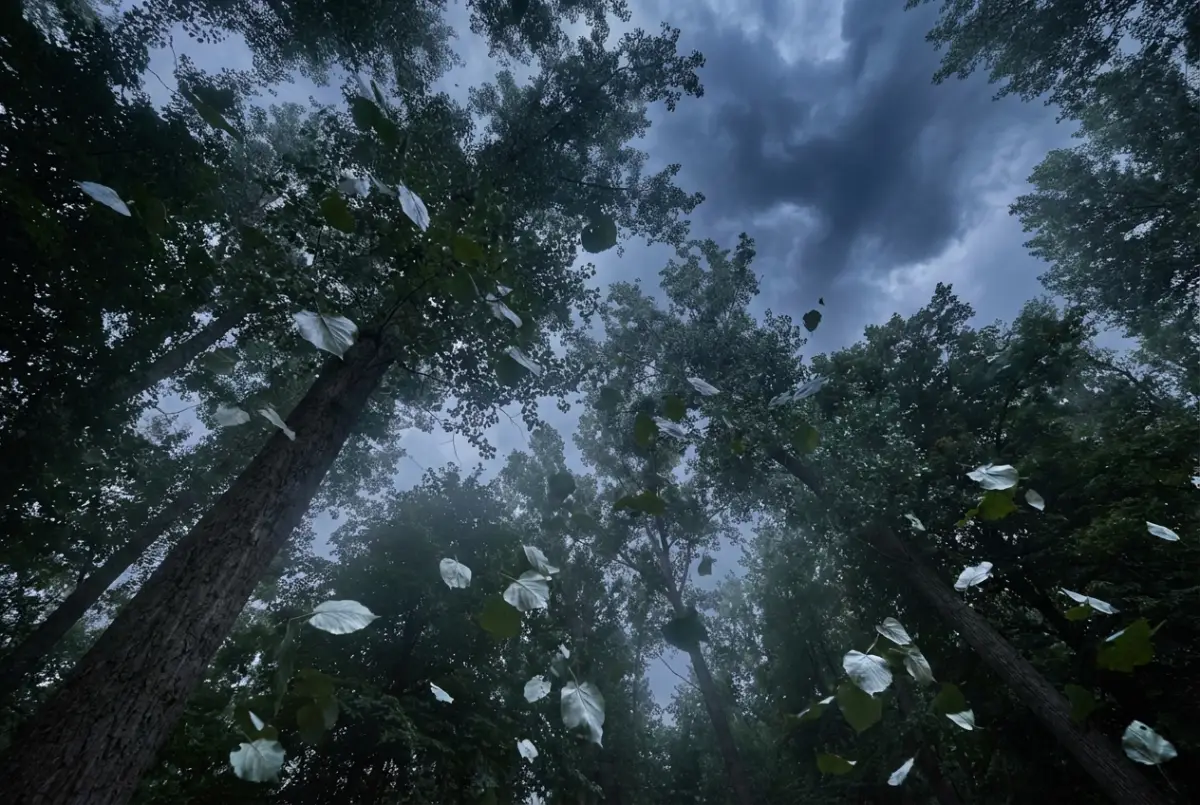
There is a moment in the forest when time seems to slow, slipping into a heavier dimension. It does not arrive abruptly. It creeps in, quietly and almost unnoticed, threading its way between the trees like morning fog along a riverbank. Sunlight that once pierced the canopy, scattering sharp, high-contrast patches across the ground, gradually loses its edge. The light becomes diffuse—soft, even—as if a vast translucent veil has been drawn over the world. Shadows fade and dissolve. Visual depth gives way to something else: an expansion of sound.
This is the state of anticipation before rain, one of nature’s rare intervals when the air feels so charged with what is coming that it seems almost tangible.
The first thing an attentive observer notices is a change in the texture of silence. This is not the calm stillness of night, when the forest sleeps. It is an alert, watchful quiet. On an ordinary day, the forest hums with chaotic noise—the dry rustle of leaves, the snap of twigs, the steady buzz of insects. But shortly before rain, as humidity rises, these sounds begin to transform. Dry leaves that once crackled in the wind absorb moisture and soften. Their sound turns muted, velvety. When the wind moves through the canopy now, the forest no longer produces a sharp, papery rustle. Instead, it exhales a deep, heavy murmur, as if millions of leaves were moving not by colliding, but by sliding against one another. High frequencies disappear. What remains are low, resonant tones—a thickening of the soundscape.
Moist air becomes a better carrier of sound, yet it also alters how sound is perceived. Noise no longer disperses freely; it lingers. Distant sounds—the rush of a river far below, or the faint hum of a highway beyond the hills—suddenly feel closer. This acoustic illusion results from denser air and temperature inversion. Low clouds act like a massive resonator, reflecting sound back toward the ground. The forest turns into an enclosed chamber: trees as walls, heavy gray clouds as the ceiling. An intimate feeling settles in, as if the world has shrunk to the limits of your vision.
Biology responds in kind, reshaping the forest’s orchestra. Birds—nature’s most sensitive barometers—fall silent. Their pause is not fear, but preparation. They sense the drop in atmospheric pressure, knowing that damp air will weigh down their feathers and make flight difficult. They retreat into dense branches and foliage, waiting. The absence of birdsong creates the most dramatic pause in forest life. Yet silence is never absolute. Near the ground, in grass and undergrowth, insects alter their rhythm. Crickets and grasshoppers, sensitive to temperature shifts, slow their movements. Their once sharp, energetic calls become intermittent, sluggish, until they fade away entirely.
Even the wind changes character. Before rain, it is no longer a steady flow but impulsive and restless. Treetops sway unevenly, as if an invisible hand were testing them. Here, sight and sound merge. Broadleaf trees—poplars, lindens—flip their leaves in gusts, revealing pale, silvery undersides. This creates a distinctive sound: not a rustle, but a rolling wave sweeping across the forest. The wind seems to probe for weakness, searching for entry points before the storm arrives. It carries a scent that is unmistakable—ozone, damp earth, and petrichor—well before the first drop falls.
A person standing in the forest at this moment feels the change not only through hearing, but through skin and breath. The air grows sticky. Humidity clings to the body, and breathing becomes slightly heavier. Ancient instincts stir. Without thinking, you stop, lift your head, and inhale deeply. This is anticipation made physical. The atmosphere feels “loaded.” The electrical balance of the air shifts, unseen yet sensed. The forest seems to hold its breath. Every living thing—from the smallest ant to the tallest oak—enters a state of waiting. It is a collective pause, a shared silence before a major event.
Curiously, sound before rain does not just change—it loses distance. Normally, forest sound travels both horizontally and vertically. In humid air, acoustic space contracts. Your own footsteps sound louder than usual, because noise no longer dissolves into dry air but remains close. A snapping twig beneath your boot feels as though it broke right beside your ear. This intensifies the feeling of solitude and, at the same time, unity with the surroundings. You are no longer an outside observer. You are inside the acoustic dome, sealed into the forest’s rhythm.
Then comes the moment just before the climax. The wind stops. Leaves freeze mid-motion. Even the distant hum that lingered moments ago vanishes. The forest becomes utterly still. This is the zero point. Clouds hang so low they brush the treetops. Light has nearly disappeared, replaced by a deep gray dimness—even if it is still midday. The silence grows so dense it seems to ring in your ears. This is not emptiness, but fullness—an atmosphere saturated beyond its limit. The air is heavy with water still in vapor form, seconds away from becoming liquid.
Not a single drop has fallen yet. The ground remains dry. Dust on the path has not turned to mud. But the forest is no longer what it was an hour ago. It has shifted, prepared itself, accepted what is inevitable. This pause—the final inhale before the storm—is one of nature’s most powerful spectacles, though it is better described as something to be heard rather than seen. There is no noise, no chaos. Only perfect, concentrated readiness for the sky to open and a new cycle of life to begin.
The forest stands motionless and silent, waiting for the first touch that will change everything.
Go backComments (0)
From This Author
Select Crypto to Support the Author 💫
×TXintEE7aezp6QxNNtbghCXvmXJdgofEyr
0x9c6299454A6B617A0Db228024279F2a3EEf956dD
bc1qj7caz3xfh5qd4ud3v3nh7k4tfl5lg8jh9er73e
0x9c6299454A6B617A0Db228024279F2a3EEf956dD
3TndfWAhPytTaBZjC2GbNWqh9iWx171SYACjbG2j5vx8
DHsrtwiL56Xk1xAj3fe8pVcfLhE8xgt3EQ
0x9c6299454A6B617A0Db228024279F2a3EEf956dD
UQDFkubJxb8KmxFmy1arJxkewzmNEg6-G2pJFVzFihB65d7W
ltc1q3fentl6ur9cxm0vxyqkdmmzxkj92j00p9l8m7z
✍ Article Author
- Registration: 26 July 2025, 19:34
- Location: Georgia