




The Stones That Move: Death Valley’s Silent Mystery
 Tornike Moss
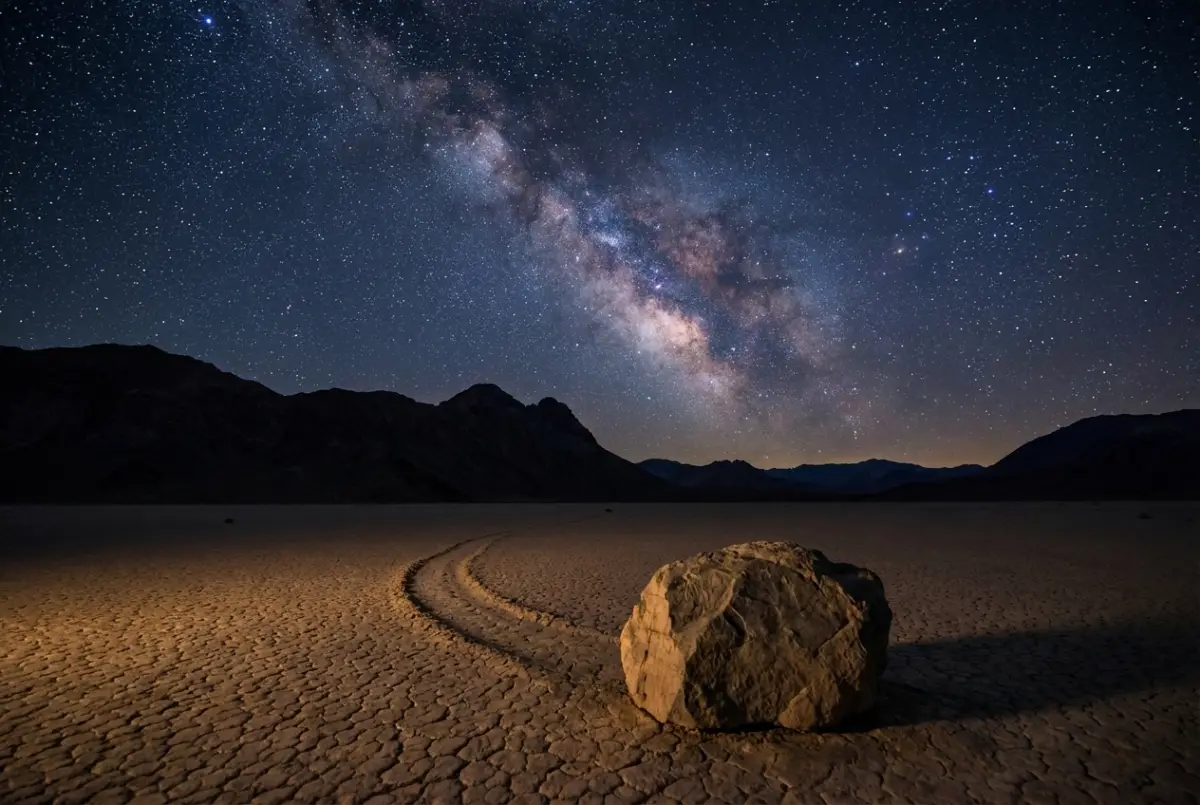
In Death Valley, the sun does not simply shine—it assaults. Here, on the border between California and Nevada, where the Earth’s crust seems to have sunk under the weight of heat itself, even the air moves reluctantly. Silence has mass. The horizon stretches so far and so vaguely that distance loses meaning. Everything appears fossilized—both literally and figuratively. Parched, cracked clay, salt-stained ground, and mountains that seem frozen in time. At first glance, this is one of the most static places on Earth, where motion feels like an anomaly and stillness the only rule.
But step onto this desolate expanse known as Racetrack Playa, lower your gaze, and an unsettling scene unfolds.
Scattered across the flat, fractured lakebed—where no plants grow and no animals linger—lie stones. Some are the size of a fist, others weigh as much as a person. The astonishing part is not their presence, but what trails behind them. Long grooves carved into the hardened mud, sometimes stretching hundreds of meters, tracing precise paths of movement. Some lines run straight as arrows; others suddenly veer at sharp angles or weave into chaotic zigzags.
The first reaction is disbelief. The mind refuses to accept what the eyes report. How can a stone—the very symbol of lifeless weight—move across a perfectly flat surface? There is no slope to blame on gravity. No footprints of humans or animals surround the rocks. It feels as though an invisible force nudged them forward and vanished without explanation.
For decades, this puzzle invited speculation. Racetrack Playa became fertile ground for theories involving extraterrestrials, magnetic anomalies, or ancient spirits. Our instinct is to fill the unexplained with mysticism, especially when logic seems to fail. The stones, silent and unmoving, with their long tails etched into the ground, appeared to mock our impatience for answers.
Yet the truth, revealed through years of careful observation, turned out to be far more elegant—and poetic—than any supernatural theory. This is not a story of hidden forces, but of a rare and precise alignment of natural elements.
Racetrack Playa was once a lake. Today, it is a dry clay basin, lifeless for most of the year. But in winter, rare rains funnel water down from the surrounding hills, flooding the playa. This is no deep lake—just a shallow sheet of water, often only a few centimeters thick. At night, as desert temperatures plunge, this thin layer freezes.
What forms is not solid ice, but delicate, transparent sheets, often compared to window glass. When morning sun rises and temperatures climb, the ice fractures into large, floating panels. And this is where the mystery begins to resolve.
Imagine a stone embedded not in mud, but in a thin layer of ice. The ice reduces friction to nearly zero. Then enters the quiet conductor of the scene: the wind. No storm is required. A steady, gentle breeze is enough to push these broad ice panels. Acting like sails or rafts, the ice sheets carry—or nudge—the stones along the slick surface beneath.
The movement is almost imperceptible. This is not a race; it is a slow glide, measured in centimeters or meters per minute. Wind presses against the ice, the ice slides across the shallow water, and the stones drift with it. When the ice melts and the water evaporates, all that remains is the stone—and the deep scar it carved into the soft mud, later hardened by the sun.
This explains why the phenomenon eluded direct observation for so long. Human perception is tuned to speed. We look for events that happen instantly. Nature, however, operates on a different clock. For the stones to move, conditions must align perfectly: enough rain to create shallow pools, but not so much that the stones float freely; enough cold to form ice; and just enough wind to set the ice in motion. This combination may not occur for years—or even decades.
The stones wait. They can remain in one place for ten years or more, until one winter night, beneath a sky crowded with stars, ice and wind finally join forces and invite them to dance.
Modern science, equipped with GPS trackers and high-resolution cameras, eventually captured this process in action. During the winter of 2013–2014, researcher Richard Norris and his team—after years of dedicated study—witnessed the stones move. More than sixty rocks slid simultaneously, drifting slowly across the frozen lakebed. There was no drama, no spectacle. Only a quiet, almost meditative process, accompanied by the faint cracking of ice—like thousands of glass cups brushing against one another.
This discovery is a humbling reminder of how limited our perception can be. We often assume that if we cannot see something happening, it is not happening at all. The moving stones of Death Valley tell a different story. The most significant changes are often invisible. They are patient. They have no finish line to reach. Their motion is simply a response to the environment—an adaptation to the brief moment when the world allows movement.
Today, if you stand on Racetrack Playa, the stones appear motionless once again. The sun beats down, the ground cracks, tourists take photographs and leave. But we now understand that this stillness is temporary—a pause between acts.
The stones of Death Valley are not alive, yet they teach one of life’s most enduring lessons: patience. Great movement does not require noise or force. Sometimes it is enough to wait for the right conditions, to allow the environment to shift in your favor, and to let the wind carry you where you need to go. Nature never rushes, yet—as these silent stones remind us—it always finds a way to move forward and leave its mark on the fractured pages of time.
Go backComments (0)
From This Author
Select Crypto to Support the Author 💫
×TXintEE7aezp6QxNNtbghCXvmXJdgofEyr
0x9c6299454A6B617A0Db228024279F2a3EEf956dD
bc1qj7caz3xfh5qd4ud3v3nh7k4tfl5lg8jh9er73e
0x9c6299454A6B617A0Db228024279F2a3EEf956dD
3TndfWAhPytTaBZjC2GbNWqh9iWx171SYACjbG2j5vx8
DHsrtwiL56Xk1xAj3fe8pVcfLhE8xgt3EQ
0x9c6299454A6B617A0Db228024279F2a3EEf956dD
UQDFkubJxb8KmxFmy1arJxkewzmNEg6-G2pJFVzFihB65d7W
ltc1q3fentl6ur9cxm0vxyqkdmmzxkj92j00p9l8m7z
✍ Article Author
- Registration: 26 July 2025, 19:34
- Location: Georgia