




The Earth That Breathes at Night: The Living Motion of Fog Across Fields and Forests
 Tornike Moss
When the sun slips below the horizon and the day’s last golden light releases the treetops, the world changes. In the city, this shift barely registers—streetlights flick on and the noise continues. But far from settlements, where asphalt ends and the land is free to breathe, nightfall follows a very different rhythm. Cool air arrives with the darkness, brushing the skin with a pleasant chill. And then, as if signaled by something unseen, one of nature’s most subtle and mysterious performances begins.
This is not a cloud descending from the sky. It is the ground responding to cooling air—the moment when the landscape awakens and begins to breathe.
At first, it is difficult to tell where it starts. You stand at the edge of a field, staring into the darkness where grass fades into black. Then you notice it: in the low places, where the land dips slightly, a thin, translucent veil forms. It does not drift like smoke carried by wind. It is heavier, denser—and unmistakably alive. These are the first tentative streams of what meteorologists call radiation fog, a term far too dry to describe what unfolds before your eyes. This is the Earth exhaling. Heat absorbed by the soil during the day now escapes upward, meeting colder air. Where they touch, a pale, milky substance is born—something that looks like water, yet is not.
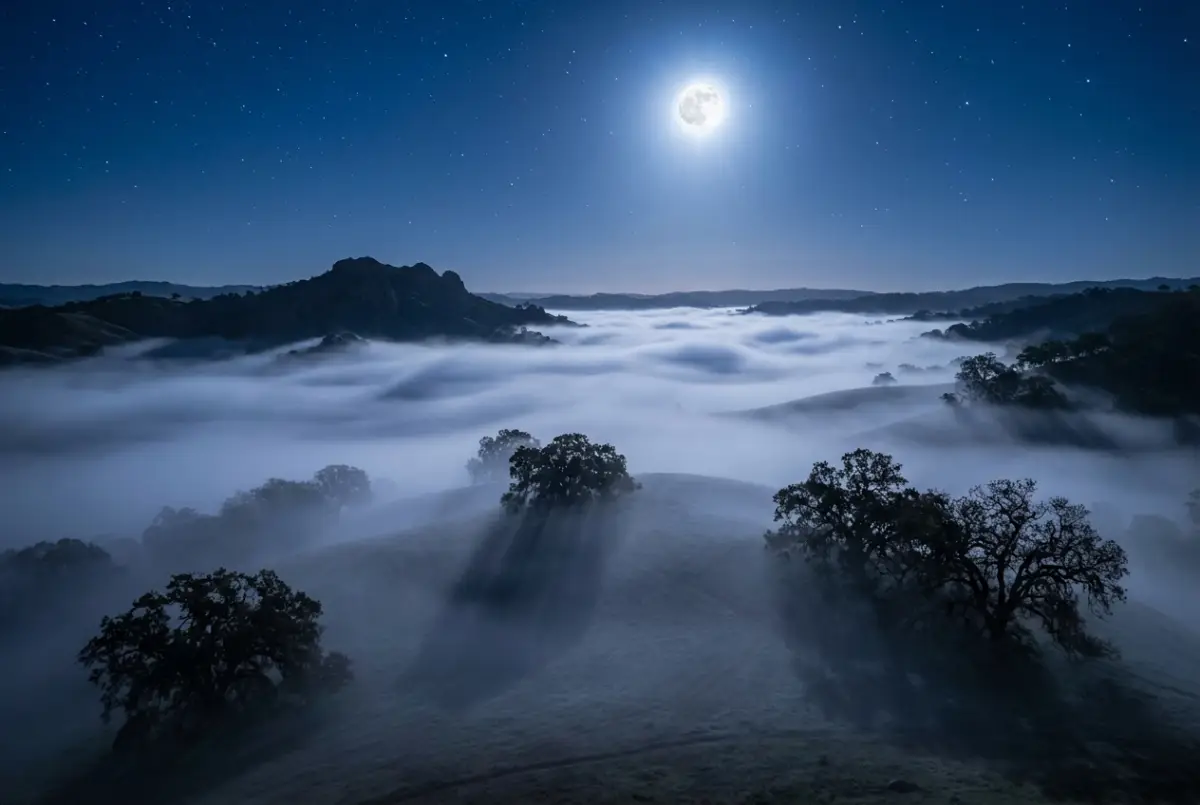
As the night deepens, the movement grows bolder. Fog no longer confines itself to hollows. It begins to flow. If you have ever seen a river reverse course or a lake spill over its banks, fog behaves much the same way. Slowly and without urgency, it rises, filling valleys, swallowing shrubs, leaving only treetops exposed—dark islands floating in a boundless white sea. The scale of this transformation is immense, yet it unfolds in near silence. You find yourself holding your breath, afraid that even the slightest movement might disturb the fragile balance. There is no wind driving clouds across the sky—only a quiet thermodynamic waltz between land and atmosphere.
The effect is especially striking along rivers. Water still holds the day’s warmth, while the air carries the first hint of winter cold. Where they meet, a thick, almost tangible wall of fog forms, tracing the river’s path. This is no static barrier. It curls and shifts, as though the river has acquired a second, ethereal body. Standing on a bridge, you watch the white mass drift below, brushing against the pillars, spilling onto the banks as if trying to cross onto land. In moments like this, the world loses its sharpness. Edges dissolve. The boundary between water and shore, sky and earth, disappears. Everything merges into a single, soft dimension where distance becomes impossible to judge.
In forests, fog behaves differently. Where it settles like a lake in open fields, here it glides like a ghost between trees. Deep in deciduous woods, where moonlight barely penetrates, fog clings to branches, wraps around trunks, and fills narrow paths. It moves with caution, advancing slowly, exploring every corner. As you walk, cool, damp air brushes your face. The sensation is not unpleasant—it is invigorating. The forest, lively by day with birdsong and rustling leaves, now falls silent. Fog has an extraordinary quality: it absorbs sound. Acting as a natural insulator, it muffles sharp noises. In a foggy forest, silence feels deeper, heavier, more profound than at any other time. Even your footsteps sound different, as if you were walking on cotton.
The greatest magic appears when the Moon is present. Silver light spills from above onto the white veil, transforming the landscape into something almost unearthly. Fog begins to glow from within, taking on a bluish, pearlescent hue. Shadows cast by trees stretch long across the mist, but they are soft, never sharp—dissolving gently into light and vapor. In moments like this, it becomes clear why ancient people believed fog was the dwelling place of spirits. It is hard to accept that this is merely condensed water. The scene is so emotionally charged that it feels as though nature is speaking—revealing a secret hidden from daylight.
Time loses meaning here. You can stand for hours watching fog reshape itself. It is never the same twice. Sometimes a light breeze passes through, tilting the entire mass like a slow-moving wave. At other times, it seems frozen in place, and only when a bush that was visible moments ago disappears do you realize it has been moving all along. This is meditation beneath an open sky. There is no need to close your eyes. On the contrary, you keep them wide open, unwilling to miss a single nuance of this living canvas.
This process—the Earth breathing—reminds us that our planet is not inert matter. It exists in constant exchange of energy, releasing and absorbing heat, moisture, air. Night fog is the visible expression of that exchange. Too often we forget that the ground beneath our feet has its own temperature, its own temperament. A foggy night restores that awareness. This is not just a line in a weather forecast; it is planetary physiology, a pulse most clearly felt in the silence of night.
As dawn approaches and the eastern sky begins to pale, the fog changes again. It seems to prepare for departure, or perhaps for transformation. The first rays of sunlight tint it pink, then gradually dissolve it into the air. The breathing pauses—or simply becomes invisible. The land warms, the cycle completes itself. The white oceans that covered the fields vanish, leaving only dew on the grass—the sole physical trace of the night’s visitation.
And yet, before the sun rises fully, before the veil is lifted, you stand there in damp grass, filled with a quiet sense of calm and gratitude. Gratitude for having witnessed a moment when nature revealed its most intimate side. You were not a participant, nor a director—only a silent observer, allowed to listen as the Earth breathed slowly, deeply, and in rhythm. That feeling—that the world around you is alive and breathing—lingers long after the fog fades and daylight reality reclaims the landscape.
Go backComments (0)
From This Author
Select Crypto to Support the Author 💫
×TXintEE7aezp6QxNNtbghCXvmXJdgofEyr
0x9c6299454A6B617A0Db228024279F2a3EEf956dD
bc1qj7caz3xfh5qd4ud3v3nh7k4tfl5lg8jh9er73e
0x9c6299454A6B617A0Db228024279F2a3EEf956dD
3TndfWAhPytTaBZjC2GbNWqh9iWx171SYACjbG2j5vx8
DHsrtwiL56Xk1xAj3fe8pVcfLhE8xgt3EQ
0x9c6299454A6B617A0Db228024279F2a3EEf956dD
UQDFkubJxb8KmxFmy1arJxkewzmNEg6-G2pJFVzFihB65d7W
ltc1q3fentl6ur9cxm0vxyqkdmmzxkj92j00p9l8m7z
✍ Article Author
- Registration: 26 July 2025, 19:34
- Location: Georgia