



The Sky Where a Rainbow Appeared at Night: Moonbows in Real Conditions
 Tornike Moss
Night arrives not like a curtain falling, but like a deeper state of the world. Far from civilization, where artificial light cannot reach, darkness becomes dense—almost tangible. You hear only nature breathing: perhaps the steady pulse of ocean waves, or more likely the thunder of a powerful waterfall, a sound that breaks the silence while also becoming part of it. The air is saturated with moisture. Cold, invisible droplets cling to your skin, swirling like mist around you. You stand and wait. Slowly, your eyes adjust to the dark. Tree silhouettes sharpen, stars flicker faintly—but the main performer has yet to appear.
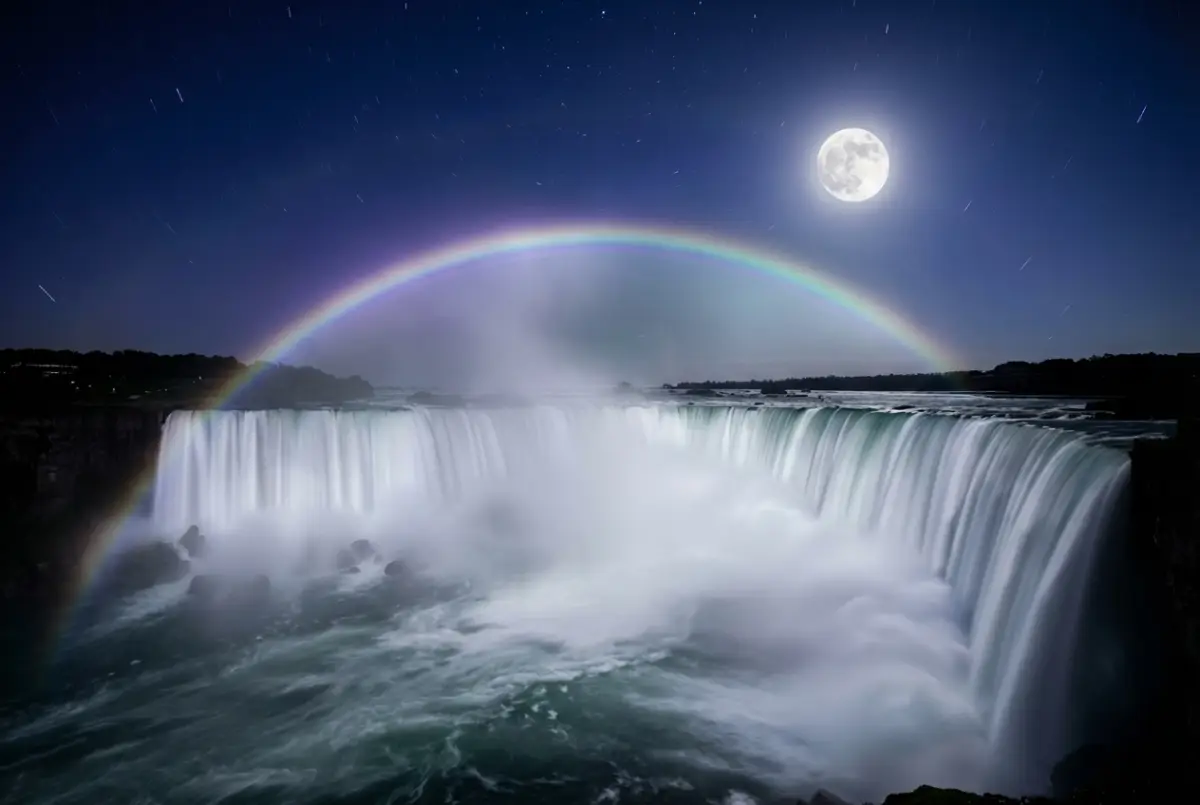
Then the Moon emerges from behind the clouds—full, cold, and dazzlingly bright against the night. Its light strikes the suspended spray of water in the air, and in that instant, without warning, something forms in the darkness that defies expectation. A curve appears. An arc stretching over a valley or across the ocean horizon. It looks nothing like the vibrant, playful rainbow we associate with summer rain. This is something else entirely—pale, ghostlike, nearly transparent, washed in silver. This is a lunar rainbow, or moonbow, one of nature’s quietest and most elusive spectacles.
What is this ethereal beauty that seems to slip from a dream into reality? In physical terms, a moonbow is no different from a daytime rainbow. The mechanism is the same: light enters a droplet of water, bends, reflects off the inner surface, and disperses into a spectrum as it exits. The only difference lies in the source of light. By day, we see direct sunlight. At night, we see sunlight reflected by the Moon and redirected toward Earth. It is a reflection of a reflection—a light echo strong enough to obey the laws of physics, yet weak enough to confuse human perception.
Here, the paradox of human vision comes into play. When most people see a moonbow, it appears white, gray, or faintly silver. Occasionally, a hint of blue or yellow can be detected, but vivid colors are rare. The reason lies in our biology. The human eye relies on two types of light-sensitive cells: cones, which detect color but require strong light, and rods, which function in darkness but perceive only shades of gray. Moonlight—even from a full Moon—is roughly 400,000 times weaker than sunlight. As a result, our color-sensitive cones remain largely inactive. We see the shape and structure of the rainbow, but not its colors. We are observing a colorful phenomenon through black-and-white vision.
Seeing a moonbow requires more than curiosity—it demands a rare and precise alignment of conditions. Nature behaves like a meticulous director here. First, the Moon must be full or nearly full to provide sufficient light. Second, it must sit low in the sky—below about 42 degrees above the horizon—otherwise the refracted light will miss the observer entirely. Third, and most challenging, the surroundings must be truly dark. Even distant city lights can overwhelm the moonbow’s subtle glow. And finally, there must be water—not just rain, which often hides the Moon behind clouds, but a constant source of fine spray: a massive waterfall or powerful ocean surf.
For this reason, certain places on Earth are considered temples of moonbows. Cumberland Falls in Kentucky is one such site. Another is Victoria Falls in Africa, straddling the border between Zambia and Zimbabwe. Imagine an African night as the Zambezi River crashes into the abyss below. The sheer volume of water sends mist hundreds of meters into the air. Under a full Moon, that mist becomes a canvas on which nature paints its silver arc. Time seems to slow. Tourists and researchers who witness this scene often describe it as spiritual or mystical. This is not a spectacle that invites shouting or applause—it is a moment that steals your breath.
Modern technology has added a new layer to this phenomenon. Photograph a moonbow with a professional camera using long exposure, and the image reveals something entirely different: a full, vivid rainbow, spanning red to violet. The camera gathers light over time and captures what the human eye cannot. This raises a subtle philosophical question: which moonbow is real? The pale, spectral arc seen with the naked eye—or the brilliant, colorful one revealed by the photograph? Perhaps the truth lies somewhere between the two. The moonbow reminds us that the world contains more than our senses alone can register.
This phenomenon is fleeting. A slight change in wind direction, a cloud drifting across the Moon, or the Moon climbing higher into the sky—and the arc dissolves. It disappears as quietly as it formed, leaving no trace beyond memory. A moonbow is not designed for crowds. It is intimate. It does not shine brightly enough to be noticed in passing. To see it, you must stop, embrace the darkness, and wait.
In the end, the moonbow is nature’s gentle reminder that light exists even in darkness—it has simply changed its form. It proves that night is not the end of color, but its moment of rest. Standing near a waterfall, damp with nocturnal mist, watching this faint, vibrating bridge between sky and earth, you realize that beauty does not require constant brilliance. Sometimes the most powerful spectacle is the one that is barely visible—balanced on the edge between presence and absence, revealed only to those who know how to look into the dark.
Go backComments (0)
From This Author
Select Crypto to Support the Author 💫
×TXintEE7aezp6QxNNtbghCXvmXJdgofEyr
0x9c6299454A6B617A0Db228024279F2a3EEf956dD
bc1qj7caz3xfh5qd4ud3v3nh7k4tfl5lg8jh9er73e
0x9c6299454A6B617A0Db228024279F2a3EEf956dD
3TndfWAhPytTaBZjC2GbNWqh9iWx171SYACjbG2j5vx8
DHsrtwiL56Xk1xAj3fe8pVcfLhE8xgt3EQ
0x9c6299454A6B617A0Db228024279F2a3EEf956dD
UQDFkubJxb8KmxFmy1arJxkewzmNEg6-G2pJFVzFihB65d7W
ltc1q3fentl6ur9cxm0vxyqkdmmzxkj92j00p9l8m7z
✍ Article Author
- Registration: 26 July 2025, 19:34
- Location: Georgia