



Why “Typing…” Is the Loudest Silence in Our Chats
 Tornike Moss
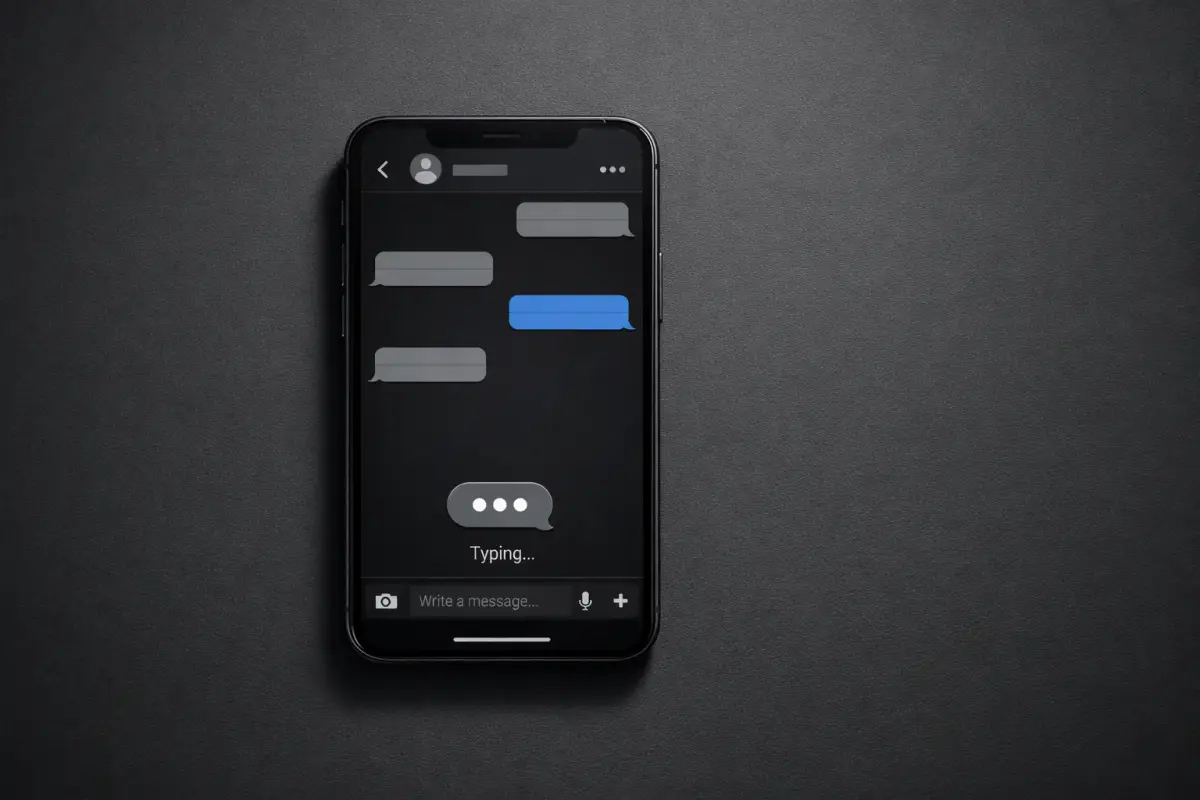
Picture this: it is late at night, or perhaps the middle of a workday you have deliberately cleared. You are holding your phone, staring at the screen. You have just sent a message — rhetorical, risky, or simply one that feels critically important. And then it appears. A small gray bubble with three dots moving in a rhythmic pulse. “Typing…”. Your heart rate rises almost imperceptibly. Your fingers tighten around the phone. Your brain begins constructing scenarios at high speed, already preparing for that dopamine surge associated with receiving a reply.
And then, suddenly, it disappears.
The bubble evaporates. No new message. No notification sound. Only your original text remains, now exposed against the silence, looking slightly vulnerable — perhaps even foolish. That brief disappearance often stings more than direct rejection. It resembles someone opening their mouth to speak, inhaling deeply, and then walking out of the room without a word.
We rarely pause to consider how this minor technical detail has reshaped the psychology of human interaction. At first glance, it is simply an interface feature — a piece of code indicating that data is being entered. In practice, however, “Typing…” has become one of the most potent psychological triggers modern communication has produced. It no longer functions as information. It functions as emotion.
Its disappearance unsettles us because it does not feel like a technical glitch. It feels like a decision. Someone typed and deleted. Someone thought and reconsidered. It is in that space of reconsideration that anxiety begins to grow.
Anticipation as a New Form of Intimacy
Why do three animated dots exert such disproportionate influence over our emotional state? The explanation lies in the architecture of the human brain and the psychology of anticipation. Neuroscience suggests that the brain often derives more pleasure from anticipating a reward than from receiving it. When you see that someone is typing, it signals that, somewhere on the other side of the digital interface, someone is actively engaged with you. In that specific moment, you are the focus of their attention. This is attention in its purest digital form.
In face-to-face conversation, we observe facial expressions, detect pauses, watch as someone searches for the right words. Messaging platforms have removed physical cues and left us with text alone. Yet the “Typing…” indicator has emerged as a form of digital body language. It reveals process rather than outcome.
When that process ends without producing a visible result, the brain interprets it as a disruption. Humans have a low tolerance for incomplete cycles. In psychology, this is described as the Zeigarnik effect — the tendency to remember and feel tension around unfinished actions more than completed ones. A vanished “Typing…” indicator is a textbook example of unfinished action. It is a question without an answer, a melody interrupted before reaching its resolution.
Here lies the paradox. Technology designed to accelerate communication and reduce uncertainty through instant feedback often introduces a subtler, more refined anxiety. Ambiguity can weigh heavier than rejection. A clear “no” is closure; life can proceed. A message that begins and stops becomes a labyrinth. What was written? Was it too emotional? Too distant? Perhaps something harsh that was ultimately restrained? Or perhaps a confession too vulnerable to send?
This uncertainty creates an intimate connection with the person who did not press “send.” We find ourselves participating in their internal deliberation, even without knowing its content. We become silent witnesses to their hesitation.
Technological Ghosts and Lost Words
Time adds another layer to the experience. How long did “Typing…” remain visible, and what followed? If the indicator pulsed for three full minutes and was ultimately replaced with a brief “OK” or “Got it,” we instinctively sense that something else existed in that invisible digital space. Entire paragraphs may have been drafted and erased. What remains is the archaeological residue of modern communication — emotions that were composed, revised, and removed before we ever saw them.
This “speaking silence” reveals that our digital avatars are often more curated, more cautious, and at times more artificial than our real-world selves. In live conversation, spoken words cannot be retrieved. In messaging apps, the backspace key functions as an instrument of immense power — an almost godlike tool allowing us to refine, reshape, and sanitize expression before it reaches another person.
When we see that someone was typing and then stopped, we are effectively witnessing their editing room. That moment can be unsettling because it exposes social vulnerability. We fear the possibility that the other person decided, “This is not worth sending,” or worse, “They are not worth this response.”
Yet there is another perspective — one less paranoid and more humane. What if the interrupted “Typing…” does not signify indifference or rejection at all? What if it represents care in its most contemporary form?
Perhaps the other person was searching for words that would not wound. Perhaps your message mattered so much that a rushed reply felt insufficient. Often, when writing stops, it is because text seems inadequate — too flat, too limited for what needs to be conveyed. We delete drafts because we would rather call, meet in person, or admit that we are not yet ready for the conversation those three dots promise.
This small animation, oscillating between expectation and disappointment, reminds us that behind every interface sit living, uncertain, sensitive individuals. People who type, delete, hesitate, and fear missteps — just as you do.
In the end, the disappearance of “Typing…” is a micro-tragedy, but it is also a sign of possibility. It means the connection still exists. Someone is thinking about you, even if they have not found the words. The next time the dancing dots fade and silence settles over the screen, resist the urge to interpret it as abandonment. Sometimes the most honest conversations reside in the sentences that were never sent. And those unspoken words remain an invisible, yet essential, part of how we relate to one another.
Go backComments (0)
From This Author
Select Crypto to Support the Author 💫
×TXintEE7aezp6QxNNtbghCXvmXJdgofEyr
0x9c6299454A6B617A0Db228024279F2a3EEf956dD
bc1qj7caz3xfh5qd4ud3v3nh7k4tfl5lg8jh9er73e
0x9c6299454A6B617A0Db228024279F2a3EEf956dD
3TndfWAhPytTaBZjC2GbNWqh9iWx171SYACjbG2j5vx8
DHsrtwiL56Xk1xAj3fe8pVcfLhE8xgt3EQ
0x9c6299454A6B617A0Db228024279F2a3EEf956dD
UQDFkubJxb8KmxFmy1arJxkewzmNEg6-G2pJFVzFihB65d7W
ltc1q3fentl6ur9cxm0vxyqkdmmzxkj92j00p9l8m7z
✍ Article Author
- Registration: 26 July 2025, 19:34
- Location: Georgia