



When the Screen Goes Black: Who Do We Really See When the Phone Falls Silent?
 Tornike Moss
You’ve probably felt it—that strange, fleeting anxiety that appears when your battery suddenly dies. Or when the internet stalls and the endless social feed, which moments ago was flooding your eyes with colorful videos and fragments of other people’s lives, abruptly freezes. This isn’t just a technical glitch. It’s the instant when digital anesthesia wears off and we are dropped back into reality.
At that exact moment—when the screen goes black—our fingers start moving instinctively, almost in panic, as if searching for rescue. What frightens us isn’t the lack of information. It’s the emptiness that waits on the other side of the screen.
Modern interfaces are designed never to stop. No app ever tells you, “That’s enough for today.” Instead, they promise that the next video will be funnier, the next post more important, the next update more relevant. Our brains have grown dependent on this constant flicker of stimulation. So when the screen goes dark, we feel like guests at a party where the music suddenly cuts out—exposed, awkward, unprotected.
Silence becomes the loudest noise of all. And strangely, we would rather be irritated and exhausted by informational chaos than remain alone with the one person we most avoid: ourselves.
Watch your own behavior. How many times have you unlocked your phone without knowing what you were looking for? We check the time and forget the numbers immediately. We open apps, close them, then open them again. This is no longer a functional action—it’s an emotional pacifier. A mechanical dance of fingers that keeps us from thinking about what unsettles us.
Because pauses are dangerous. In pauses, questions emerge: Am I happy? Am I living the right life? Why do I feel lonely? As long as the screen is lit, there’s no space for those questions. Bright colors and other people’s stories muffle our inner voice with impressive efficiency.
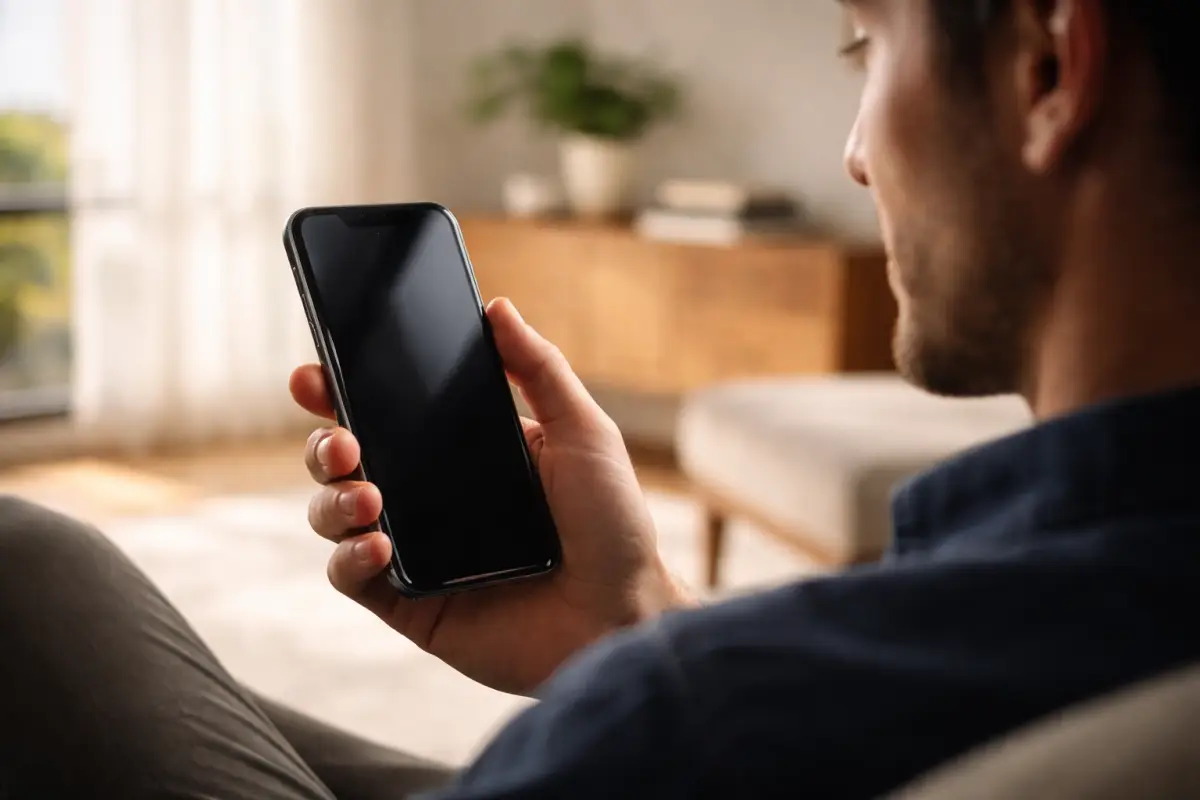
The most unsettling moment arrives when the screen turns completely black. It becomes a mirror—a dark, glossy surface reflecting our own image. Not the polished selfie we post in stories, but the real one: slightly tense, tired, eyes sunken, staring at glass.
This encounter with our unfiltered double is so uncomfortable that we instinctively press a button to light the screen again, to erase the reflection. We replace ourselves with pixels, because pixels are safe. Our own presence is not.
There’s a bitter paradox here. We live in an era where doing nothing has become the hardest task of all. And yet it’s precisely in boredom—in those quiet minutes spent facing a blank screen—that genuine ideas and real calm are born.
But we’ve grown so afraid of emptiness that we fill it with noise until our eyes finally close.
So here’s the question worth sitting with, the next time your phone goes dark:
Can you resist the urge to escape—and look your own reflection in the black glass in the eyes, without immediately turning away?
Comments (0)
From This Author
Select Crypto to Support the Author 💫
×TXintEE7aezp6QxNNtbghCXvmXJdgofEyr
0x9c6299454A6B617A0Db228024279F2a3EEf956dD
bc1qj7caz3xfh5qd4ud3v3nh7k4tfl5lg8jh9er73e
0x9c6299454A6B617A0Db228024279F2a3EEf956dD
3TndfWAhPytTaBZjC2GbNWqh9iWx171SYACjbG2j5vx8
DHsrtwiL56Xk1xAj3fe8pVcfLhE8xgt3EQ
0x9c6299454A6B617A0Db228024279F2a3EEf956dD
UQDFkubJxb8KmxFmy1arJxkewzmNEg6-G2pJFVzFihB65d7W
ltc1q3fentl6ur9cxm0vxyqkdmmzxkj92j00p9l8m7z
✍ Article Author
- Registration: 26 July 2025, 19:34
- Location: Georgia