


Why Screens Pull Us in More Strongly at Night
 Tornike Moss
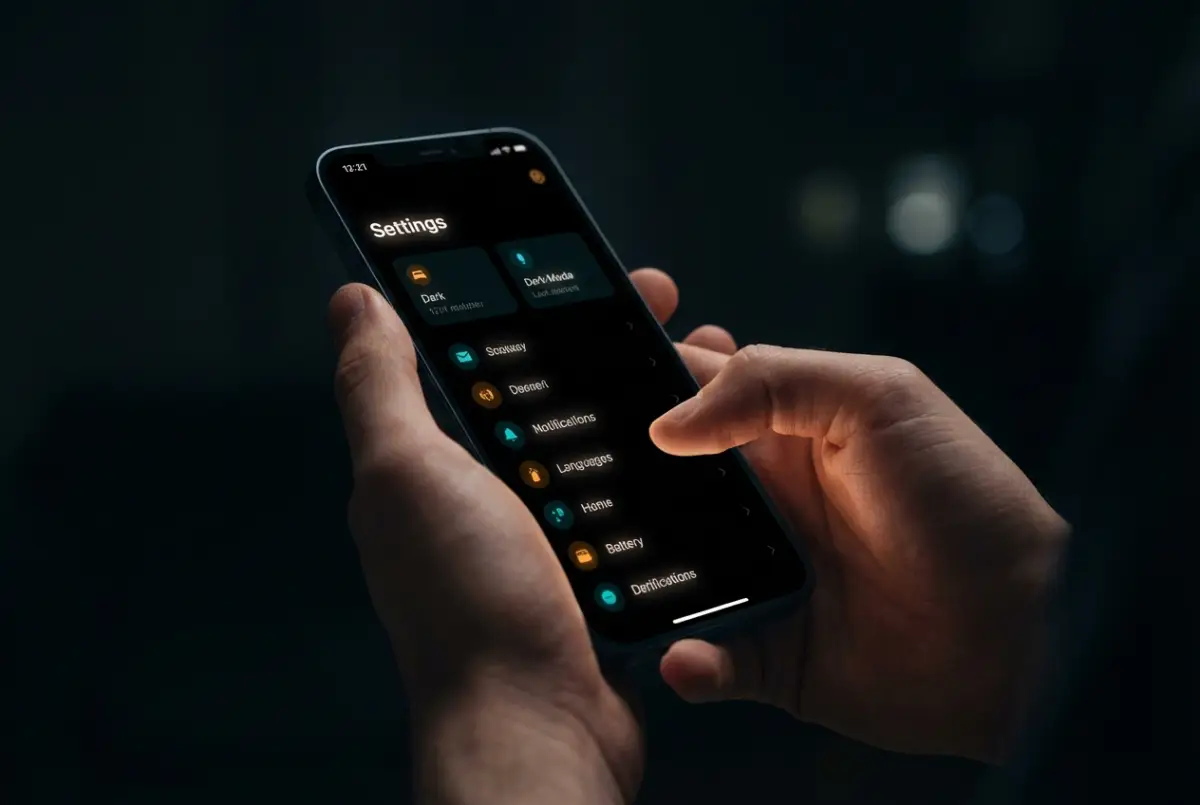
You have probably noticed a strange transformation that happens to your smartphone or laptop the moment the last trace of daylight disappears and artificial light—or complete darkness—takes over the room. The same app that felt like a simple information source or work tool alongside your morning coffee suddenly takes on a different emotional weight at night. Buttons seem softer, colors deeper and more saturated, and the text on the screen feels as if it is speaking directly to you, not to thousands of other users. In reality, nothing has changed at the software level. The code is identical, the pixels are arranged the same way, and no designer has embedded a hidden “night magic” algorithm. The change does not happen inside the screen, but in front of it—in you and in your environment. What you are experiencing is a complex interaction between light, biology, and psychology that makes the digital world feel more “real” after dark.
The first and most powerful architect of this illusion is contrast. During the day, our eyes and brains are locked in constant competition with aggressive ambient light. Sunlight streaming through windows or harsh office lighting washes out the screen’s brightness. At noon, black on a display is never truly black—it appears as dark gray, diluted by reflections from the surrounding environment. At night, this competition disappears. When the room is dark, the screen becomes the only light source. Black merges with darkness, borders dissolve, and the image seems to float in midair. This visual isolation creates a “cinema effect”: everything beyond the screen fades away, leaving only the interface, glowing with a hypnotic intensity. That is why photos appear more detailed and graphic elements feel more refined after sunset.
But the shift is not just external; it happens inside our eyes as well. In low light, our pupils dilate to capture as much light as possible. This physiological response subtly alters focus and depth perception. With widened pupils, luminous objects—text, icons, buttons—develop a faint halo, a soft glow photographers call “bloom.” This microscopic blur removes the clinical sharpness we associate with daytime viewing and makes the interface feel more organic, almost tangible. This is where one of modern UI design’s most influential choices comes into play: dark mode. It is not merely an aesthetic trend; it is a response to the eye’s physiological needs. A white background at night acts like a spotlight, while a dark background offers relief. White text on black feels lighter, less oppressive, making information easier to absorb—yet emotionally more immersive.
Beyond physics and optics lies a deeper layer: our cognitive state. During the day, the brain operates in “survival and problem-solving” mode. We pick up our phones with specific intentions—replying to emails, checking the weather, ordering a ride. The interface is a tool, like a hammer or a key, used and set aside. Our attention is fragmented; the environment is noisy. At night, this mode shifts. A tired brain loosens its analytical filters and relies more on emotional perception. A “functional” interface becomes an “emotional” space. We stop searching for information and begin absorbing impressions. Nighttime scrolling is no longer about catching up on news; it becomes a meditative, trance-like state in which time dissolves. Subtle details—animation speed, the softness of transitions—suddenly feel more noticeable and more satisfying because the brain is no longer rushing.
Color temperature plays an important role as well, especially through automatic night filters. When a screen shifts from blue tones to warmer, yellowish hues, it subconsciously evokes candlelight or a campfire. Cold, technological light becomes warm and familiar. This change not only supports melatonin production but also reshapes our psychological relationship with the device. It stops feeling like a cold machine and starts to feel like a companion. In the quiet of night, when external stimuli fade, visual information becomes “louder.” Each notification, each new page feels more significant than it would during the day. This is the paradox of attention economics: the fewer distractions around us, the stronger the screen’s gravitational pull.
Ultimately, the nighttime transformation of an interface is like walking through a museum after the lights have been dimmed and only the exhibits remain illuminated. The exhibits are the same as they were during the day, but our relationship with them becomes intimate. The boundary between technology and human perception thins. We forget that we are holding glass and plastic; only content and light remain. This phenomenon reminds us that design is not static—it is a living process completed only when someone looks at it. And because our gaze changes between day and night, the reality we perceive on the screen changes as well.
So if you are reading this at night, take a moment to look closely at the words on your screen. Don’t they feel just a little clearer, a little closer, than they would tomorrow morning?
Go backComments (0)
From This Author
Select Crypto to Support the Author 💫
×TXintEE7aezp6QxNNtbghCXvmXJdgofEyr
0x9c6299454A6B617A0Db228024279F2a3EEf956dD
bc1qj7caz3xfh5qd4ud3v3nh7k4tfl5lg8jh9er73e
0x9c6299454A6B617A0Db228024279F2a3EEf956dD
3TndfWAhPytTaBZjC2GbNWqh9iWx171SYACjbG2j5vx8
DHsrtwiL56Xk1xAj3fe8pVcfLhE8xgt3EQ
0x9c6299454A6B617A0Db228024279F2a3EEf956dD
UQDFkubJxb8KmxFmy1arJxkewzmNEg6-G2pJFVzFihB65d7W
ltc1q3fentl6ur9cxm0vxyqkdmmzxkj92j00p9l8m7z
✍ Article Author
- Registration: 26 July 2025, 19:34
- Location: Georgia